Apache Spark WTF??? — 🥶 The Last Error 👻
🕯️ Chapter ️I: In Which I Journey into the Heart of the Parser

“Everything you spit, it is wishy-washy
I put all my mind, but the error’s fishy and fuzzy”
(adapted from “The Last Emperor” by MadChild)
🕯️ Chapter II️*: Of Parsers, Phantoms, and the House of Catalyst*
It was not enough to witness the Parser once and flee in terror. No, dear reader — like all cursed souls who gaze too long upon forbidden code, I found myself drawn back. Back into the House of Catalyst*, that vast, echoing castle of transformations and plans.*
Within its cryptic halls, I discovered that the Parser is but the first of many gatekeepers — a pale, tireless sentinel that watches over the border between human folly and machine understanding.
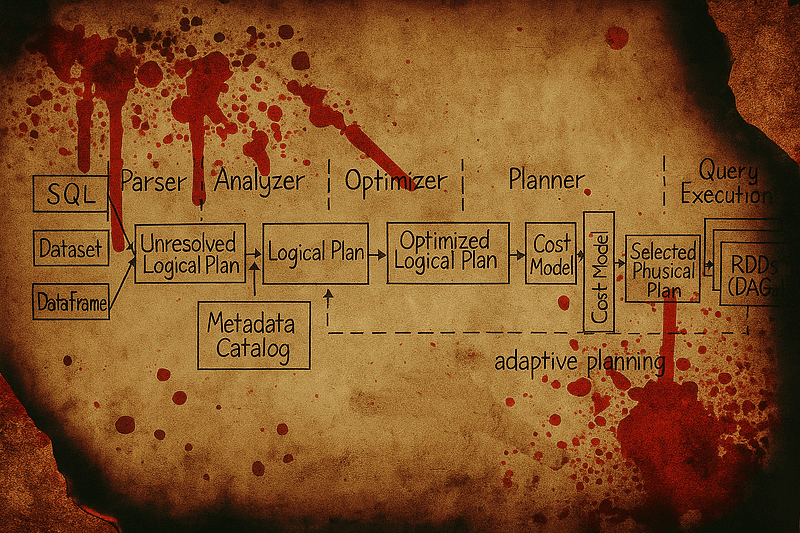
🦴 The Parser: The First Gate
When we write our humble SQL —
SELECT name FROM vampires WHERE age > 100;— it seems innocent enough. But Spark does not see a query. It sees incantations.
The Spark SQL Parser awakens, using a grammar forged in ANTLR(ANother Tool for Language Recognition). Its task: to translate our text into a structure — a parse tree*, a skeleton of meaning.*
Every keyword, identifier, and symbol is tokenized, dissected, and arranged into a LogicalPlan*, that spectral outline of what our query intends to do. At this stage, no data has moved, no computation begun. It is all parchment and ink — syntax and semantics, brittle and pure.*
But beware: should our query contain an extra comma, a misplaced parenthesis, or a heretical alias, the Parser will not forgive. It will hiss back at us from the command line with its infamous charm:
org.apache.spark.sql.catalyst.parser.ParseException: ...
And yet, there is a strange mercy in its cruelty. For the Parser’s wrath, while immediate and dramatic, is often clear*— its messages, though stern, are decipherable. The errors of the Parser are the most human in Spark’s underworld: simple, direct, and almost polite compared to the cryptic horrors that await beyond the first gate.*
And so it guards the threshold — cold, unyielding, perfect in its pedantry.
💀 The Analyzer: The Second Gate
Yet the Parser’s work is merely the prelude to something far more sinister. Beyond its chamber lies the Analyzer*, a creature of intellect and obsession.*
Where the Parser cares only for structure, the Analyzer demands truth. It wanders through our LogicalPlan like a revenant in a graveyard, resolving names, identifying tables, and binding columns to their proper lineage.
Each reference we make —vampires.name, age > 100—is checked against catalogs and metadata. If something cannot be found, the Analyzer will whisper a cold error into our logs:
“Cannot resolve column name ‘
blood_type’ given input columns [fang_length,coffin_id]…”
Here, the logical plan takes on flesh. Tables are recognized, columns are resolved, and functions — those arcane rituals of computation — are verified against the Spark registry. It is during this phase that Spark truly understands our query, or rejects it as an abomination.
⚙️ The Alchemy of Resolution
Internally, the Analyzer works through rules*— small transformations that run repeatedly over the logical plan. These rules are like spells cast upon the structure, each one refining and clarifying until all ghosts of ambiguity are banished.*
- ResolveRelations*: Summons actual tables from the catalog.*
- ResolveReferences*: Matches columns to their origins.*
- ResolveFunctions*: Ensures our UDFs and built-ins exist.*
- CheckAnalysis*: The final priest, declaring whether our query may pass — or perish.*
Each rule runs in sequence, and sometimes again, until no unresolved souls remain.
And only then, when the plan stands whole and shining, does Spark dare send it deeper into the labyrinth — to the Optimizer*, where other horrors await.*
But that, dear reader, is a tale for another night.
🕯️ Chapter III: Of Parse and Analysis Exceptions — The Two Faces of Doom
If the Parser is the gatekeeper and the Analyzer its lurking warden, then their errors are the two fangs that sink into the necks of the unwary developer:ParseException and AnalysisException.
Both bite, both draw blood, yet they differ in nature — one wounds the body of our query, the other its soul.
🦴 The ParseException: The Syntax Revenant
The ParseException is the first horror one encounters — the jump-scare of the Spark underworld. It arises when Spark cannot even read what we have written. The words, though typed by human hands, make no sense to the grammar forged in the Parser’s ancient ANTLR tomb.
Typical signs of a ParseException include:
- Misplaced or missing punctuation (
SELECT name, FROM table) - Forgotten or extra parentheses (
(SELECT * FROM ...left unclosed) - Mangled SQL keywords or expressions (
SELETC,GROUP BYY, etc.) - Any structural sin that violates the sacred grammar.
When the Parser encounters such blasphemy, it refuses to proceed. No plan is generated, no further step is taken. The query dies before it is even born.
And yet, as we’ve seen before, the Parser’s curses are mercifully understandable.
It will tell us exactly where it choked, what it expected, and what foul token it found instead. A clear tombstone on our screen, warning: “Here lies your missing comma.”
💀 The AnalysisException: The Pit of Despair
But should our query survive the Parser’s scrutiny, beware. Beyond the first gate lies the Analyzer*— and here, things grow far darker.*
The AnalysisException does not strike because of bad grammar. It comes for queries that look correct, feel correct, and pass the Parser’s test — yet conceal fatal flaws of meaning.
In this abyss dwell the classic horrors:
- Unresolved columns:
Cannot resolve 'blood_type' given input columns [fang_length, coffin_id] - Missing tables:
Table or view not found: vampires - Ambiguous references: Two tables both named “victims,” and the Analyzer doesn’t know which one to drain.
- Invalid data types, mismatched casts, or illegal joins: When the logical structure collapses under the weight of incompatible schemas.
The Analyzer walks the LogicalPlan like a necromancer raising the dead, resolving names, types, and functions. When it fails, the result is an AnalysisException*— a message both truthful and maddening, sometimes buried in a labyrinth of internal identifiers.*
These errors are not about syntax, but about understanding. The query was well-formed, but its meaning was void. It’s the SQL equivalent of a beautiful incantation that summons nothing.
🩸 When ParseExceptions Rise Again: The Cursed Reincarnations
There are nights, however, when the boundary between these two realms blurs. When a syntax mistake slips past the Parser’s watchful eye and reemerges later — reborn as an AnalysisException*.*
How can this be? Because the Parser, for all its grammar and vigilance, sometimes defers its judgment. Not all SQL features are defined purely by syntax — some are context-dependent*, requiring the Analyzer’s wisdom to fully comprehend.*
Examples of these spectral reincarnations include:
- Invalid identifiers that look correct syntactically:
SELECT * FROM 123table. May pass initial tokenization but later horrifies the Analyzer when it tries to resolve a numeric table name. - Unsupported or dialect-specific constructs: The Parser may build a tree it thinks is fine, only for the Analyzer to discover that Spark has no earthly idea what to do with it.
- Expressions that parse cleanly but reference the void:
SELECT SUM(blood_type) FROM vampires. Here, the Parser happily constructs a plan. Only the Analyzer notices thatblood_typeisn’t numeric—and cries out in despair.
In such cases, what begins as a ParseException waiting to happen mutates into an AnalysisException, haunting developers who thought they were safe.
It is not a bug — it is the natural curse of separation between form and meaning*.*
The Parser can only read. The Analyzer can only understand.
And sometimes, understanding hurts more.
⚗️ Chapter IV: The Laboratory of Misery — Experiments with the Undead Queries
No tale of horror is complete without experimentation. And so, under the pale glow of the terminal, I built a chamber — a small Spark laboratory — to study the unholy spawn of ParseException and AnalysisException.
What follows is the autopsy table of SQL gone wrong. Each test is an incantation read from a grim YAML manuscript, executed inside Spark’s dark heart. Some queries die swiftly at the hands of the Parser; others shamble forward, only to collapse during Analysis. All are catalogued for posterity — and for your amusement.
Should you be reckless enough to replicate these rituals yourself, you may consult the forbidden repository, kept under lock and digital key at: the-last-error.
Enter you at your own peril, for the exceptions forget not.
Here lie the outcomes of our spectral trials:
===== AUTOPSY SUMMARY =====
Total creatures: 51
Survivors (None): 5
Met Fate (ParserException): 29
Died horribly (AnalysisException) : 16
Unknown cause of death (Other) : 1

- trailing_comma_1
  desc: A trailing comma, left like a corpse at the end of a SELECT list. The parser gags, unable to proceed.
  sql: SELECT id, name, FROM t
  exception: AnalysisException
  message: [TRAILING_COMMA_IN_SELECT] Trailing comma detected in SELECT clause. Remove the trailing comma before the FROM clause. SQLSTATE: 42601; line 1 pos 0;

- trailing_comma_2
  desc: A subquery undone by an extra comma — the echo of syntax gone mad.
  sql: SELECT id FROM t WHERE id IN (SELECT id, FROM t)
  exception: AnalysisException
  message: [TRAILING_COMMA_IN_SELECT] Trailing comma detected in SELECT clause. Remove the trailing comma before the FROM clause. SQLSTATE: 42601; line 1 pos 30;

- unterminated_string_1
  desc: A lonely quote opened the ritual and was never closed. The parser howls into the void.
  sql: SELECT 'unterminated FROM t
  exception: ParseException
  message: [PARSE_SYNTAX_ERROR] Syntax error at or near '''. SQLSTATE: 42601 (line 1, pos 7)

- unterminated_string_2
  desc: O’Reilly — cursed by the apostrophe. The parser impales itself upon the single quote.
  sql: SELECT name FROM t WHERE name = 'O'Reilly
  exception: ParseException
  message: [PARSE_SYNTAX_ERROR] Syntax error at or near 'Reilly': extra input 'Reilly'. SQLSTATE: 42601 (line 1, pos 35)

- bracketed_identifier_1
  desc: Square brackets — relics of ancient SQL dialects — forbidden sigils in Spark’s sacred grammar.
  sql: SELECT [id], [name] FROM t
  exception: ParseException
  message: [PARSE_SYNTAX_ERROR] Syntax error at or near '['. SQLSTATE: 42601 (line 1, pos 7)

- invalid_token_1
  desc: The accursed '$$' symbol — an unholy glyph that no parser dares interpret.
  sql: SELECT id $$ name FROM t
  exception: ParseException
  message: [PARSE_SYNTAX_ERROR] Syntax error at or near '$'. SQLSTATE: 42601 (line 1, pos 10)

- invalid_token_2
  desc: The heretical '++' — a C relic intruding upon the SQL tomb. The parser recoils.
  sql: SELECT id ++ name FROM t
  exception: AnalysisException
  message: [UNRESOLVED_COLUMN.WITH_SUGGESTION] A column, variable, or function parameter with name `name` cannot be resolved. Did you mean one of the following? [`id`, `val`, `score`]. SQLSTATE: 42703; line 1 pos 13;

- bad_parentheses_1
  desc: A parenthesis opened and never closed. The parser feels the cold breath of imbalance.
  sql: SELECT (id FROM t
  exception: ParseException
  message: [PARSE_SYNTAX_ERROR] Syntax error at or near 'FROM'. SQLSTATE: 42601 (line 1, pos 11)

- bad_parentheses_2
  desc: Too many parentheses — a tangle of syntax from which no AST can emerge.
  sql: SELECT id)) FROM t
  exception: ParseException
  message: [PARSE_SYNTAX_ERROR] Syntax error at or near ')'. SQLSTATE: 42601 (line 1, pos 9)

- bad_function_call_1
  desc: SUM invoked without its closing rite. The function bleeds out mid-incantation.
  sql: SELECT SUM(id FROM t
  exception: ParseException
  message: [PARSE_SYNTAX_ERROR] Syntax error at or near 'FROM': missing ')'. SQLSTATE: 42601 (line 1, pos 14)

- bad_function_call_2
  desc: An argument missing — the spell of SUBSTR incomplete, its power dissipated.
  sql: SELECT SUBSTR(name, 1, ) FROM t
  exception: ParseException
  message: [PARSE_SYNTAX_ERROR] Syntax error at or near ')'. SQLSTATE: 42601 (line 1, pos 23)

- bad_join_1
  desc: A JOIN left dangling in eternal limbo — no table, no salvation.
  sql: SELECT * FROM t JOIN u ON t.id = u.id JOIN
  exception: ParseException
  message: [PARSE_SYNTAX_ERROR] Syntax error at or near end of input. SQLSTATE: 42601 (line 1, pos 42)

- bad_join_2
  desc: A LEFT JOIN without its counterpart — a half-conjured monstrosity.
  sql: SELECT * FROM t LEFT JOIN ON t.id = u.id
  exception: ParseException
  message: [PARSE_SYNTAX_ERROR] Syntax error at or near '.'. SQLSTATE: 42601 (line 1, pos 30)

- reserved_keyword_1
  desc: SELECT and FROM masquerade as columns — a recursion so deep, even the parser screams.
  sql: SELECT select, from FROM t
  exception: AnalysisException
  message: [UNRESOLVED_COLUMN.WITH_SUGGESTION] A column, variable, or function parameter with name `select` cannot be resolved. Did you mean one of the following? [`id`, `score`, `val`]. SQLSTATE: 42703; line 1 pos 7;

- reserved_keyword_2
  desc: ‘order’ is not your servant; it is a reserved incantation, and it strikes back.
  sql: SELECT order FROM t
  exception: AnalysisException
  message: [UNRESOLVED_COLUMN.WITH_SUGGESTION] A column, variable, or function parameter with name `order` cannot be resolved. Did you mean one of the following? [`id`, `score`, `val`]. SQLSTATE: 42703; line 1 pos 7;

- bad_brackets_1
  desc: An open bracket left unclosed — a small madness in square form.
  sql: SELECT col[ FROM t
  exception: ParseException
  message: [PARSE_SYNTAX_ERROR] Syntax error at or near 't': missing ']'. SQLSTATE: 42601 (line 1, pos 17)

- bad_brackets_2
  desc: Malformed index — numbers without purpose, syntax without mercy.
  sql: SELECT col[1 2] FROM t
  exception: ParseException
  message: [PARSE_SYNTAX_ERROR] Syntax error at or near '2': extra input '2'. SQLSTATE: 42601 (line 1, pos 13)

- bad_case_1
  desc: A CASE opened but never ended — a conditional lost to eternity.
  sql: SELECT CASE WHEN score > 10 THEN 'high' ELSE 'low' FROM t
  exception: ParseException
  message: [PARSE_SYNTAX_ERROR] Syntax error at or near 'score'. SQLSTATE: 42601 (line 1, pos 17)

- bad_case_2
  desc: WHEN missing, logic adrift — a CASE that forgot what it was judging.
  sql: SELECT CASE score > 10 THEN 'high' ELSE 'low' END FROM t
  exception: ParseException
  message: [PARSE_SYNTAX_ERROR] Syntax error at or near 'THEN'. SQLSTATE: 42601 (line 1, pos 23)

- malformed_subquery_1
  desc: A subquery that selects nothing — the parser gazes into the abyss.
  sql: SELECT * FROM t WHERE id IN (SELECT FROM t)
  exception: AnalysisException
  message: [UNRESOLVED_COLUMN.WITHOUT_SUGGESTION] A column, variable, or function parameter with name `FROM` cannot be resolved.  SQLSTATE: 42703; line 1 pos 36;

- malformed_subquery_2
  desc: A missing comma between id and name — the smallest sin, yet unforgivable.
  sql: SELECT * FROM (SELECT id name FROM t) x
  exception: None
  message: None

- missing_groupby_1
  desc: GROUP BY, followed by the void — the parser waits for what never comes.
  sql: SELECT id FROM t GROUP BY
  exception: ParseException
  message: [PARSE_SYNTAX_ERROR] Syntax error at or near end of input. SQLSTATE: 42601 (line 1, pos 25)

- missing_orderby_1
  desc: ORDER BY with nothing to order — futility itself made syntax.
  sql: SELECT id FROM t ORDER BY
  exception: ParseException
  message: [PARSE_SYNTAX_ERROR] Syntax error at or near 'ORDER'. SQLSTATE: 42601 (line 1, pos 17)

- double_comma_1
  desc: Two commas in a row — a nervous twitch of the typist immortalized in failure.
  sql: SELECT id,, name FROM t
  exception: ParseException
  message: [PARSE_SYNTAX_ERROR] Syntax error at or near ','. SQLSTATE: 42601 (line 1, pos 10)

- misplaced_comma_1
  desc: A comma before FROM — misplaced punctuation, eternal damnation.
  sql: SELECT id, name FROM, t
  exception: AnalysisException
  message: [UNRESOLVED_COLUMN.WITHOUT_SUGGESTION] A column, variable, or function parameter with name `id` cannot be resolved.  SQLSTATE: 42703; line 1 pos 7;

- bad_comment_1
  desc: A comment begun and never ended — whispers trapped forever in the code.
  sql: SELECT id /* comment FROM t
  exception: ParseException
  message: [UNCLOSED_BRACKETED_COMMENT] Found an unclosed bracketed comment. Please, append */ at the end of the comment. SQLSTATE: 42601

- bad_comment_2
  desc: A line comment split across the dark — the newline severs more than text.
  sql: SELECT id -- comment
name FROM t
  exception: None
  message: None

- bad_identifier_1
  desc: A double quote never closed — the parser loses its grip on reality.
  sql: SELECT "id FROM t
  exception: ParseException
  message: [PARSE_SYNTAX_ERROR] Syntax error at or near '"'. SQLSTATE: 42601 (line 1, pos 7)

- bad_identifier_2
  desc: A backtick without purpose — the alias left dangling in semantic limbo.
  sql: SELECT `id` name FROM t
  exception: None
  message: None

- bad_literal_1
  desc: A number that tried to be a word — abomination in token form.
  sql: SELECT 123abc FROM t
  exception: AnalysisException
  message: [UNRESOLVED_COLUMN.WITH_SUGGESTION] A column, variable, or function parameter with name `123abc` cannot be resolved. Did you mean one of the following? [`val`, `id`, `score`]. SQLSTATE: 42703; line 1 pos 7;

- bad_literal_2
  desc: ‘0xG’ — the cursed glyph. The parser shrieks, for it knows not what that means.
  sql: SELECT 0xG FROM t
  exception: AnalysisException
  message: [UNRESOLVED_COLUMN.WITH_SUGGESTION] A column, variable, or function parameter with name `0xG` cannot be resolved. Did you mean one of the following? [`id`, `val`, `score`]. SQLSTATE: 42703; line 1 pos 7;

- bad_semicolon_1
  desc: Two statements divided by a semicolon — a heresy Spark refuses to parse.
  sql: SELECT id FROM t; SELECT name FROM t
  exception: ParseException
  message: [PARSE_SYNTAX_ERROR] Syntax error at or near 'SELECT': extra input 'SELECT'. SQLSTATE: 42601 (line 1, pos 18)

- vendor_syntax_1
  desc: ‘TOP 10’ — the foreign tongue of SQL Server. Spark rejects such witchcraft.
  sql: SELECT TOP 10 * FROM t
  exception: ParseException
  message: [PARSE_SYNTAX_ERROR] Syntax error at or near '10'. SQLSTATE: 42601 (line 1, pos 11)

- vendor_syntax_2
  desc: ‘ROWNUM’ — a ghost from Oracle, banished from Spark’s pure land.
  sql: SELECT * FROM t WHERE ROWNUM < 10
  exception: AnalysisException
  message: [UNRESOLVED_COLUMN.WITH_SUGGESTION] A column, variable, or function parameter with name `ROWNUM` cannot be resolved. Did you mean one of the following? [`id`, `val`, `score`]. SQLSTATE: 42703; line 1 pos 22;

- bad_window_1
  desc: An OVER clause missing its soul — no partition, no salvation.
  sql: SELECT row_number() OVER (PARTITION BY) FROM t
  exception: ParseException
  message: [PARSE_SYNTAX_ERROR] Syntax error at or near ')'. SQLSTATE: 42601 (line 1, pos 38)

- bad_window_2
  desc: A lag function missing an argument — time stands still.
  sql: SELECT lag(value, ) OVER (ORDER BY id) FROM t
  exception: ParseException
  message: [PARSE_SYNTAX_ERROR] Syntax error at or near ')'. SQLSTATE: 42601 (line 1, pos 18)

- bad_cast_1
  desc: CAST without a type — the shapeshift failed, the form remains lost.
  sql: SELECT CAST(id AS ) FROM t
  exception: ParseException
  message: [PARSE_SYNTAX_ERROR] Syntax error at or near ')'. SQLSTATE: 42601 (line 1, pos 18)

- bad_cast_2
  desc: PostgreSQL’s :: operator — an outsider symbol not recognized in Spark’s chapel.
  sql: SELECT id::int FROM t
  exception: None
  message: None

- bad_escape_1
  desc: A backslash runs wild — the literal collapses into chaos.
  sql: SELECT 'line1\nline2 FROM t
  exception: ParseException
  message: [PARSE_SYNTAX_ERROR] Syntax error at or near '''. SQLSTATE: 42601 (line 1, pos 7)

- bad_json_1
  desc: Field access wrapped in single quotes — forbidden sorcery.
  sql: SELECT json_col.'name' FROM t
  exception: ParseException
  message: [PARSE_SYNTAX_ERROR] Syntax error at or near ''name''. SQLSTATE: 42601 (line 1, pos 16)

- bad_json_2
  desc: The Postgres ‘->’ operator — a relic from another world, rejected on sight.
  sql: SELECT json_col->'name' FROM t
  exception: Other
  message: An error occurred while calling o29.sql.

- bad_parentheses_3
  desc: A table wrapped in parentheses — an unnatural containment. The parser panics.
  sql: SELECT * FROM (t) u
  exception: None
  message: None

- bad_identifier_symbol
  desc: A column name bearing forbidden runes (‘#’) — Spark’s grammar refuses to speak it.
  sql: SELECT _#id FROM t
  exception: ParseException
  message: [PARSE_SYNTAX_ERROR] Syntax error at or near '#'. SQLSTATE: 42601 (line 1, pos 8)

- host_code_injection
  desc: Java code inside SQL — a cursed hybrid the parser refuses to summon.
  sql: SELECT java.time.LocalDate.now() FROM t
  exception: AnalysisException
  message: [REQUIRES_SINGLE_PART_NAMESPACE] spark_catalog requires a single-part namespace, but got `java`.`time`.`LocalDate`. SQLSTATE: 42K05

- bad_like_1
  desc: LIKE without quotes — a patternless invocation. The parser sees only madness.
  sql: SELECT * FROM t WHERE name LIKE %
  exception: ParseException
  message: [PARSE_SYNTAX_ERROR] Syntax error at or near 'LIKE'. SQLSTATE: 42601 (line 1, pos 27)

- bad_rlike_1
  desc: RLIKE with parentheses — a ritual performed incorrectly, results unspeakable.
  sql: SELECT * FROM t WHERE name RLIKE (abc)
  exception: AnalysisException
  message: [UNRESOLVED_COLUMN.WITH_SUGGESTION] A column, variable, or function parameter with name `name` cannot be resolved. Did you mean one of the following? [`id`, `val`, `score`]. SQLSTATE: 42703; line 1 pos 22;

- bad_distinct_1
  desc: DISTINCT followed by a comma — contradiction incarnate.
  sql: SELECT DISTINCT, name FROM t
  exception: AnalysisException
  message: [UNRESOLVED_COLUMN.WITH_SUGGESTION] A column, variable, or function parameter with name `DISTINCT` cannot be resolved. Did you mean one of the following? [`id`, `score`, `val`]. SQLSTATE: 42703; line 1 pos 7;

- bad_cte_1
  desc: A CTE with a trailing comma — recursive madness in YAML form.
  sql: WITH cte AS (SELECT id, FROM t) SELECT * FROM cte
  exception: AnalysisException
  message: [TRAILING_COMMA_IN_SELECT] Trailing comma detected in SELECT clause. Remove the trailing comma before the FROM clause. SQLSTATE: 42601; line 1 pos 24;

- bad_cte_2
  desc: WITH without AS — a lonely clause, stripped of meaning.
  sql: WITH cte SELECT * FROM t
  exception: ParseException
  message: [PARSE_SYNTAX_ERROR] Syntax error at or near 'SELECT'. SQLSTATE: 42601 (line 1, pos 9)

- bad_aliasing_1
  desc: Alias misplaced — a whisper of structure that collapses into gibberish.
  sql: SELECT id name, FROM t
  exception: AnalysisException
  message: [TRAILING_COMMA_IN_SELECT] Trailing comma detected in SELECT clause. Remove the trailing comma before the FROM clause. SQLSTATE: 42601; line 1 pos 0;

- bad_union_1
  desc: A UNION whose second SELECT forgot its fields — the two sides can never be joined.
  sql: SELECT id FROM t UNION SELECT FROM u
  exception: AnalysisException
  message: [UNRESOLVED_COLUMN.WITHOUT_SUGGESTION] A column, variable, or function parameter with name `FROM` cannot be resolved.  SQLSTATE: 42703; line 1 pos 30;
🕯️ Chapter V: The Last Error — Farewell from the Crypt
And so the sun rises over the desolate landscape of jobs, stages, and executors. The horrors of the Parser and the wailing ghosts of AnalysisExceptions fade into memory, their screams recorded only in logs and YAML grimoires.
I close my terminal for the final time in this hallowed sanctuary*, leaving behind three years of spectral errors, half-finished queries, and the lingering stench of bugs. Spark continues its eternal cycle, indifferent to the mortals who once summoned it.*
To the dared reader who walks these haunted paths: may your SQL be well-formed, your casts correctly typed, and your joins never dangling.
*Here lies the record of my labors, the final errors, and the whispers of a data engineer departing into the night…*To be continued?
🕯️ Epilogue: The Obituary
I could not have withstood these years of terror and despair without the souls I encountered along the way in my first project: Alberto Hernandez, Rigoberto López, Vicente Gardulski, Antonio Barreiro, and Ricardo Ruiz. Their presence was like torches in the suffocating darkness of Spark’s haunted corridors.
It would be unjust to depart without honoring the team that sheltered me in my final stage, the GBE coven (thank you, Joan*,* Paola*,* David*,* Unai*, …). Nor can I forget the band of spectral guides who welcomed me with open arms when I first entered the abyss — my dear* D**eath T**ollers (Ángel, Brais*,* JC*,* Ramón*,* María*,* Cristina*, and many others).*
Finally, I wish to give my most special thanks to two souls who have left a mark on my professional life these past three years*:* Sergio Múñozand César Segura.
Sergio, you were a key reason I embraced the challenge of this enterprise. Cesar, Snowflake superhero — and my friendly nemesis — you unknowingly nudged me to begin writing these articles. 666 thanks to both of you.
And as the cursor blinks into the void, remember… the errors never die.
“It’s my last, it’s my last, it’s my last error,
I’m of the kind who loves a hassle none dare enter,
I’m debugger-keen, I’m a Spark mentor,
And this is my last, it’s my last, it’s my last error.”
(adapted from “The Last Emperor” by MadChild)