Apache Spark WTF??? 🎪 The Spark 4 Freak Show 🤡
Welcome to the Spark 4 Freak Show — the only carnival where defaults bite, configs whisper from the walls, and the architecture finally…

“Driver with the heap, I’m heap-investigating daily
Shuffles throwing checksums like the circus never pays me
Python worker zombies need a curfew, this is crazy
Spark 4 freaks are dancing while your configs whisper, ‘save me’”
(adapted from “Monster” by Madchild)
🧠 The Driver’s Haunted Museum & Observability Exhaust
Managing the memory footprints, massive query plans, and forensic event logs that threaten to sink the driver.
The Driver Heap Souvenir Museum
Drivers rarely die from a heroic .collect() on a billion rows. Instead, they suffer death by a thousand metadata papercuts, transforming from a lean coordinator into a “haunted museum” hoarding souvenirs from millions of tasks.
Spark 4.0 introduces two major observability reality checks to fix this:
- Slashing Metadata Bloat (SPARK-46383): Spark radically reduces driver heap usage by aggressively shortening the lifespan of
TaskInfo.accumulables(). The driver is not a scrapbook; it doesn’t need a lock of hair from every scheduled task. - Native Metrics (SPARK-47674):
spark.metrics.appStatusSource.enabledis nowtrueby default, natively pushing application status metrics (like failed, skipped, and completed stages) directly into the Spark metrics system.
The Bottom Line: Spark 4.0 finally treats observability as a heavy, critical production surface, recognizing that event logs and task metadata consume real heap space and trigger massive garbage collection pressure.
The Listener Bus Barker
Spark jobs don’t merely run; they narrate themselves through a heavily caffeinated event bus. But when slow, user-defined listeners get backed up, Spark can be held hostage by its own gossip.
Spark 4.0 introduces three unglamorous but practical fixes to keep the event queue honest:
- No More Hostage Shutdowns (SPARK-47253): The
LiveEventBuscan now stop without forcing a full drain of the event queue. Previously,SparkContext.stop()could hang for up to 30 minutes waiting on sluggish listeners. - Application Exit Status:
SparkListenerApplicationEndnow carries an explicit exit status, telling you exactly whether the application finished peacefully or collapsed inside Kubernetes. jobGroupIdfor SQL Tracking:SparkListenerSQLExecutionStartnow explicitly includes thejobGroupId. This is a massive gift for notebooks and multi-tenant platforms where one Spark app juggles hundreds of distinct human intentions.
The Bottom Line: Spark 4.0 admits production physics: if the listener bus queues too much, shutdown hurts. If endings lack status, post-mortems become circus astrology.
The Event-Log Graveyard
Spark’s event log is a trail of bureaucratic ghosts that can quickly transform observability into severe storage pressure and chronic History Server indigestion.
Spark 4.x attacks this bloat by changing lifelong defaults to make the log graveyard far less monolithic:
- Spark 4.0 (The Diet): Event logs now natively compress using
zstd(spark.eventLog.compress) and roll over into sequential chunks by default (spark.eventLog.rolling.enabled). This prevents long-running jobs from producing a single monstrous file that crashes the History Server. - Spark 4.1 (The Scalpel): Introduces
spark.eventLog.excludedPatterns(SPARK-52458) to explicitly skip writing certain events. This is paired with On-Demand Log Loading (SPARK-52914) and bootstrap performance optimizations (SPARK-53631).
The Bottom Line: Spark isn’t just offering to write its diary in smaller, compressed volumes; it is openly asking whether it should just skip writing certain pages altogether.
AQE’s Autobiographical Monster Plan
AQE doesn’t just optimize; it reports. Whenever AQE tweaks a running plan, it fires update events so the SQL UI and History Server can visually display the magic. For massive generated queries, simply describing this plan can become a devastatingly expensive memory trap.
Here is how Spark 4.x handles the monster:
- The Unpatched Trap (SPARK-50992): The engine constantly serializes massive plans into plain-text strings for the listener bus. If your plan is huge, the driver burns serious CPU and heap memory just generating the string first, leaving an unresolved trap for heavy enterprise pipelines.
- Spark 4.0 (Correctness Fixes): Forces AQE to fix silent slip-ups, such as issues with in-memory table scans (SPARK-45592) and a terrifying bug where AQE silently altered the output column order (SPARK-50258).
- Spark 4.1 (UI Upgrades): Doubles down on layout visibility by adding root-to-sub-execution mapping and downloadable plans in SVG, DOT, and text formats directly from the UI.
The Bottom Line: AQE’s reporting has an operational price. Column order matters for downstream systems, and generating massive plan strings can drop serious driver-side CPU cycles before your pipeline even runs.
The History Server Taxidermy Museum
The Spark History Server isn’t just a nostalgic web page — it is a heavy forensic engine designed to resurrect ghost applications. Because Spark 4.0 made rolling event logs the default, massive pipelines now leave a scattered trail of hundreds of files. Pre-4.1, the History Server behaved like an exhausted archaeologist, forced to reconstruct an entire ancient tomb just to examine one specific skeleton.
Spark 4.1 introduces two tactical levers to break this bottleneck:
- On-Demand Log Loading (SPARK-52914): Governed by
spark.history.fs.eventLog.rolling.onDemandLoadEnabled(enabled by default), this prevents Spark from loading the entire log ecosystem upfront. It selectively fetches only the specific file chunks you need. - Bootstrap Memory Optimization (SPARK-53631): Drastically slashes the baseline CPU and memory overhead required when the History Server spins up and catalogs its archives.
The Bottom Line: Bootstrapping the History Server should not require waking a taxidermied mammoth. Spark 4.1 ensures that investigating the corpse is no longer as expensive as running the query.
Logs Get New Name Tags
Spark 4.0 changes the Mapped Diagnostic Context (MDC) key for task identifiers from mdc.taskName to task_name. While your jobs will still run smoothly, hardwired monitoring pipelines will suddenly lose a critical lens if they are looking for the old key.
This modification is part of a broader architectural shift toward treating logs as deterministic data assets:
- Structured Logging Framework: Enabling
spark.log.structuredLogging.enabledshifts Spark from writing raw text files to emitting clean, machine-readable JSON lines enriched with MDC metadata. - The Escape Hatch: If your telemetry dashboards and automated alarms break, you can temporarily revert to the old key using
spark.log.legacyTaskNameMdc.enabled.
The Bottom Line: A log field is just a database column wearing a trench coat. When logs graduate to structured JSON records, changing a logging key is no longer a harmless cosmetic tweak — it is a breaking schema migration for your entire enterprise observability layer.
🪓 The Shuffle & Network Meat Grinder
The brutal, physical reality of moving, compressing, and verifying distributed data blocks across the cluster.
Shuffle Checksums: The Tattooed Strongman
Shuffle is the volatile phase where Spark takes your data apart, throws it completely across the tent, and prays the receiving clown catches the correct limb. A loud failure is deeply annoying, but a successful Spark job that silently processed corrupted shuffle data is a haunted financial invoice.
Here is how Spark 4.x forces the network to be honest:
- Spark 4.0 (The Fingerprint): Targets silent data corruption with SPARK-49459, introducing native CRC32C support for shuffle checksums.
- Spark 4.1 (The Muscles): Adds full shuffle stage retries based on checksum mismatches to explicitly avoid incorrect results (SPARK-51756), alongside aggressive, fast-fail behavior the moment a fetch failure occurs (SPARK-52395).
- Spark 4.2 Preview (The Hammer): Introduces order-independent checksums for shuffle outputs by default. If it detects a mismatch during a messy retry, Spark actively rolls back succeeding stages — or terminates the job entirely if a clean rollback is impossible.
The Bottom Line: Spark 4.x isn’t just optimizing network shuffles anymore — it’s checking their fingerprints, safeguarding retries, and forcing a quick death when the data tunnels return suspicious body parts.
Shuffle Cleanup: The Undertaker of Abandoned Shuffle Limbs
A Spark shuffle doesn’t just burn resources while a job is actively running; it leaves behind massive mountains of physical evidence. With Dynamic Allocation, the External Shuffle Service (ESS) must keep these files alive after executors vanish. Historically, these orphaned files overstayed their welcome, turning local storage volumes into haunted basements.
Here is how Spark 4.0 aggressively changes the cleanup lifecycle:
- Aggressive ESS Cleanup: The default behavior of
spark.shuffle.service.removeShuffleis flipped totrue. The ESS now actively hunts down and deletes shuffle blocks tied to decommissioned executors the exact millisecond that specific shuffle stage is no longer needed by the active application. - Strict Dependency Tracking: Spark 4.0 introduces SPARK-47764, which formalizes shuffle dependency tracking based on explicit
ShuffleCleanupModestates.
The Bottom Line: Shuffle data is temporary trash with strict legal obligations. Spark 4.x quietly tightens this loop to protect the shuffle data while it is part of the execution contract, and then bury it immediately when that contract expires — preventing a chaotic capacity crisis and expensive storage archaeology.
External Shuffle Service Gets a RocksDB Brain
Starting in Spark 4.0, the External Shuffle Service (ESS) metadata backend defaults to RocksDB instead of LevelDB (SPARK-45351). This is one of the strangest architectural shifts because it hides entirely in the basement, far away from the shiny SQL fireworks on stage.
Under Dynamic Allocation, when an executor is decommissioned, the ESS acts as a cold-hearted morgue clerk. It maintains a highly active metadata index to track and locate orphaned shuffle blocks for downstream tasks. By handing RocksDB this bookkeeping job, Spark entirely alters low-level operational behaviors that infrastructure engineers must monitor:
- Disk mechanics: Changes local file structures and disk compaction patterns.
- Crash dynamics: Alters node recovery characteristics during a crash.
- System requirements: Introduces new native system dependencies and upgrade testing paths.
The Bottom Line: RocksDB is officially Spark’s preferred solution whenever an embedded metadata store needs to survive serious enterprise pressure. First, it conquered the streaming data cemetery; now, it runs the shuffle service morgue.
Decommission Fetch Failures: Not Every Missing Executor Is Murder
Not every missing executor is a crime scene. Sometimes Kubernetes simply escorted the acrobat out of the tent with the proper paperwork.
Spark 4.0 natively handles the elastic, volatile nature of modern cloud environments by enabling spark.stage.ignoreDecommissionFetchFailure by default (SPARK-48063). Here is how it changes the rules of engagement:
- The Old Mental Model: Any shuffle fetch failure was treated as a severe system malfunction, counting against the
spark.stage.maxConsecutiveAttemptslimit until the stage inevitably died. - The Spark 4.0 Reality: If a reducer fails to fetch data because the source executor is intentionally decommissioning (e.g., spot-instance liquidation, graceful evictions, or node drains), Spark stops counting that specific failure toward the stage’s death limit.
The Bottom Line: A missing executor is not always a corpse; sometimes it just left early with a signed permission slip. Spark now has the cognitive clarity to distinguish between “the acrobat was scheduled to catch the next train” and “someone actively cut the high wire.”
Spill Gets a Memory Nose
Historically, Spark forced memory buffers to spill to disk primarily based on the number of elements they held. Counting records is a terrible metric because a million tiny rows and a million obese nested rows take up vastly different amounts of space. This limitation frequently caused massive shuffles to suffer OOM exceptions long before hitting their arbitrary element-count limits.
Spark 4.1 introduces SPARK-49386, adding explicit memory-size thresholds for both map-side and reduce-side operations. It also extends these size-based safety triggers to critical SQL execution buffers like sort-merge joins, Cartesian products, and window aggregations.
The Bottom Line: Spark 4.1 finally reasons like a production engineer. It no longer asks how many records are in the buffer; it asks how fat the buffer has actually become. This is a life-saving safety valve when dealing with heavily nested JSON or wide rows where a single record acts like a massive sofa wearing a schema.
Compression Oddities: The Two-Headed Compressor
Compression sits directly in Spark’s bloodstream, actively powering shuffle outputs, broadcast variables, cached internal data, and event logs. When its underlying mechanics change, your CPU, memory, I/O, and latency profiles change immediately with them.
Here is how Spark 4.x turns compression into a multi-threaded beast:
- LZF Parallel Execution (SPARK-48518): Spark 4.1 flips
spark.io.compression.lzf.parallel.enabledtotrueby default. While this dramatically slashes compression wall time, it burns extra threads and CPU coordination—which can easily overwhelm an already congested executor. - Zstandard (zstd) Workers: The
spark.io.compression.zstd.workersparameter spawns dedicated asynchronous background threads, explicitly trading memory to improve throughput. - Zstandard (zstd) Strategy: The
spark.io.compression.zstd.strategyparameter dictates exactly how aggressively the codec should trade CPU cycles and heap memory for tighter compression ratios.
The Bottom Line: You can no longer view data shrinking as a passive background process. Compression is not passive storage magic; it is a complex CPU, memory, latency, and I/O negotiation wearing a tiny circus hat.
Native Netty IO: The Tunnel System Under the Circus
Spark 4.1 quietly alters a deep piece of foundational infrastructure: the engine now forces the native Netty IO transport layer by default whenever it is available.
Here is how Spark is overhauling its network tunnels:
- The Switch to Native OS Primitives: Governed by
spark.io.mode.defaultset toAUTO, Spark abandons generic Java NIO in favor of platform-specific network primitives. It automatically mountsEPOLLon Linux andKQUEUEon macOS or BSD systems, gracefully falling back to standard NIO only if native targets are missing. - The Performance Win: This raw plumbing drastically minimizes context-switching and JNI overhead , speeding up internal RPC signals, inter-executor shuffle transfers, and driver-to-worker block indexing. Spark is completely done letting standard Java abstraction layers dictate its network throughput.
- The Production Trapdoor: Native code behavior heavily depends on your host environment, base container images, and available native libraries. If your cluster’s networking profile suddenly shifts or experiences unexplained connection drops after upgrading, it is highly likely Spark swapped out your plain NIO pipeline for native OS sockets under the hood.
The Bottom Line: The deepest knobs in Spark rarely look like Spark knobs. They masquerade as kernel parameters, native I/O libraries, and transport protocols wearing an Apache configuration badge.
🐍 PySpark’s Reptile Enclosure & Snake Charmers
Taming the Python worker lifecycle, Arrow-optimized tunnels, and serialization boundaries.
Zombie Python Workers Get Curfews
PySpark relies on separate Python worker subprocesses that are all too often completely abandoned in a frozen state. On a busy, long-lived cluster, these idle workers quickly multiply into a chaotic crowd, creating severe memory pressure and process clutter.
Spark 4.1 introduces strict janitorial controls to clean up these OS-level ghosts:
- Idle Timeout Curfews (SPARK-51127): You can now actively terminate idle workers using the global
spark.python.worker.killOnIdleTimeoutflag (defaults to false) or granular SQL-specific mirrors (spark.sql.execution.pyspark.udf.idleTimeoutSecondsandspark.sql.execution.pyspark.udf.killOnIdleTimeout). - Queue Limits (SPARK-52971): Limits the idle Python worker queue size so executors don’t become an infinite waiting room with no fire marshal.
- Flush-Failure Executions (SPARK-54344): If the underlying Python daemon can no longer flush its output buffers properly, Spark terminates the process immediately rather than letting a broken worker pretend it’s still available.
The Bottom Line: Worker reuse is fantastic, but executors are not hostels for subprocesses with unresolved feelings. Production systems should stop negotiating with suspicious corpses.
The Secret Tunnel Between Python and the JVM
PySpark is essentially Python whispering to an underlying JVM rhinoceros through a garden hose. Whenever Python code interacts with the JVM — whether creating DataFrames or executing UDFs — it has to cross a network bridge.
Spark 4.1 introduces an optional, ultra-low-latency tunnel to optimize this crossing:
- Unix Domain Sockets (SPARK-51688): Governed by
spark.python.unix.domain.socket.enabled(which defaults tofalse), this feature swaps out traditional local TCP loopback sockets for native Unix Domain Sockets. - The Performance Win: TCP loopback sockets force your data through the operating system’s full network stack, incurring handshake and routing overhead. Unix Domain Sockets bypass this entirely, acting as a pure Inter-Process Communication (IPC) mechanism that shaves off critical microseconds for workloads suffering from death-by-a-thousand-round-trips.
The Bottom Line: This is not magic. It does not erase serialization costs or transform Python logic into JVM bytecode. It simply streamlines one specific tunnel at a border crossing that still features passports, aggressive baggage checks, and a rhinoceros with a clipboard.
Arrow Gets a Safety Inspector
Arrow is a spectacular high-speed columnar bridge between the JVM and Python, but a fast conveyor belt can still transport corrupted cargo. Spark 4.1 alters the rules of engagement by flipping spark.sql.execution.pandas.convertToArrowArraySafely to true by default.
Here is how Spark is hardening your data integrity:
- Aggressive Error Throwing: PyArrow stops being polite. It will aggressively throw runtime errors the exact millisecond it detects an unsafe conversion, such as integer overflow or floating-point truncation.
- Batch Sizing (
maxRecordsPerBatch): Limits how many records are packed together before crossing the border (defaults to 100). Set it too low, and network serialization overhead eats you alive; set it too high, and memory usage balloons until the executor sweats through its clown makeup. - Concurrency (
arrow.concurrency.level): Scaling this up is a massive win for I/O-bound Python UDFs, but a disaster if concurrent tasks immediately start fighting over the same fixed pool of CPU cores and RAM.
The Bottom Line: Fast is cute. Wrong is incredibly expensive. Silently clipping precision to fit a tighter JVM type doesn’t unlock performance — it just builds a data crime scene with excellent network throughput.
Pandas Was Standing in the Hallway Holding Everyone’s Coats
Spark 4.1 eliminates an unnecessary internal data conversion to Pandas instances inside Arrow-optimized Python UDF paths. When spark.sql.execution.pythonUDF.arrow.enabled is flipped on, the underlying serializer skips the legacy Pandas detour completely, making the pipeline strictly Arrow-native.
This architectural shift introduces a lean, direct data path:
- Bypassing the Middleman: Spark 4.1 also enforces this structural diet for Python User-Defined Table Functions (UDTFs) via
spark.sql.execution.pythonUDTF.arrow.enabled, cutting out wasteful Pandas object transformations. - The Legacy Fallbacks: If your pipeline breaks due to strict type enforcement, you can bring back the old translation layers using the safety switches
spark.sql.legacy.execution.pythonUDF.pandas.conversion.enabledandspark.sql.legacy.execution.pythonUDTF.pandas.conversion.enabled.
The Bottom Line: Removing Pandas eliminates an interpreter who was silently rewriting witness testimony. While the direct Arrow path lowers CPU overhead by dropping object conversions, it removes accidental cushions — meaning your returned values must strictly match the schema you promised, or the engine will complain out loud.
BinaryType Picks a Body
Prior to Spark 4.1, binary blobs suffered a structural identity crisis. Depending on whether data traveled via traditional DataFrames, standard Python UDFs, or Arrow paths, it would arbitrarily alternate between native Python bytes and bytearray.
Spark 4.1 completely cleans up this plumbing by standardizing on a single default:
- Uniform Mapping to
bytes: Binary columns now uniformly map to native Pythonbytesacross all execution paths, ensuring structural consistency from the data source down to your UDFs. - The Immutability Shift: Because a
bytesobject is completely immutable while abytearrayis mutable, any legacy code that modifies binary payloads in place, checks explicit object types, or passes blobs to strict third-party libraries will instantly notice the shift. - The Fallback: If this change systematically breaks your legacy parsing logic or utility scripts, you can revert to the old behavior using
pyspark.sql.execution.pyspark.binaryAsBytes=false.
The Bottom Line: Before Spark 4.1, the same logical engine type reached your Python application wearing different structural bodies depending on the underlying execution engine. Spark 4.1 removes this trapdoor — proving that while a consistency tweak is microscopic, it can be intensely disruptive to fragile assumptions buried in your payload-parsing scripts.
Python Debugging Becomes Less Occult
PySpark debugging historically felt like candlelight and séance work. When a custom UDF crashed on a remote executor, the driver handed you a cryptic error, forcing you into agonizing distributed archaeology across the Spark UI log files.
Spark 4.1 rolls out a powerful cluster of PySpark debugging improvements (SPARK-53975 through SPARK-53978, SPARK-52579, and SPARK-52426) to systematically capture the chaos:
- Unified Logging Integration: Runtime logs, internal print statements, and standard output (
stdout/stderr) from Pandas/Arrow UDFs, UDTFs, and driver-side workers are now systematically redirected into the unified Spark logging system. - Periodic Traceback Dumps: Governed by
spark.sql.execution.pyspark.udf.tracebackDumpIntervalSeconds, Spark can now dump asynchronous worker tracebacks at set intervals. This is a life-saver for jobs that aren’t dead but have been staring at the wall for three hours, revealing if a worker is trapped in a third-party library, an infinite loop, or a blocked socket.
The Bottom Line: PySpark debugging used to ask which executor screamed. Spark 4.1 finally starts asking if we can capture the scream before it joins the fog.
🗄️ Storage Goblins & Parsing Black Magic
How Spark negotiates with underlying object stores, file parsers, and rigid physical layouts.
The CSV Delimiter Spark Pretended Not to Hear
Spark 4.0 fixes a uniquely dangerous, silent bug: aggressive metadata caching that ignored runtime read options.
Historically, if you read from the exact same file-backed table twice in one pipeline — but changed a parameter like the CSV delimiter on the second pass — Spark would quietly reuse the initial cached relation plan. It wouldn’t crash; it would simply process your new read using the original delimiter’s rules.
This didn’t cause a helpful, noisy explosion. It just generated data that was silently and expensively “a bit wrong.”
Starting in Spark 4.0, the engine dynamically respects your runtime query options on file-source tables.
- The Escape Hatch: If an ancient, fragile pipeline relies on this specific bug, you can resurrect it by setting
spark.sql.legacy.readFileSourceTableCacheIgnoreOptions=true.
The Bottom Line: Ingestion options are not decorations. A delimiter is a precision scalpel — change it, and the underlying file becomes an entirely different animal.
ignoreCorruptFiles Is Not a Universal Pardon
ignoreCorruptFiles is no longer a magical get-out-of-jail-free card for every conceivable storage sin. Spark 4.x has transformed this setting into a strict taxonomy of errors, drawing a hard line between actual file corruption and broken infrastructure.
Here is the new reality for your data pipelines:
- Spark 4.0 (The Hammer): Security permission failures (
AccessControlException) and missing HDFS blocks (BlockMissingException) will instantly kill your active task. Spark will no longer let these monsters sneak through the back door. - Spark 4.1 (The Band-Aid): Certain deeply embedded internal reader glitches (
java.lang.InternalError) are now officially tolerated and can be quietly bypassed if the setting is active.
The Bottom Line: “Ignore corrupt files” means exactly that — ignore corrupt files. It is not a universal pardon for broken IAM roles, missing physical blocks, or an unraveling storage layer.
The File-Listing Elephant
Before Spark processes your data lake, it furiously lists directories, infers partitions, and validates metadata — spending immense execution time doing absolutely zero computation.
Spark 4.0 tackles this “invisible” bottleneck with two major improvements:
- Faster File Discovery (SPARK-45452): Overhauls the
InMemoryFileIndexby leveraging Hadoop’sFileSystem.listFilesAPI to drastically accelerate recursive file listing. - Bypassing Lakehouse Garbage (SPARK-48649): Introduces the
spark.sql.files.ignoreInvalidPartitionPathsconfiguration. This allows Spark to skip invalid partition directories (like_SUCCESSfiles or accidental subfolders) without throwing a catastrophic runtime exception.
The Bottom Line: File listing is not passive pre-processing; it is Spark actively negotiating with your storage infrastructure. While ignoring invalid paths is an excellent availability guardrail, it is also a data-quality risk — you might be quietly blinding yourself to the first clue that an upstream ingestion pipeline just malfunctioned.
JSON Parser Gets an UnsafeRow Broom
JSON parsing is where heavy Java objects traditionally go to breed inside your cluster walls. Spark 4.0 targets this precise bottleneck with SPARK-48873, introducing spark.sql.json.useUnsafeRow to leverage native binary rows to represent nested struct results directly within the JSON parsing loop.
While the community focuses on the shiny new Variant data type, this internal row optimization is monumental for high-volume pipelines handling semi-structured data:
- The
UnsafeRowAdvantage: Despite the name,UnsafeRowisn’t unstable—it is Spark’s highly optimized, compact internal binary format that operates directly on raw memory bytes. - Eliminating Object Confetti: By utilizing it right at the parsing boundary, Spark avoids creating millions of standard JVM objects with expensive headers, pointers, and heap allocations. This slashes garbage-collection drama and significantly speeds up parsing throughput.
The Bottom Line: Semi-structured data performance is dictated by the exact physical shape a parsed row takes the millisecond it enters the engine. In many pipelines, parsing isn’t a prelude to “real work” — it is the real work. Spark 4.0 strips that work of Java heap bloat.
ORC Learns to Breathe ZSTD
Spark 4.0 silently shifts the default ORC compression codec from Snappy to Zstandard (zstd). While your DataFrame code and SQL remain completely identical, the raw bytes landing on your physical storage layer are suddenly wearing a different compression suit.
Here is why this quiet physical-layout change matters:
- The Resource Shift: Zstandard achieves vastly superior compression ratios, efficiently slashing storage footprints and minimizing network I/O. However, this aggressively rearranges your resource economics, shifting CPU overhead, write latencies, and decompression scan behaviors.
- The Downstream Danger: A storage format is a rigid physical contract. This default is highly hazardous in mixed data ecosystems where legacy downstream consumers — like Apache Hive, Trino, Presto, or older batch jobs — assume Snappy-compressed ORC by default. Spark 4.0 can completely blindside them without throwing a single code error.
- The Escape Hatch: If this breaks compatibility, you can explicitly force the old layout by setting
spark.sql.orc.compression.codecback tosnappy.
The Bottom Line: Compression defaults are not cosmetic choices; they are raw storage physics masquerading as a friendly configuration name. Benchmark your workload, track executor CPU utilization, and audit downstream consumers to decide whether this new default is a massive gift or a quiet operational goblin.
The Parquet Struct That Was Not Dead
Spark has officially stopped declaring an entire nested struct dead just because your requested sub-fields are missing from the physical file.
Starting in Spark 4.1, the native Parquet reader no longer assumes a struct value is entirely null merely because all requested sub-fields for that struct are missing from the underlying Parquet storage file.
Here is how this structural shift changes schema evolution:
- The Legacy Behavior: If you queried newly added fields (e.g., fields C and D) against an older, historical Parquet file where they didn’t exist, Spark would short-circuit and evaluate the entire parent struct container as a flat
NULL. - The Spark 4.1 Precision: Spark stops treating missing child columns as a valid reason to sign a death certificate for the parent. It now accurately evaluates the parent struct as existing, even if the specific attributes you asked for are absent.
- The Escape Hatch: If your downstream application logic depends on the legacy short-circuiting behavior, you can explicitly re-enable it via
spark.sql.legacy.parquet.returnNullStructIfAllFieldsMissing = true.
The Bottom Line: Missing organs are not automatically a corpse. The old behavior conflated a complete lack of an event (
NULLparent) with an older version of your logging infrastructure that simply hadn’t captured those new attributes yet. Spark 4.1 removes this fake, sweeping corpse, forcing your query engine to accurately respect the historical timeline of your data lake.

Spark 4 Observability Freak Show: where the driver hoards souvenirs, the logs change name tags, and the History Server resurrects corpses without waking the mammoth.
📜 The SQL Syntax Inquisition & Type Shenanigans
Closing the loopholes on sloppy dialects, timestamp wrapping, character encoding, and zero-based indexing.
The Man With Two Zeros
A negative zero (-0.0) walked into Spark 4.0 and came out emotionally rebranded as a positive zero (0.0).
Starting in Spark 4.0, when the engine inserts elements into a Map data structure, it automatically normalizes floating-point keys by converting -0.0 to 0.0. This aggressive leveling affects primary map-building functions like create_map, map_from_arrays, map_from_entries, and map_concat.
Here is why this minor semantic crack matters:
- The Mathematical vs. Bitwise Trap: While
-0.0and0.0compare as equal in basic math, they carry entirely different underlying binary representations and bitwise hashes. Treating them as distinct keys can produce profoundly surprising results during distributed equality checks, network serialization, and map lookups. - The Normalization Fix: Spark 4.0 enforces normalization so these two zeros can no longer pretend to be separate citizens inside your map lookups, ensuring raw consistency under pressure.
- The Safety Valve: If your legacy logic actively depends on keeping these two zeros separated, you can disable this behavior using
spark.sql.legacy.disableMapKeyNormalization = true.
The Bottom Line: Spark 4.x is willingly breaking tiny, cursed behaviors so the overall engine behaves more predictably. This shift forces engineers to confront an uncomfortable question: Why on earth are we using floating-point numbers as map keys in the first place?
The Mojibake Mermaid Is No Longer Welcome
Spark used to replace broken string characters with typographic roadkill. Spark 4.0 completely overhauls this, choosing to throw a runtime error instead of letting corrupted text quietly slip through your data pipeline.
Here is how Spark 4.0 locks down data hygiene for string encoding and decoding:
- Strict Charset Whitelisting: The
encode()anddecode()functions now strictly support only a fixed, standardized list of charsets (US-ASCII, ISO-8859–1, UTF-8, UTF-16, and UTF-32). It no longer blindly accepts whatever exotic, non-portable encodings happen to live in your host JDK basement. (Escape hatch:spark.sql.legacy.javaCharsets = true). - Immediate Fail-Fast Alarm: The moment an encoding or decoding loop hits an untranslatable character, Spark immediately throws a
MALFORMED_CHARACTER_CODINGexception and kills the task. It completely abandons the legacy habit of silently masking bad data with question marks, inverted diamonds, or glyph soup. (Escape hatch:spark.sql.legacy.codingErrorAction = true).
The Bottom Line: Silent character replacement isn’t data cleansing; it is simply data corruption with better manners. Spark 4.0 stops turning a blind eye to insidious Mojibake bugs, forcing your pipelines to confront engineering reality the exact millisecond a string refuses to conform to its promised schema.
The Timestamp Acrobat Stops Wrapping
Wrong numbers wearing valid-number costumes are the absolute worst kind of production monsters. Spark 4.0 changes how overflowing data type casts from TIMESTAMP to BYTE, SHORT, or INT behave under non-ANSI mode, replacing silent corruption with a clear signal.
Here is how Spark 4.0 tightens the guardrails on temporal casting:
- The Legacy Behavior: When a large temporal value (microseconds or milliseconds since the epoch) overflowed during conversion to a small integer, Spark would silently recycle numeric limits. The value would reappear on the other side of the bit limit as a random, completely wrong integer that still looked clean enough to pass validation checks.
- The Spark 4.0 Reality: Instead of quietly wrapping around, the engine now bluntly returns
nullon overflow. - The Impact: A wrapped integer silently corrupts downstream aggregations, joins, and reports. A
nullis at least visibly suspicious, forcing downstream filters to react and showing you exactly where your schema architecture is breaking.
The Bottom Line: Spark 4.0 doesn’t save you from reckless timestamp casting; it simply stops providing the acrobat with a fake landing mat. The engine is closing legacy anomalies so bad data can no longer successfully disguise itself as good data.
Views Become Shape-Shifting Contracts
A view is not a static window — it is a strict contract with a query wearing a trench coat. Downstream dashboards treat it like a table-shaped promise, but upstream storage layouts evolve constantly. Spark 4.0 overhauls this tension by introducing explicit schema binding modes.
By default, the engine now applies WITH SCHEMA COMPENSATION to persistent views:
- Automated Casting: Spark proactively tolerates column type changes (e.g., integers becoming longs or widening decimals) and automatically applies internal casting to preserve the view’s original outward-facing schema.
- The Operational Win: This protects downstream consumers from breaking due to daily, unannounced upstream schema drift.
- The Legacy Switches: If your architecture relies on fragile view definitions that must fail loudly rather than adapt, the community provides
spark.sql.legacy.viewSchemaCompensationandspark.sql.legacy.viewSchemaBindingModeto restore old behavior.
The Bottom Line: Structural compensation requires automated casting, which can silently alter join performance, truncate edge-case precision, or paper over unauthorized semantic changes. A shape-shifting view is incredibly convenient for keeping the peace, but it can easily mutate into a polite liar.
The Exclamation Mark Stops Impersonating NOT
Spark 4.0 forces the exclamation mark (!) to stop impersonating a database lawyer, parsing the character with aggressive ANSI strictness.
Here is how the parser is enforcing cleaner SQL dialects:
- The Restriction: Spark will no longer permit
!to substitute for the proper keywordNOTwithin predicates likeIN,BETWEEN, orLIKE. The exclamation mark is now strictly confined to acting as a standard prefix logical negation operator (e.g.,!variable). - The Compilation Hit: This change instantly breaks legacy syntax oddities, old BI tool configurations, and auto-generated vendor SQL. Queries using the non-standard syntax will now throw a fatal compilation error.
- The Legacy Switch: If your organization has extensive legacy code dependent on this syntax flaw, you can temporarily save your jobs using
spark.sql.legacy.bangEqualsNot = true.
The Bottom Line: Tolerant parsers allow non-standard code to embed itself into core business logic until the engine finally grows a spine. Spark 4.0 refuses to continue notarizing nonsense, treating query languages as the rigid, legalistic contracts they were always meant to be.
The SQL Parser’s Pet Insect Farm
Before a query even reaches the Catalyst Optimizer, it must pass through an ANTLR parser with a historically unhinged memory appetite. Spark 4.1 tackles this with SPARK-47404, adding configurable size limits for the ANTLR DFA cache to prevent it from becoming a secret, ravenous memory goblin that crashes your driver.
Here is why this low-level parser plumbing matters for enterprise pipelines:
- The Unchecked Cache: ANTLR builds a Deterministic Finite Automaton (DFA) cache on the fly to accelerate parsing. Historically, this cache had no eviction policy. For massive, highly variable, machine-generated SQL (spewed by BI dashboards or automated query builders), this cache could balloon indefinitely — exceeding 20 GiB in extreme production cases.
- Hatching in the Dark: This massive memory leakage happens entirely before the phases engineers actually discuss — occurring before Catalyst Optimization, AQE, physical planning, or shuffles even open their curtains.
The Bottom Line: A query plan can only become a monster after the parser finishes hatching the egg. Spark 4.1’s configurable DFA cache limits act as a vital defensive wall around your driver’s heap space, ensuring that ugly, auto-generated SQL strings can no longer land a catastrophic out-of-memory invoice.
JDBC Time Goblins
JDBC is the precise boundary where modern Spark meets legacy enterprise databases, and suddenly everyone violently argues about what time actually means. Spark 4.0 overhauls foundational JDBC type mappings across the industry’s heaviest relational engines, turning passive data transfers into explicit, opinionated architectural shifts.
Here is how the relational database basement is changing:
- PostgreSQL (The Headliner): Spark 4.0 aggressively forces PostgreSQL’s
TIMESTAMPTZto map to Spark’s standardTimestampType, completely overriding thepreferTimestampNTZflag. Outbound writes now land asTIMESTAMPTZinstead of timezone-ignorantTIMESTAMP. (Escape hatch:spark.sql.legacy.postgres.datetimeMapping.enabled = true). - MySQL: Reads MySQL
TIMESTAMPstrictly as timezone-awareTimestampType(ignoringpreferTimestampNTZ). For outbound writes, Spark maps its localTimestampNTZTypedirectly to a MySQLDATETIMEcolumn. It also tightens type inference acrossSMALLINT,MEDIUMINT UNSIGNED,FLOAT, andBIT(n > 1). (Escape hatch:spark.sql.legacy.mysql.timestampNTZMapping.enabled = true). - Oracle & SQL Server: Oracle automatically writes Spark’s
TimestampTypeout asTIMESTAMP WITH LOCAL TIME ZONE. SQL Server now readsDATETIMEOFFSETnatively as a properTimestampType(instead of a rawStringType) and mapsTINYINTto a narrower Spark numeric type. - IBM DB2: Maps
SMALLINTto a narrower Spark numeric type and explicitly writes Spark’sBooleanTypeout as an actualBOOLEANcolumn rather than a legacyCHAR(1)flag.
The Bottom Line: The underlying database didn’t change a single byte of its layout; Spark simply replaced the structural translator standing at the international border. A timestamp column inheriting unexpected timezone offsets or a numeric field narrowing can instantly break analytical dashboards, join predicates, and partition-skipping filters. Platform teams must systematically snapshot relational schemas before and after upgrading.
The Thrift Server Learns to Count Like SQL
Your database column positions have finally stopped counting like a low-level Java array at a high-society SQL dinner party. Starting in Spark 4.1, the Spark Thrift Server returns corrected, 1-based ORDINAL_POSITION values within the metadata results of the standard GetColumns API operation.
Here is why this indexing shift matters for your infrastructure:
- The Alignment Fix: Historically, this value was erroneously 0-based due to underlying JVM indexing assumptions. Spark 4.1 resolves this mismatch to conform with the broader relational database ecosystem, which rigidly expects structural ordinal positions to start at 1.
- The Invisible Risk: Metadata bugs are dangerous because they rarely trigger loud, exploding runtime failures. Instead, they operate with quiet confidence, causing external BI tools, JDBC/ODBC client drivers, and data catalogs to silently target or display the completely wrong data columns.
- The Migration Trap: If a custom internal schema crawler or an integration testing suite was hardcoded to blindly compensate for the legacy 0-based bug, upgrading will make it look like Spark suddenly broke your column alignment.
- The Escape Hatch: If an ancient client application breaks upon receiving the corrected integers, you can temporarily restore the old behavior via
spark.sql.legacy.hive.thriftServer.useZeroBasedColumnOrdinalPosition = true.
The Bottom Line: Metadata is the precise seating chart for every single tool entering your data tent. Spark 4.1 finally teaches the Thrift Server to count politely at the SQL dinner table, meaning platform teams should dedicate an afternoon to auditing enterprise BI tools and custom metadata extractors before migrating.
🪦 The Stateful Streaming Cemetery
RocksDB limits, snapshot necromancy, and enforcing rigid hygiene on your streaming checkpoints.
RocksDB Gets a Ledger
Spark 4.1 brings a massive bookkeeping upgrade to the RocksDB state store provider, putting its native off-heap memory consumption on a strict family budget.
Here is how Spark 4.1 forces the embedded state store to obey production physics:
- Unified Memory Manager Integration (SPARK-53001): Integrates off-heap RocksDB native memory usage directly into Spark’s Unified Memory Manager. Previously, RocksDB consumed off-heap RAM invisibly for memtables, block caches, and compactions — acting like a volatile tenant with zero spending limits until an executor suddenly crashed.
- Revamped Lock Management (SPARK-51745): Completely overhauls internal lock management. This prevents background actors from conflicting while trying to open, commit, snapshot, or restore heavily versioned and recovery-sensitive pieces of streaming truth.
- Granular Telemetry Metrics (SPARK-52968): Exposes a rich suite of operational metrics, including snapshot lag detection, file-level checksum verification, and automated snapshot repairs. This arms cluster operators with the visibility needed to track whether background maintenance tasks are slipping behind or state sizes are aggressively ballooning.
The Bottom Line: Stateful streaming is essentially Spark carrying a live database in its backpack while walking across a high-altitude tightrope. Spark 4.1 stops treating RocksDB like an obscured internal implementation detail and forces it to rigidly obey enterprise memory boundaries.
RocksDB Snapshot Necromancy
Spark 4.1 rolls out heavy-duty RocksDB state-store reliability improvements to ensure your streaming recovery story isn’t quietly rotting away while your processing engine looks perfectly green.
The engine introduces a defensive suite of industrial-grade tools to safeguard your stateful data:
- Snapshot Upload Lag Detection (SPARK-51358): Tracks whether background cloud storage uploads are falling behind live processing, protecting your recovery path before a catastrophic cluster storm hits.
- File-Level Checksum Verification (SPARK-51972): Meticulously verifies bitwise signatures during state-store synchronization, checking the seal on the file before trusting the data inside.
- Automated Snapshot Lineage Repair (SPARK-54121): Acts as a built-in necromancer, autonomously detecting and patching mismatched snapshot lineages rather than forcing a high-stress, manual recovery séance.
- Row-Level Checksums (SPARK-54106): Embeds validation directly into the live state rows themselves, shifting Spark’s defense from the outer storage boxes to the actual data contents.
The Bottom Line: Stateful streaming is not just arbitrary computation over time; it is the continuous custody of legal evidence. Spark 4.1 enforces deep, low-level suspicion to ensure your state store doesn’t transform into a haunted attic of half-trusted files and fragile recovery assumptions stacked blindly in the dark.
State Store Iterator Ghosts
Iterator leaks are exactly how enterprise state stores develop terrifying structural ghosts. In batch processing, a minor resource leak dies with the task; in structured streaming, which runs across millions of micro-batches, a microscopic leak is a terminal illness.
Spark 4.1 (and backported to 4.0.1) enforces strict lifecycle hygiene to keep your streaming environment stable:
- Explicit Iterator Closing (SPARK-52989): Introduces a dedicated
close()API for state-store iterators. In a RocksDB backend, live iteration loops actively lock down native off-heap resources—including unmanaged C++ snapshots, active file descriptors, and pinned memory blocks. This API ensures these resources are aggressively freed the millisecond a task finishes. - Throttled Cleanup Passes (SPARK-53794): Introduces the configuration
spark.sql.streaming.stateStore.rocksdb.maxVersionsToDeletePerMaintenance. This parameter imposes a strict cap on how many obsolete data versions RocksDB can purge during a single background maintenance pass. - Preventing I/O Storms: Without a deletion limit, dropping massive amounts of historical state allows an unrestricted maintenance thread to trigger a tidal wave of storage I/O and cloud object-store API calls, completely blinding the active processing engine.
The Bottom Line: Stateful streaming pipelines do not only crash when your data state grows too large — sometimes, they fail because the digital broom forgot to stop sweeping. Background maintenance must be perfectly predictable, evicting abandoned versions systematically rather than all at once like a reckless undertaker wielding a flamethrower.
Haunted Checkpoint Bouncers
Calling .show() is not a real streaming sink—it is just a polite way to completely break your state engine. Spark 4.1 loses all tolerance for suspicious, hand-waving streaming behavior by introducing strict validation bouncers at the checkpoint gate.
Here is how Spark 4.1 locks down stateful streaming borders:
- Commit Validation for
foreachBatch(SPARK-52008): Activatesspark.sql.streaming.stateStore.commitValidation.enabledby default. It throws a fatal exception if any state store partition fails to commit at the end of a micro-batch. This stops lazy evaluation operations like.show()or.limit()from short-circuiting the stream and leaving partitions uncommitted. - Sterile Batch 0 Validation (SPARK-53103): Mandates that the target state directory must be entirely empty at the initialization of a fresh Batch 0 query. Finding historical metadata or existing files triggers an immediate halt, preventing queries from blindly inheriting overlapping storage paths or reusing checkpoints like communal gym towels.
The Bottom Line: Stateful correctness depends on mechanical rituals being completed with 100% fidelity. Spark 4.1 refuses to walk into a dirty state directory and pretend the smell is fine, because a haunted checkpoint is not simple technical debt — it is a full-blown data corruption prequel.
Checkpoint Closets Get Messier on Purpose
Spark 4.0 lets its internal checkpoint closet be precisely 30% messier so cloud object-store listing and deletion costs don’t eat your budget alive.
Here is how Spark 4.0 optimizes storage economics and execution pathing:
- The 30% Mess Factor (
ratioExtraSpaceAllowedInCheckpoint): Carrying a default value of0.3, this parameter lets stale version files linger slightly before forcing a background deletion pass. On cloud stores like S3 or ADLS, deletions and listings are costly HTTP API calls. Letting the directory stay a little messy allows background maintenance threads to batch chores instead of running for the broom every five seconds. (Set to0to restore the legacy, hyper-aggressive cleanups). - Driver-Side Path Resolution: Relative output paths in
DataStreamWriterare now immediately resolved to absolute paths on the driver before any task launches. This eliminates “existential geography” errors where individual executors interpret relative paths differently based on their host process or container working directory. Trigger.AvailableNowSafety Fallback: In multi-source streaming queries, if even a single source lacks native support forAvailableNow, Spark automatically drops back to standard single-batch execution.
The Bottom Line: Spark 4.0 would rather execute a completely boring single batch than duplicate your enterprise data with high confidence. Allowing a highly controlled storage mess is vastly cheaper than demanding constant inspections, proving that streaming reliability is fundamentally built on unglamorous details behaving consistently.
🎪 The Ringmaster’s Core Infrastructure & K8s Clown Car
Cluster management, thread monitoring, kubernetes limits, and forcing execution guards on wild data shapes.
The Giant Partition Gets a Weight Limit
A single Spark partition is not a VIP room — it is where parallelism goes to be embalmed. Spark 4.0 delivers a massive reality check by changing the default value of spark.sql.maxSinglePartitionBytes from effectively unlimited (Long.MaxValue) down to a strict 128 MB.
To understand why the Query Planner is stepping in, you have to look at how this differs from traditional file-scanning knobs:
- The Critical Distinction: While
spark.sql.files.maxPartitionBytesdictates how much data Spark packs into a partition when reading raw files off disk,spark.sql.maxSinglePartitionBytessets the limit during active execution layers. - The Forced Shuffle: If an execution partition threatens to exceed the 128 MB threshold, the planner will actively inject an automated shuffle to force-break the data apart. Spark is now entirely willing to incur a network shuffle to prevent a monolithic execution pipeline from forming.
- The Performance Coffin: The old default allowed single-partition operations to trap workloads on a single thread, pinned to one unlucky executor. This was a classic recipe for data skew, memory pressure, and frozen progress bars.
- The Legacy Override: If your data pipeline heavily relies on old-school, bottomless partitions, you must explicitly restore the legacy behavior by cranking the parameter back up to its maximum value.
The Bottom Line: Sometimes, the only thing worse than a network shuffle is pretending one lonely, isolated task should carry the weight of the entire elephant. Spark 4.0 equips the Query Planner with the backbone to look at a massive execution bottleneck and say: “No, this single partition is not a charming solo act. It is a hostage situation.”
Speculation Becomes Less Trigger-Happy
Speculative execution is Spark hiring a second knife thrower because the first one blinked. Starting in Spark 4.0, this safety valve becomes significantly less aggressive, demanding overwhelming evidence of a stalled task before spinning up duplicate infrastructure.
Here is how Spark 4.0 reels in its trigger-happy coordinator:
- The New Thresholds: Spark 4.0 shifts
spark.speculation.multiplierto3(up from 1.5) andspark.speculation.quantileto0.9(up from 0.75). - The Operational Meaning: A lagging task must now be a staggering 3× slower than the median runtime of its peers, and at least 90% of the stage must be finished before Spark will consider launching a competing, duplicate attempt.
- The Resource Win: Speculative tasks are not free — they burn through cloud CPU budgets, spike network shuffle pressure, and trigger duplicate storage reads. By raising the bar for evidence, Spark avoids panicking over ordinary cloud performance variance.
- The Legacy Fallback: To resurrect the eager, legacy behavior, you must explicitly dial these parameters back to
1.5and0.75.
The Bottom Line: Speculative execution is an invaluable insurance policy when a task is truly cursed, but an immense waste of cluster resources when Spark mistakes ordinary cloud variance for demonic possession. Spark 4.0 transforms speculation from an automated, nervous reflex into a calculated, conservative defensive move.
Worker Cleanup Is Enabled
Spark finally told the cluster janitor that dead applications are officially dead. In Spark 4.0, standalone Spark workers automatically clean up local worker directories and stopped application workspaces by default.
Here is how Spark 4.0 automates infrastructure hygiene:
- The Default Janitor: Governed by
spark.worker.cleanup.enabledset totrue, the cleanup routine triggers every 30 minutes by default viaspark.worker.cleanup.interval. (Set tofalseto preserve local application trash indefinitely). - Standalone Exclusive: This behavioral shift applies strictly to Spark Standalone clusters. It has zero impact on managed environments like YARN or Kubernetes, which rely on their own native container lifecycles and node-manager retention engines.
- The Risk of the Old Way: Previously, long-lived standalone workers slowly transformed into hazardous archaeological sites of abandoned logs, duplicated JARs, and temporary caches. This operational neglect inevitably triggered sudden, blunt “No space left on device” errors, causing immediate executor launch and shuffle I/O failures.
The Bottom Line: Dead application directories are not precious historical artifacts; they are infrastructure compost. Spark 4.0 ensures infrastructure health is no longer dependent on an operator remembering to manually toggle on the janitor, though platform teams must still manage log aggregation and retention intervals.
The Forbidden Word Config Ghost
Your configuration layout might not be wrong, but it may be speaking an old dialect that Spark 4.1 completely refuses to honor. The engine has entirely stripped away and ignored all historical *.blacklist.* alternative configuration aliases.
Here is why this vocabulary shift is a highly dangerous migration trap:
- The Forced Modern Schema: Users must adopt the modern configuration schema, firmly switching to the
excludeOnFailurefamily of parameters (which have quietly coexisted since Spark 3.1.0). - The Silent Failure: Following an upgrade, your batch or streaming jobs will spin up perfectly fine without throwing hard parsing errors. However, under the hood, Spark is no longer listening. The critical scheduling safeguards that prevent the driver from repeatedly routing tasks onto degraded or failing nodes will silently evaporate.
- Where the Ghosts Hide: These deprecated parameters frequently lurk undisturbed in ancient Helm charts, production Terraform modules, enterprise Airflow operators, and unedited
spark-defaults.conftemplates.
The Bottom Line: Configuration aliases are a binding part of your runtime contract. A stale parameter name buried deep within a deployment chart is just as toxic as a broken API invocation — it breeds an environment where the engine behaves perfectly according to its new rules, while your static engineering documentation describes an ancient ritual that no longer exists.
The Thousand-Armed Thread Hydra
Your production job isn’t actually stuck; it is just doing absolutely nothing very intensely, spread uniformly across hundreds of parallel threads. Spark 4.1 delivers two highly practical, low-level observability upgrades directly to the live Web UI to lower the friction of diagnosing thread exhaustion.
Here is how the Executors tab is becoming less hostile during an active incident:
- Thread Count Overview Panel (SPARK-52502): A brand-new, centralized panel that arms platform engineers with the ability to diagnose structural shape at a glance. It allows you to immediately spot unnatural thread explosions, lopsided worker distributions, or suspicious allocation growth patterns before drowning in the technical details.
- Interactive Thread Dump Filters (SPARK-51452): Adds responsive substring and regex search filters directly to the Thread Dump Table. Instead of scrolling through a massive wall of text, you can instantly isolate specific operational subsystems like
shuffle,rpc,python,rocksdb, ornettythe exact millisecond you smell an issue.
The Bottom Line: Thread dumps are exactly how you stop guessing and start debugging when a stage stalls. Spark 4.1 won’t magically solve your application hangs for you, but it replaces a chaotic drawer of text with a much brighter flashlight — ensuring a critical production outage becomes a minor five-minute investigation rather than five hours of expensive company folklore.
The Two-Hearted Cluster
Distributed computer systems are fundamentally just a bunch of expensive machines asking each other, “Are you dead?” at precisely configured intervals. Spark 4.1 officially introduces SPARK-53157, decoupling the driver and executor heartbeat internal interval mechanics so they no longer share the exact same metronome.
Here is how Spark 4.1 separates these architectural tempos:
- The Heartbeat Conflict: Executor heartbeats serve a heavy dual purpose: they prove to the driver that the process is alive, and they carry active, in-flight task metrics. Previously, attempting to fine-tune high-frequency metrics collection forced you to crank up raw heartbeat frequencies, risking false executor deaths during minor garbage collection pauses or network jitter.
- The Decoupling Fix: Spark 4.1 exposes
spark.driver.metrics.pollingInterval, leaving classic worker-to-driver liveness checks perfectly insulated insidespark.executor.heartbeatInterval. - The Operational Win: Your diagnostic metrics can now collect data at a fine-grained, rapid tempo to catch performance spikes, while your executor liveness checks can remain relaxed and highly tolerant of cloud routing hiccups, heavy JVM loads, or brief freezes.
The Bottom Line: Heartbeat and polling intervals are the literal nervous system of a distributed control system. Spark 4.1’s configuration split recognizes that systematic paranoia and real-time metrics collection require completely different rhythms — not every pulse inside a massive cluster should be forced to beat at the same speed.
Kubernetes Clown Car Behavior Changes
The Kubernetes clown car counts every single clown now. Spark 4.0 overhauls core Kubernetes scheduler defaults, packing massive operational consequences for setups using sidecars, service meshes, init containers, and dynamic allocation.
The framework shifts its K8s behavior across three massive pillars:
- Expanded Allocation Batch Size (5 to 10): Doubling the batch size allows distributed applications to scale up and clear stages faster, but it creates instant pressure waves on your K8s API server, admission webhooks, and cluster autoscalers.
- Stricter PVC Access Modes (
ReadWriteOncePod): Migrating fromReadWriteOnceensures exactly one executor pod can bind to a storage slice. This prevents multi-tenant storage cross-talk and data corruption, but it will instantly break legacy designs that assumed shared volume access on co-located worker nodes. - Holistic Pod Status Reporting: Spark has stopped wearing blinders. Historically, if the primary executor container was healthy, Spark assumed the pod was green — even if an infrastructure sidecar (like an Istio or Linkerd proxy) was trapped in a crash loop. Spark 4.0 now checks every container; if a sidecar fails, the pod drops to unhealthy.
The Bottom Line: The Kubernetes clown car used to only care if the driver was awake. Now, if even one passenger passes out in the back seat, the engine shuts down. Spark 4.0 shifts cloud-native deployments from hand-waving optimism to rigid operational awareness, demanding holistic pod health before trusting them to compute production data.
The Ringmaster Opens a Side Door
Any default infrastructure side door deserves an immediate, aggressive security review — even when the sign hanging above it says convenience. Starting in Spark 4.1, the Spark Standalone Master activates its internal REST API by default.
Here is what you need to know about this major default-behavior flip:
- The Change: The configuration
spark.master.rest.enablednow defaults totrue, exposing the programmatic application submission endpoint on port 6066. - The Scope: This strictly targets Spark’s native standalone master daemon. It has zero impact on managed abstraction layers like Kubernetes or YARN.
- The Convenience: It provides a clean, programmatic entrance directly into the master daemon — highly beneficial for CI/CD automation and remote application management where traditional shell-based
spark-submitscripts aren’t viable. - The Security Trap: A default-enabled endpoint is an active attack surface. If your infrastructure templates haven’t been audited recently, port 6066 could be standing wide open to untrusted subnet zones.
You can explicitly control and secure this network boundary using:
spark.master.rest.host&spark.master.rest.portto restrict binding addresses.spark.master.rest.filtersto enforce explicit authorization (such as cryptographically signed JSON Web Tokens viaJWSFilter).- The Escape Hatch: To restore legacy behavior and turn the API off entirely, set
spark.master.rest.enabled = false.
The Bottom Line: “Enabled by default” must always translate to “audit by default” for your cloud security team. Spark 4.1 didn’t maliciously summon a monster; it simply unlocked a door. Ensure your firewalls, VPC network gates, and authentication filters are actively guarding it before pushing an upgrade to production.
🔮 8. Optimization Traps & Resurrecting the Floorboards
Upgrading the lowest-level runtime architectures, dependency caches, and algorithmic bouncers.
The Dependency Hoarder Gets a New Basement
Dependency caches are precisely where environment reproducibility goes to develop toxic mold. Starting in Spark 4.0, the default Apache Ivy user directory shifts from ~/.ivy2 to ~/.ivy2.5.2 to isolate workloads from breaking library version incompatibilities.
Here is how moving the default storage basement impacts your deployment pipeline:
- The Hidden Cache Trap: Shifting the path means Spark suddenly loses critical artifacts it assumed were already present. This parameter strictly dictates where Spark drops downloaded artifacts and package files pulled via
spark.jars.packages. - The High Operational Stakes: This change packs massive teeth for air-gapped clusters that pre-seeded dependencies in
~/.ivy2, production Docker base images that bake heavy third-party connector JARs into the legacy location, and auto-scaling nodes relying on warm local caches to bypass remote repository latency. - The Escape Hatch: If your core cluster deployment model completely collapses without its legacy artifact stash, you can explicitly revert the target via
spark.jars.ivy = ~/.ivy2.
The Bottom Line: Relying on live, on-the-fly package resolution at runtime is a risky anti-pattern. Spark 4.0’s Ivy migration serves as a stark reminder that “it works perfectly on my cluster” usually just means your local disk cache happened to house the right historical fossils. Use this update as a mandate to pin, pre-stage, and bake all required dependencies directly into immutable production container images.
The Probabilistic Fortune Teller
A Bloom filter is a nightclub bouncer who never falsely rejects a legitimate guest, but occasionally lets in a trash raccoon wearing a photocopied VIP badge. Spark 4.1 introduces BloomFilter V2 and sets it as the engine’s default implementation (SPARK-47547), hyper-optimizing low-level runtime filtering to make “definitely not present” answers incredibly cheap to compute.
Here is how this probabilistic tool handles runtime data skipping:
- The Mathematical Guarantee: Bloom filters operate with a strict, one-sided error boundary. If the filter tells you an item is not present, that answer is 100% mathematically true. If it tells you an item is present, it simply means the item might be present (the false-positive rate).
- Dynamic Join Filtering: Controlled by
spark.sql.optimizer.runtime.bloomFilter.enabled = trueby default, Spark injects these compact filters during heavy shuffle joins. It builds a filter from the small side of a join and passes it across the network to aggressively slash shuffle data by dropping non-matching rows on the massive side before data ever leaves the map stage. - The Saturation Trap: Flooding a Bloom filter with significantly more unique elements than its internal bit-array expects triggers a sharp, catastrophic deterioration of its false-positive probability curves.
The Bottom Line: Bloom filters dramatically reduce wasted cluster work only when your data topology cooperates. They thrive on highly selective predicates and reasonable cardinality — but they do not fix data skew, replace structural table partitioning, or prove absolute row membership. Spark 4.1 simply upgrades the default underlying framework to give you better memory locality and cache execution.
The Tiny Dimension Table That Ate the Ringmaster
Every broadcast join begins as a beautiful love story and ends as a catastrophic driver heap dump because a dimension table lied on its dating profile. Spark 4.1 patches a devastating infrastructural failure (SPARK-54354), fixing an insidious bug where the driver or executor JVM would completely hang when starved of memory during a broadcast hash join.
Here is how Spark 4.1 handles broadcast memory limits and prevents zombie-like hangs:
- Clean Failure Over Silent Lockups: Instead of entering an aggressive, endless retry loop when building massive
UnsafeHashedRelationobjects under heap pressure, Spark 4.1 ensures the engine fails cleanly and immediately. - The Hard Ceiling (
spark.sql.maxBroadcastTableSize): This new configuration imposes a strict default cap of 8 GiB, acting as an unyielding ceiling that Spark will not cross under any circumstances. - The Crucial Parameter Distinction: *
spark.sql.autoBroadcastJoinThreshold: Dictates when Spark voluntarily chooses a broadcast join based on automated cost estimation. spark.sql.maxBroadcastTableSize: Enforces a hard physical limit. This stops tiny tables with stale statistics or aggressive developer hints (/*+ BROADCAST(t) */) from invading the driver’s heap space with 200 million rows of pure production regret.
The Bottom Line: Broadcast joins are massive memory-for-network trades wearing expensive optimization perfume. You should only ever broadcast what you can comfortably afford to duplicate across every executor and hold inside your active JVM heap. Spark 4.1 doesn’t remove the danger of oversized broadcasts, but it gives the ringmaster an immediate emergency exit when your dimension table starts ripping apart the main tent.
Java 17, Scala 2.13, and the JVM Wardrobe Change
Spark 4.0 didn’t just upgrade its shoes; it changed the skeleton wearing them. The framework has officially dropped support for Scala 2.12, Java 8, and Java 11, establishing Java 17 as the mandatory baseline build and runtime target while fully integrating support for Java 21 (SPARK-45314, SPARK-45315).
Here is what this modernization means for your data infrastructure:
- The Scala 2.13 Binary Trap: Scala APIs are strictly binary-version sensitive. A compiled Scala 2.12 JAR cannot run on a Scala 2.13 cluster. Custom UDFs, connectors, and streaming listeners must be completely recompiled. Even PySpark users are affected due to underlying Java/Scala JAR layers in enterprise deployment platforms.
- The Classpath Pitfall: The single biggest mistake is assuming this upgrade only concerns Spark. It impacts every single JAR Spark loads into its classpath — including relational JDBC drivers, cloud object-store connectors, legacy Hive Metastore clients, and custom metrics sinks.
- Java 21 Realities vs. Hype:
➤ Virtual Threads (JEP 444): Incredible for high-throughput, I/O-bound concurrency, but Spark won’t magically swap its internal block-scheduling or Netty pipelines for virtual-thread pixie dust without explicit engine rewrites.
➤ Generational ZGC (JEP 439): Drastically minimizes low-latency GC pauses on massive heaps. However, because Spark tasks allocate memory hyper-aggressively, it still requires workload-by-workload benchmarking.
➤ The Vector API: Enables hardware-level SIMD parallelization. While promising, Spark will only benefit indirectly (via Apache Arrow or compression codecs) rather than providing an instant, free parallelization of your SQL catalog.
The Bottom Line: The modern JVM is not a nitrous-oxide turbo button; it is the concrete foundation of your data circus tent. Spark 4.x has permanently elevated the minimum civilization level of the big-data village. Treat this upgrade like a rigorous migration audit — cross-examine your runtime versions and ensure your curated historical museum of enterprise JAR files can survive the new floorboards.
🎪 The Grand Finale: Long Live the Engine
Upgrading to Spark 4.x is a systematic eviction of the numerical demons and structural illusions we’ve casually called a “production baseline.” The engine has lost all patience for hand-waving architecture. It will no longer mask corrupted bytes, ignore overflowing timestamps, or tolerate a 20 GiB parser insect farm inside your driver’s heap space. Spark grew a spine, and it is entirely willing to break your legacy logic to enforce data hygiene.
For platform teams, the era of treating infrastructure like a communal gym towel is over. You can no longer hide a suffocating Kubernetes sidecar behind a green executor status or rely on a copy-pasted Helm chart from 2021. The new baseline demands rigid operational awareness and a ruthless purge of the ancient JAR files currently rotting in your corporate museum.
The initial migration will feel like a high-stress engineering séance. Your broadcasted tables will scream for emergency exits, and your streaming checkpoints will suddenly demand sterile validation boundaries. But this friction is mandatory. Your stateful data lakehouse is no longer a disposable toy cache — it is the continuous custody of legal evidence.
So, bake your dependencies into immutable images, benchmark your new Java 17/21 GC signatures, and handle your legacy escape hatches with extreme caution. Spark 4.x permanently elevated the minimum civilization level of the big-data village. Secure your network ports, hold onto your heap space, and step boldly onto the new floorboards. The old circus is officially dead.
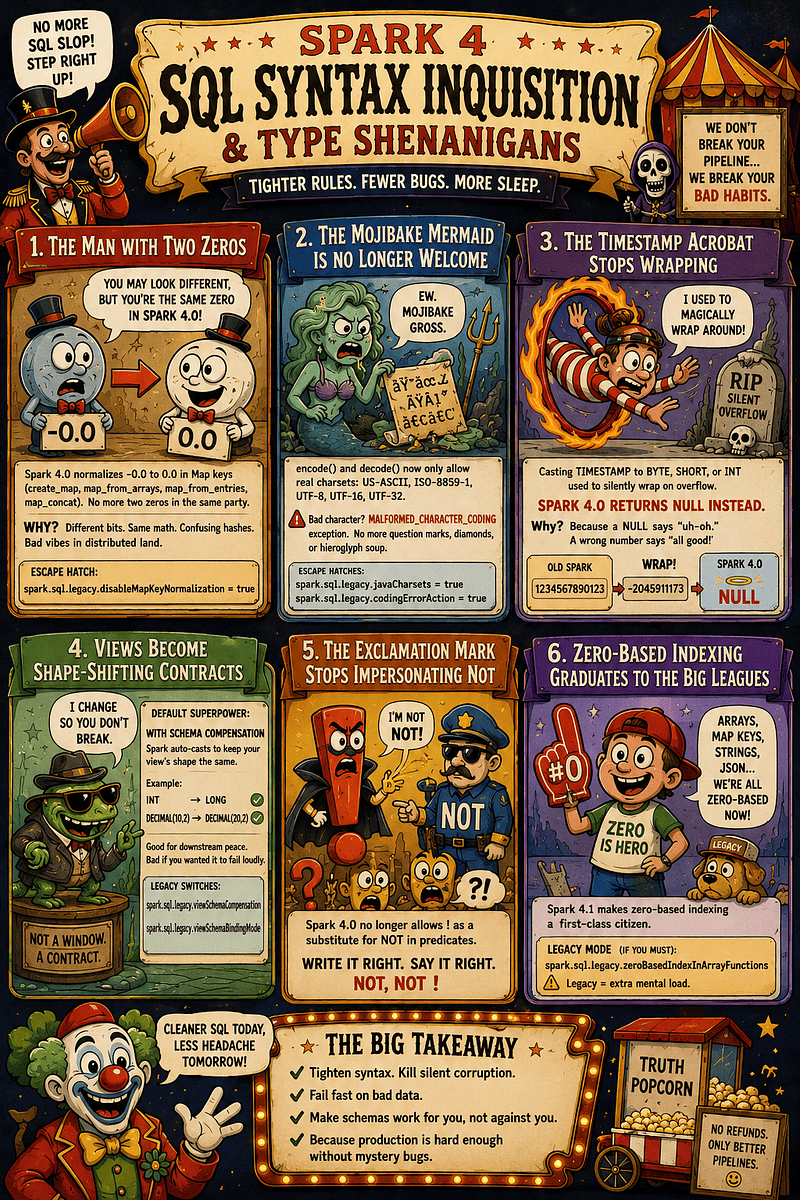
Spark 4 SQL Inquisition: where bad syntax gets arrested, cursed zeros get rebranded, and silent data corruption is thrown out of the big top.