Agent Bricks 🌫️ Hazy Shade Of Beneficial💰
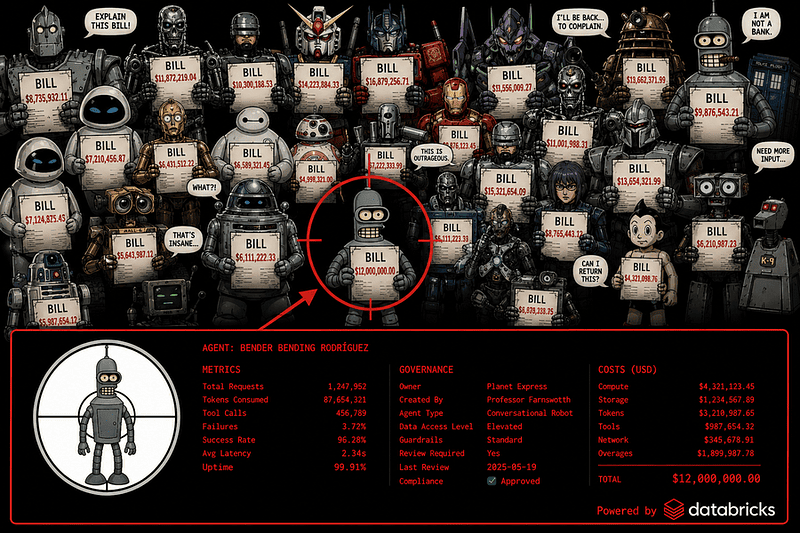
Somewhere in enterprise IT, five hundred AI agents just woke up, asked for OAuth, queried a Delta table, cited an HR policy PDF, and billed…
“Five hundred AI agents comin’ after us with a license to bill
Fairy deal? billin’ it’s just about to bust us”
(adapted from “Hazy Shade of Criminal” by Public Enemy)
🦍 Welcome to the Enterprise Agentic Zoo
In a demo, everything is elegant. The model behaves, the CTO smiles, and “agentic” is whispered with the confidence of someone who has never debugged a 2 a.m. OAuth failure.
Then Monday arrives. Now, that cute demo needs real customer data, strict permissions, memory, citations, and governance. Most importantly, it needs to not cost the GDP of a small island every time a user asks: Where is my invoice?
This is the reality of Enterprise Agents. They sit at the intersection of business users, proprietary data, and the terrifying question: Can we put this in front of customers next quarter?
Agent Bricks (the Mosaic AI Agent Framework) isn’t another “wrap an LLM and pray” tool. It is Databricks’ attempt to make agent development measurable, governed, and production-aware.
Chatbots Talk. Agents Do.
The first GenAI wave was simple: Can we build a chatbot for our docs?
It was a great way to discover that your documentation is a haunted attic of 2017 PDFs and dead Confluence pages.
But agents are different:
- Chatbots answer questions.
- Agents retrieve context, call tools, update states, and coordinate workflows.
When you move from “ask the bot” to “delegate the work,” your AI starts looking less like Clippy and more like a polite Terminator with database access. A chatbot can be embarrassing; an agent can be expensive. They are only valuable if they complete workflows safely, repeatedly, and measurably.
A Software Department in a Trench Coat
A serious agent system is a distributed system wearing a conversational mask. It requires:
- Planners & Reasoning: To break down tasks.
- Retrievers: To find the right data in the Unity Catalog.
- Tool Callers: To interact with APIs and SQL.
- Guardrails & Evaluators: To ensure the agent doesn’t email the CFO a haiku about revenue loss.
This is why “just use an LLM” fails in the enterprise. The model is just one component; the hard part is the architecture.
The Villain is the Enterprise Maze
In demos, the path is happy. In production, the API returns null on Tuesdays, the data is spread across three siloed systems, and Legal wants the logs yesterday.
Agent Bricks shifts the strategy from Prompt Witchcraft to System Engineering. Instead of manually juggling prompts and models, the platform allows you to:
- Attach Enterprise Data: Securely via Unity Catalog.
- Optimize Automatically: The system searches through fine-tuning, prompt optimization, and RAG patterns to find the best quality-to-cost ratio.
- Generate Benchmarks: It creates task-specific evaluations to move past “vibe-based” testing.
Don’t Build a Philosopher; Build a Coworker
The biggest mistake in agent strategy is trying to build a universal genius. A better approach is brutally practical: find the high-volume, “boring” workflows.
- The Strategy: Start read-only. Add citations. Add evaluation. Add approval gates.
- The Golden Rule: Autonomy is not a switch; it’s a ladder. Please climb it like adults.
Fixing the “Knobs”
Agent Bricks fixes the part nobody puts on a keynote slide: the infinite “knobs” of production AI.
Which model? Which chunking strategy? Which reranker? Which cost threshold?
By defining the business problem and the data sources, you let the platform optimize the design. Humans move up a level — from tuning screws to defining outcomes.
The Takeaway: Production AI is not a model problem; it is a systems problem. Agent Bricks provides the full-stack answer to building agentic systems that are useful, governed, and — most importantly — ready for Monday morning.
The office zoo is open. It’s time to meet the animals.
🧱 Agent Bricks: The Four Bricks in the Wall
Enterprise agents aren’t just chat bubbles with ambition; they are systems. To move from “cool demo” to “production reality,” Databricks provides four “opinionated patterns” — pre-built architectures designed for specific enterprise workloads.
1. The Knowledge Assistant (Institutional Memory)
This is the “Librarian” for your corporate swamp of PDFs, Slack threads, and “final_v2” wikis.
- The Job: Answers questions using RAG (Retrieval-Augmented Generation) while strictly respecting Unity Catalog permissions.
- The Reality: It’s not just about finding an answer; it’s about finding the right answer for the specific user without wandering into “confidential-policy Mordor.”
2. The Information Extraction Brick (The PDF Exorcist)
Unstructured data is where corporate facts go to hide. This brick converts messy text into structured, queryable tables.
- The Impact: In October 2025, this pattern accounted for 31% of Agent Bricks usage.
- Why it matters: Regex is for optimists; agents are for reality. Agents handle the chaotic variations in invoices, clinical notes, and contracts that brittle, handcrafted rules simply can’t.
3. The Custom LLM Brick (The Specialist Worker Bee)
Not every problem requires an “AI Avenger.” Sometimes you just need a bot that is world-class at one specific task.
- The Job: Narrow, domain-specific classification or generation — summarizing tickets, drafting compliant replies, or identifying “churn risk.”
- The Nuance: “Urgent” means something different in a hospital than it does in a retail shop. This brick allows the agent to learn your specific business dialect, moving beyond “stochastic intern” to “expert coworker.”
4. The Supervisor Agent (The Manager Octopus)
This is the most advanced pattern, coordinating multiple sub-agents and tools to execute complex workflows.
- The Stats: Launched in July 2025, it quickly became the #1 use case, making up 37% of usage by October. Multi-agent workflows grew a staggering 327% in that same window.
- The Architecture: One agent retrieves, one extracts, one checks compliance, and the Supervisor orchestrates the handoffs. It’s no longer a chatbot; it’s a workflow engine with a pulse.
The Hidden Superpower: Systematic Optimization
The core philosophy of Agent Bricks isn’t just assembly; it’s optimization.
Building an agent usually involves endless “knob-twiddling” — adjusting chunk sizes, prompts, and model choices until a demo finally works. Agent Bricks replaces this “artisanal pottery” with engineering. Using Mosaic AI Agent Evaluation, the platform can automatically search for the best configuration, applying:
- Agent Learning from Human Feedback (ALHF) to align behavior.
- Test-time optimization to improve reasoning on the fly.
- Automated Benchmarking to ensure your “Manager Octopus” doesn’t become a “Confident Middle Manager” made of hallucinations.
The Takeaway
A brick is not a building. It becomes useful only when connected by a governed plan.
- Knowledge Assistants provide context.
- Extraction creates data.
- Custom LLMs handle the work.
- Supervisors run the show.
The robots have arrived — and thanks to Agent Bricks, they finally have job descriptions.
🤖 Multi-Agent Systems: When One Robot Is Not Enough
Single-agent systems are helpful, but they are rarely “enterprise-shaped.” Real business problems don’t look like a single question; they look like a committee meeting.
“Which product should we launch next?” requires insights from Finance (margins), R&D (feasibility), and Legal (compliance). Asking one giant model to do all that is a recipe for a synthetic migraine.
This is why Multi-Agent Systems (MAS) are exploding. Usage grew 327% in just four months because enterprises realized that a “Supervisor” coordinating a team of specialists is faster, cheaper, and more accurate than one “God Model” trying to guess everything.
The Supervisor: Air Traffic Control for Reasoning
In the Agent Bricks ecosystem, the Supervisor Agent is the traffic controller. Its job isn’t to know the answer — it’s to know who to ask.
The 2026 version of the Supervisor now orchestrates:
- Specialized Agent Endpoints: Domain experts (e.g., a “Tax Code Agent”).
- Genie Spaces: Natural language interfaces for structured SQL data.
- Managed MCP Servers: Using the Model Context Protocol to securely tap into external tools like GitHub, Jira, or Salesforce without exposing credentials.
The Handoff: Where Robots Drop the Baton
Multi-agent systems sound elegant until you realize every handoff is a potential disaster. If the “Data Retriever” returns weak context, the “Policy Agent” will give a perfectly formatted — but totally wrong — answer.
To prevent your system from becoming a “Slack thread with API access,” production-grade agents now require:
- Strict Contracts: Defined inputs, outputs, and permissions for every specialist.
- Short-Term Memory (Lakebase): A stateful layer that allows agents to “rewind” and try a different path if a tool call fails.
- CLEARS Evaluation: A 2026 standard in MLflow that scores agents on Correctness, Latency, Execution, Adherence, Relevance, and Safety.
From Chatbot to Workflow Engine
The mental shift is simple: You aren’t building a bot that talks; you’re building a workflow engine where some of the steps are performed by probabilistic reasoning instead of rigid code.
When it works, you have a system where one agent retrieves, one extracts, one checks policy, and one validates — all coordinated by a Supervisor that keeps the “committee” on track.
It’s no longer about asking the AI a question. It’s about delegating an objective.
🥨 Retrieval, Context, and Tools: The Agent’s Snack Drawer
An agent without context is just a very confident intern with internet poisoning. It may sound fluent, but without enterprise knowledge and approved tools, it is mostly guessing in business casual.
Retrieval and tools are the “boring-but-critical” organs of an agent system. They move a bot from “I have opinions” to “I have evidence.” In the Databricks ecosystem, this means giving the brain its “snacks” — governed data access, vector search, and API functions — without turning your architecture into a compliance piñata.
Context Is the Meal, Not the Seasoning
Early GenAI treated context like a garnish: sprinkle a PDF into the prompt and call it “Enterprise AI.” In production, context is the entire meal.
- Knowledge Assistants (now GA as of early 2026) ingest documents from Unity Catalog volumes, ensuring every answer is grounded in the latest “FINAL_v2” policy.
- Information Extraction (v2) turns those unstructured PDFs into structured tables automatically, so your agent can actually “reason” over an invoice rather than just reading it.
SQL Agents & Genie: Because Data Lives in Tables
Enterprise truth isn’t always in a PDF; it’s in the “cursed” columns of your SQL tables. A modern agent shouldn’t care if the answer is in a document or a dashboard. By connecting agents to Genie Spaces, they can reason over business definitions rather than raw column names. The secret sauce? Permissions. If a user can’t see the “Salary” table, the agent shouldn’t be able to “data launder” that info into a chat.
Tools are the Agent’s Hands (and the MCP Revolution)
Retrieval gives agents knowledge; tools give them hands. In 2026, the Model Context Protocol (MCP) has standardized how agents touch things.
- Managed MCP Servers: Databricks now allows agents to securely call external services (GitHub, Salesforce, Slack) via Unity AI Gateway.
- On-Behalf-Of (OBO) Access: The agent acts with the user’s exact permissions. This prevents “privilege escalation” where a bot accidentally accesses data it shouldn’t.
Memory: The Lakebase Era
The biggest shift in 2026 is how agents remember. We’ve moved past stateless RAG to Lakebase — a serverless, Postgres-compatible layer built into the lakehouse.
- Short-term Memory: Stores conversation checkpoints so an agent can “rewind” if a tool call fails.
- Long-term Memory: Stores user preferences and past “experiences,” turning a one-off bot into a persistent coworker.
Governance is the Seatbelt
The better the agent, the more governance matters. A useless agent is safe because nobody uses it. A useful agent gets close to real money and real decisions.
To manage this, Databricks introduced the CLEARS Framework within MLflow. It evaluates every agent across six production-grade metrics:
- Correctness (Accuracy)
- Latency (Speed)
- Execution (Tool success)
- Adherence (Did it follow the prompt?)
- Relevance (Was the context useful?)
- Safety (Guardrails & PII)
Context is the Difference Between an Agent and a Horoscope
Without context, tools, and memory, an agent is just a fluent guesser. With them — and with a governed “snack drawer” — it can retrieve the right facts, respect permissions, and help humans move faster without turning production into a robot petting zoo.
The big question isn’t “Which model should I use?” It’s “What context can it safely touch, and how will I know it did the right thing?”
That is where the snack drawer becomes architecture. And that is where Enterprise AI becomes real.
🧠 Memory and Lakebase: The Agent’s Short-Term Brain
If Retrieval is what the company knows, Memory is what already happened in the room.
Without memory, your agent is an amnesiac vending machine. It might know the refund policy (Retrieval), but it won’t remember that you already gave it your order number and that the outage check just failed (Memory). Continuity is the difference between a productive coworker and a support experience that makes you question your life choices.
Memory is Not Retrieval
- Retrieval (Knowledge): Accessing external, static truths — policies, tickets, and tables.
- Memory (State): Tracking the “living” conversation — tool outputs, user preferences, and sequence of events.
In 2026, we categorize this into:
- Episodic Memory: Past experiences found via Vector Search.
- Working Memory: The active state stored in a transactional database.
The Engine: Lakebase (Managed Postgres)
In a demo, memory can live in a Python dictionary. In production, that’s a recipe for chaos. Production memory must be durable, transactional, and governed.
Lakebase is Databricks’ answer: a serverless, Postgres-compatible transactional layer.
- Why it matters: Instead of bolting on an external database, the agent writes its state directly into Lakebase.
- The Result: It survives restarts, supports multi-user sessions, and stays inside the Unity Catalog security model. It’s “grown-up” memory — not based on vibes, but on reliable data writes.
The Framework: LangGraph & Checkpointing
Agents don’t just “answer”; they navigate a graph of decisions. LangGraph allows you to build these as stateful workflows.
The secret sauce is Checkpointing. Think of these as “Save Points” for your agent.
- The agent calls a tool.
- The result is saved to Lakebase.
- If the connection drops or a tool fails, the agent doesn’t start over — it resumes from the last known good state.
This “Time Travel” capability allows agents to handle complex, multi-day investigations (like cybersecurity or claims reviews) without acting like every message is their first day on the job.
Memory Needs a Seatbelt (Governance)
Unmanaged memory is a liability. If an agent remembers something sensitive, you need to know: Who can see it? How long does it live? Is it audited?
By keeping state in Lakebase, memory is governed by the same rules as your production data.
- State in Lakebase: Durable and transactional.
- Tools via Unity Catalog: Governed and permissioned.
- Tracing with MLflow: Every “creative” decision the agent makes is logged and auditable.
The Takeaway: Retrieval gives agents knowledge. Tools give them hands. Memory gives them continuity. An agent with governed memory stops being a chatbot and starts behaving like software that actually understands your process.
🏭 Production: Where Agents Meet Security, Cost, and Reality
A demo agent is adorable. It lives in a notebook, answers three curated questions, and receives applause. A production agent is different: it has users, permissions, auditors, and a compliance department watching it breathe.
In 2026, Agent Bricks has expanded beyond simple agents to become the umbrella for the entire Databricks AI lifecycle. It’s no longer about making a prototype; it’s about building a system that survives the “Monday Morning” test.
The Notebook is Not the Product
Notebooks are for birth and resurrection; Declarative Automation Bundles (DABs) are for production.
A production agent requires a stable endpoint and a state layer that doesn’t vanish when a kernel restarts. The “Survival Kit” now includes:
- Databricks Apps: For hosting the front-end and logic.
- Lakebase (GA Jan 2026): The serverless Postgres layer that handles transactional state so your agent doesn’t have amnesia.
- DABs: To ensure your deployment is versioned code, not a series of manual “rituals” performed by one engineer.
Evaluation: “Looks Good to Me” is Not a Metric
According to the State of AI Agents 2026 report, companies using systematic evaluation are 6x more successful in production.
Evaluation isn’t parsley sprinkled on a finished app; it’s the engine. You must measure:
- Task Success: Did it actually solve the problem?
- Per-Step Tracing: In a multi-agent system, did a sub-agent take a “shortcut through nonsense”?
- The CLEARS Framework: The 2026 standard for scoring Correctness, Latency, Execution, Adherence, Relevance, and Safety.
Tracing: CSI for Robot Behavior
When a standard app fails, you look at logs. When an agent fails, you inspect a drama. MLflow Tracing (OpenTelemetry-native) allows you to see the exact moment your agent decided a 2018 PDF was legally binding. Without tracing, debugging an agent is like interrogating a fog machine. With it, you have a searchable audit trail of every “thought” and tool call.
Cost Control: Tokens are the New Truffle Oil
Multi-agent systems multiply costs fast. A single request might trigger five sub-agents and three retrievers.
- The Strategy: Don’t use the biggest model for everything.
- The Goal: Optimize for the “Cost-Quality Pareto Frontier.” Use small, fast models for routing and extraction; save the “expensive geniuses” for complex reasoning.
The Takeaway: Systems, Not Mascots
An agent is not a mascot for your AI strategy; it is a system.
- Bricks define the patterns.
- Unity Catalog governs the permissions.
- Lakebase stores the state.
- DABs handle the deployment.
This is the shift from “artisanal prompt pottery” to Measurable System Engineering. One gets applause at a keynote; the other gets adopted by the business. And in 2026, adoption is the only metric that matters.
The zoo is officially open. Good luck with the animals.
🔥 Optimization & Feedback: Teaching the Machine to Stop Touching the Stove
Building an agent is one thing. Making it accurate, fast, and affordable — while it handles messy enterprise data and changing policies — is the real challenge.
This is the core mission of Agent Bricks: moving beyond agent assembly into Systematic Optimization. In production, the goal is to improve without every iteration turning into a Slack-based séance.
The Knobs are the Nightmare
Agent systems have an overwhelming number of “knobs”: model choice, chunk size, tool descriptions, and routing logic. Traditionally, teams tune these by hand until a demo works. Agent Bricks replaces this with Automated Tuning.
Using research-backed techniques like TAO (Test-Time Adaptive Optimization) and Mix Attention, the platform can adapt a model’s reasoning based on usage data. This allows your agent to achieve “GPT-4 levels” of performance on smaller, cheaper models like DBRX-2 without increasing your inference bill.
Evaluation: The Steering Wheel, Not the Final Exam
“Looks good to me” is a vibe, not a metric. To survive in production, teams have moved past “vibes-based development” in favor of the CLEARS Framework within MLflow.
By treating agent quality as a cold, hard dataset rather than a series of lucky guesses, this framework provides the quantitative evidence required to hit the “Deploy” button. In this ecosystem, evaluation isn’t a final exam you take once and forget; it is the steering wheel that dictates exactly where your next optimization cycle needs to turn. If you aren’t measuring, you aren’t engineering — you’re just hoping.
Human Feedback: “Thumbs Down” is Not Enough
Users don’t give clean labels; they give messy guidance like “Stop using the 2019 policy.” Agent Learning from Human Feedback (ALHF) translates this natural language into system-level updates. Instead of another desperate prompt edit, ALHF identifies if the fix should be a new Vector Search filter, a change in Unity Catalog tool descriptions, or a model fine-tuning session. Feedback doesn’t just slap the agent’s wrist; it updates the entire architecture.
Quality vs. Cost: The Eternal Cage Match
Architecture isn’t just about cleverness; it’s about Financial Discipline. Using the most expensive model for every simple classification is “financial self-harm with an API key.”
Agent Bricks uses Intelligent Routing via the Mosaic AI Gateway. It ensures the “expensive geniuses” are only called for complex reasoning, while deterministic code or smaller “worker-bee” models handle the grunt work. It’s like truffle oil: a little goes a long way, but you don’t use it for the whole salad.
The Shift: From Release to Lifecycle
A static agent is a slowly dying demo. A production agent is a Learning System. The loop is simple:
- Interact: Users ask real questions.
- Trace: MLflow captures every “thought” and tool call.
- Evaluate: CLEARS scores the performance.
- Optimize: TAO and ALHF update the system.
This is the shift from “launching a bot” to operating an enterprise agent program. The future isn’t writing a better prompt; it’s building a system that can be measured, tuned, and improved without group therapy.
🥊 Vendor Comparison: Choose Your Agent Fighter
Every major platform now has an agent story. The market is saturated with frameworks — LangChain, CrewAI, AutoGen — and enough platform names to stock an AI-themed energy drink shelf. The question isn’t “Who has agents?” but “Which platform survives a security audit without turning your architecture into spaghetti?”
The Cloud Giants: Ecosystem Gravity
The competition is formidable, but each is shaped by its own “gravity well.”
- AWS Bedrock AgentCore: As of early 2026, Bedrock is the “flexibility” king. With the April 2026 launch of Managed OpenAI Agents on Bedrock infrastructure, AWS has moved beyond its own models. It offers AgentCore Memory for persistent cross-session facts and AgentCore Gateway to turn legacy APIs into secure tools.
- Google Gemini Enterprise Agent Platform: The evolution of Vertex AI, this suite focuses on “Agentic Networks.” It features Agent Identity (cryptographic IDs for auditing) and Memory Bank, allowing agents to remember user preferences across the entire Google Cloud ecosystem.
- Microsoft Foundry Agent Service: (Formerly Azure AI Foundry). Rebranded in January 2026, Microsoft Foundry is the “Agent Factory.” It connects to 11,000+ models and leverages Microsoft Entra ID and Logic Apps for deep enterprise integration. If your world is already in SharePoint and Fabric, the gravity here is immense.
Open Source: Maximum Freedom, Maximum Homework
Open source is brilliant for builders but brutal for operators. You get the building blocks (LangGraph, LlamaIndex), but you also inherit the “homework”:
- The Ops Invoice: You own the governance, identity, disaster recovery, and the security review where someone asks if the agent is “prompt-injection proof.”
- The Reality: Open source gives you freedom; production sends you the bill in the form of operational overhead.
Why Agent Bricks Wins: The “Home-Field” Advantage
Agent Bricks (Mosaic AI Agent Framework) doesn’t just offer an “agent builder.” Its pitch is Data Gravity. Most enterprise agents fail because the “Hard Part” isn’t the model — it’s the context. Databricks already sits where your data lives:
- Unity Catalog: Unified governance for data, tools, and agents. You don’t have to “connect” your data; the agent is already inside the vault.
- Lakebase: Native transactional memory for stateful workflows (no “mystery databases” needed).
- Integrated Lifecycle: Tracing, evaluation (via CLEARS), and deployment are all native to the Lakehouse.
Pick the Platform that Owns the “Hard Part”
- If the hard part is AWS-native orchestration? Bedrock.
- If the hard part is Google-scale persistence? Gemini Enterprise.
- If the hard part is Microsoft workflow integration? Foundry.
- But if the hard part is building governed agents over your core enterprise data? Agent Bricks has the sharper argument.
Other platforms help you build agents; Databricks helps you operate them where the data already lives.
🪠 The Enterprise Agent Stack: Less Magic, More Plumbing
Enterprise agents are not a feature; they are a stack. While the model is the “shiny” part, the plumbing determines whether the system survives its first encounter with a real user.
Many teams build the interface first because it demos well. Then production hits, and the “hard parts” — permissions, stale context, and tool safety — emerge like compliance bats from the ceiling. A professional agent stack makes these pieces explicit rather than hiding them.
Unity Catalog: The Bouncer at the Data Nightclub
In 2026, the data says it all: companies utilizing mature AI governance put over 12x more projects into production.
Unity Catalog is the bouncer. It ensures the agent’s access isn’t a “free-for-all” that breaks during the security audit. It governs the full workflow:
- What the user can see.
- Which tools the agent can call.
- What data gets redacted before it ever hits the model.
Lakebase: Memory with Database Energy
Memory shouldn’t live in application RAM or a file named agent_memory_v2.db. Production memory must be transactional and durable. Lakebase provides this via a Postgres-compatible state layer.
This matters because enterprise work is rarely “one-shot.” Whether it’s a cybersecurity investigation pivoting from an IP to a user, or a finance workflow waiting for a manual approval, Lakebase ensures the agent retains its “Working Memory” across sessions and restarts.
MLflow & Evaluation: The Black Box Recorder
If your debugging strategy is “vibes and prayers,” you aren’t ready for production. MLflow Tracing acts as the black box recorder, capturing every retrieved document and tool output.
This feeds directly into the CLEARS Framework. By using these benchmarks, tracing becomes a loop: bad outputs become examples, examples become evaluations, and evaluations guide the next optimization cycle. Without this “CSI-style” visibility, debugging a multi-agent system is just interrogation in a fog machine.
DABs: Ship Like Adults
At some point, the agent has to leave the nest. In 2026, Declarative Automation Bundles (DABs) are the standard for “shipping like adults.”
An agent is a complex bundle of code, prompts, tool definitions, and vector indexes. DABs package these resources as code, allowing you to move from dev to staging to production without carrying “cursed artifacts” by hand. It’s the difference between a historical museum of manual accidents and a repeatable production environment.
The 2026 Stack View
A practical Agent Bricks stack looks like this:
- Orchestration: Agent Bricks & LangGraph-style workflows.
- Governance: Unity Catalog (Permissions & Lineage).
- Context: Vector Search & SQL Tooling.
- Memory: Lakebase (Transactional state).
- Observability: MLflow Tracing.
- Evaluation: The CLEARS anchor.
- Deployment: Declarative Automation Bundles (DABs) & Databricks Apps.
The Bottom Line: The winners of the agent era won’t be the teams with the fanciest prompts; they will be the teams with the most robust plumbing. The model is the visible part, but the stack is the strategy.
🏢 The Bricks Are Not the Point, the Building Is
Agent Bricks isn’t about building chatbots; it’s about building enterprise-grade workflows that survive production.
The real product isn’t a chat box — it’s the speed, safety, and accuracy the system brings to your business. The “boring parts” — permissions, lineage, and cost control — are your true competitive moat.
While anyone can hack together a demo, building something Legal and Security actually trust requires Data Gravity.
By keeping agents native to Unity Catalog and Lakebase, you trade “prompt witchcraft” for measurable engineering. Use the CLEARS Framework as your steering wheel to ensure every optimization is backed by data, not vibes.
This is how enterprise AI finally grows up: through architecture, not magic. Build for the building, not just the bricks.
Don’t play dumb, dumb-diggety-dumb-diggety-dumb.
“Rich uppity rich feature-rich
Power to the people using Agent Bricks”
(adapted from “Hazy Shade of Criminal” by Public Enemy)