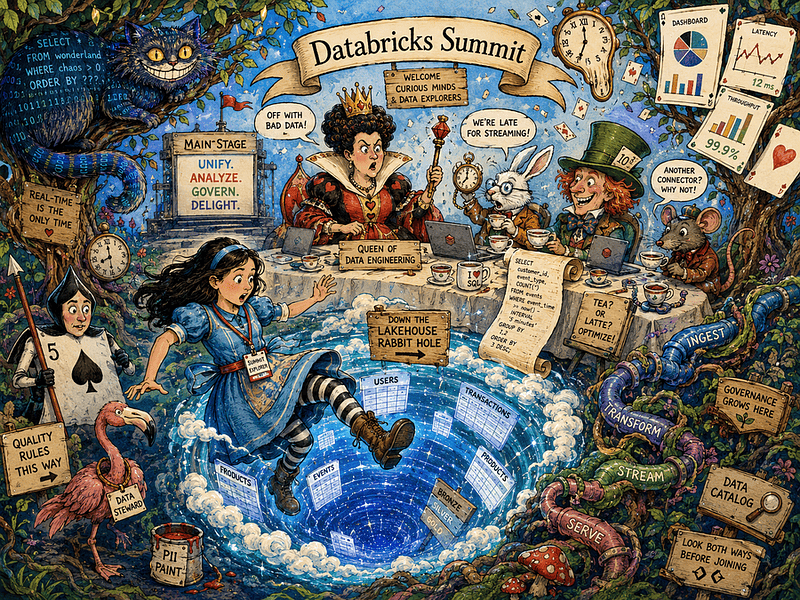
Databricks Summit 2026 👑 Salute The Queen 👸🏻
Back in 2014, data engineering was a simpler, more peaceful madness. Our infrastructure ran on vibes and a heavily traumatized cron job. If…
“Now the years keep turning, but the message remains.
Real data, real agents, real apps, real pain.
…
So here’s a toast to the pioneers who paved the way,
the architects of every stack we celebrate today.”
(adapted from “Salute the Mic” by Mackenzie Wheeler)
🕳️ Down the Lakehouse Rabbit Hole
There is always a moment when a keynote stops being marketing and becomes a mild existential threat. At Databricks Summit 2026, that moment arrived with autonomous AI agents.
Not because agents are magical. Not because demos are suddenly production. And definitely not because the enterprise has finally achieved clean metadata enlightenment. Because agents need data.
So do apps, dashboards, real-time workflows, security detections, customer experiences, and every executive metric currently being refreshed by a pipeline nobody wants to touch. The business wants all of it clean, governed, low-latency, auditable, permission-aware, cost-controlled, and preferably streaming fast enough to make the White Rabbit check his watch twice.
And who is standing in the middle of this kingdom, holding a broken CDC pipeline, a graveyard of Airflow DAGs, and a dashboard that has not refreshed since Tuesday? Exactly. The data engineer.
The Artificial Brain Has a Logistics Problem
The agentic future begins with a seductive idea: AI is already smart enough.
The latest models can summarize, reason, generate code, interpret documents, and solve problems that would emotionally injure most humans before lunch.
👑 But inside the enterprise, intelligence is no longer the clean bottleneck. Context is.
We built an artificial brain, then locked it outside the company. It knows human history, public documentation, programming languages, and an alarming number of motivational frameworks. What it doesn’t know is your customer IDs, your broken joins, your undocumented revenue logic, your regional consent rules, or why “active user” means four different things depending on which VP is holding the clicker.
That is the Rabbit-Hole moment.
The enterprise doesn’t need a smarter model floating above the castle. It needs roads under the castle: ingestion, transformation, lineage, semantics, permissions, freshness, observability, and data quality. Before an agent can safely act, someone has to make the messy middle legible enough for machines to survive it.
That someone is data engineering. Surprise.
The Fall Never Really Ends
Alice falls into Wonderland and quickly learns that ordinary rules no longer apply. Bottles change her size. Doors lead nowhere useful. Creatures speak in riddles. Everyone has strong opinions about procedure and very little interest in accountability.
Enterprise data has been living there for years.
Humans survived it with tribal knowledge. A broken dashboard could be explained by walking across the office and asking Marta from Finance what she changed in the spreadsheet before lunch. A suspicious metric could be patched with a caveat in the meeting notes. A column called customer_clean could remain neither clean nor entirely about customers because the three people who understood the joke still worked here.
Agents cannot operate like that. Agents are literal little goblins with API access. They will read the column name, trust the schema, follow the permissions, generate the SQL, trigger the workflow, and produce a beautifully formatted answer that gives the CFO spiritual damage.
The old pain was simple: Can you build this pipeline?
The new pain is worse: Can you build, govern, observe, cost-control, test, version, and safely operate hundreds of pipelines, some of them created or modified by AI at machine speed?
👑 The agentic era doesn’t remove the plumbing. It moves the plumbing deeper into the platform, makes it more automated, and raises the consequences when it fails.
🌊 The Pool of Tears
Alice doesn’t fall neatly into Wonderland and immediately receive a roadmap.
First, she changes size, loses control of her body, misunderstands the rules of the room, and cries so much that she nearly drowns in the consequences of her own confusion.
Enterprise data teams may not be trapped in a hallway with a tiny golden key, but emotionally, the architecture is familiar.
For years, companies kept growing and shrinking their data platforms in unnatural ways. A little SaaS connector here. A custom CDC job there. A warehouse migration half-finished. A dashboard patched after quarter close. A spreadsheet promoted to business-critical infrastructure because nobody wanted to reopen the argument. Each decision made sense in the moment. Each one solved a problem just long enough for the next problem to arrive wearing a bigger hat.
Then the platform woke up one morning floating in a pool of its own technical debt. And now everyone wants agents.
Everyone Wants Agents. Nobody Wants the Plumbing Invoice.
The agentic future sounds wonderfully clean from the keynote balcony.
Agents will answer questions, generate pipelines, repair workflows, inspect metrics, summarize incidents, recommend actions, and maybe one day explain why the dashboard went feral five minutes before the board meeting.
Beautiful. But agents don’t arrive in a vacuum. They arrive in the architecture that already exists.
They inherit the undocumented joins, the stale dashboards, the duplicate customer tables, the half-trusted metrics, the inconsistent permissions, the orphaned pipelines, the temporary workaround from 2021, and the bronze table nobody owns but everybody queries.
👑 That’s the uncomfortable truth. AI doesn’t erase the platform’s history. It accelerates its consequences.
A stale dashboard used to waste a meeting. A stale dashboard connected to an autonomous workflow can trigger the wrong campaign, refresh the wrong forecast, escalate the wrong incident, or send a very confident summary to someone with budget authority and insufficient coffee.
A duplicated table used to be annoying. A duplicated table in an agentic environment becomes a fork in reality. One agent reads the certified version, another finds the cheaper-looking shadow copy, and suddenly two automated decisions disagree with perfect grammar.
A missing owner used to mean a Slack thread. A missing owner now means nobody knows who can approve the agent’s proposed fix, who pays for the backfill, or who gets blamed when the temporary pipeline becomes a recurring spiritual event.
That is how technical debt becomes operational risk.
The Messy Middle Is Now the Main Stage
Between raw source systems and business outcomes sits the messy middle.
That’s where data engineering actually lives.
It’s not the glamorous part of the architecture diagram. It’s the part with strange joins, late-arriving records, schema drift, naming conventions from three reorganizations ago, and a gold table whose business owner left in 2022 but whose dashboard still runs the revenue meeting.
Humans survived this layer through social knowledge. They knew which table was cursed. They knew which dashboard was official only because everyone agreed to stop fighting. They knew which metric required a footnote, which source system lied on weekends, and which pipeline could be restarted safely only if the moon was emotionally stable.
👑 Agents don’t inherit that folklore. They inherit metadata.
If the metadata is thin, stale, contradictory, or missing, the agent doesn’t become cautious. It becomes confidently wrong.
This’s why the messy middle can no longer remain an informal human survival layer. It has become the main stage.
The place where definitions are standardized, lineage is captured, permissions are enforced, quality is tested, and ownership is explicit is no longer boring platform hygiene.
It’s the difference between automation and automated nonsense.
The Pool Is Not Just Technical
Technical debt is a misleading phrase because it sounds too tidy.
A debt has a principal, an interest rate, and a repayment schedule. Most enterprise data debt is more like Wonderland water damage. It seeps into definitions, dashboards, permissions, ownership, cost models, source contracts, and team behavior.
By the time anyone notices, the floorboards are soft and the architecture smells expensive.
👑 The real cost is not just broken pipelines. It’s hesitation.
Nobody trusts the metric enough to automate the decision. Nobody trusts the lineage enough to retire the sidecar. Nobody trusts the ownership enough to let an agent near the workflow. Nobody trusts the migration enough to turn off the legacy warehouse. Nobody trusts the dashboard enough to stop exporting the spreadsheet.
That lack of trust becomes the tax every team pays before doing anything useful. And in an agentic world, the tax compounds faster.
🦤 A Caucus-Race and a Long DAG
Before the shiny Summit announcements start running around the castle with press badges, we need to visit the real crime scene.
Not the model layer. Not the dashboard. The stack.
In Alice’s Adventures in Wonderland, the Caucus-Race is a masterpiece of organizational nonsense. Everyone runs in circles. Nobody explains the rules. There’s no clear beginning, no clear end, and somehow, after all the motion, everyone declares themselves a winner.
Welcome to the modern enterprise data platform.
Kafka is screaming about partitions. Airflow is late and blaming the scheduler. A SaaS ingestion tool is pouring tea into proprietary formats. A Spark job is pretending it has documentation. A CDC pipeline is coughing blood into a bronze table. A BI extract is running on a schedule nobody remembers approving. A spreadsheet is still, somehow, part of the architecture.
Nothing here was originally stupid. That’s the important part.
Most fragmented stacks were built by smart people making reasonable compromises under unreasonable deadlines. Every tool had a purpose. Every shortcut answered a real business need. Every exception made sense when the room was on fire.
Then the years passed. The exceptions became patterns. The patterns became platforms. And one day, the architecture looked less like a system and more like a conspiracy board made of invoices.
We Made Peace With Circular Motion
For years, the industry accepted this with a shrug.
Yes, the pipeline is fragile, but it usually runs.
Yes, the dashboard is wrong, but it’s wrong in a familiar direction.
Yes, the finance mart becomes archaeology if Patricia leaves, but Patricia has not left yet, so please stop bringing this up during planning.
👑 That was the quiet bargain of fragmented data stacks: they kept the business moving, but made the movement harder to understand.
Work happened. Jobs ran. Tables refreshed. Tickets closed. Dashboards loaded. Executives nodded.
The race continued. But circular motion is not the same as progress.
A system can be busy and still be ungoverned. A pipeline can succeed and still produce nonsense. A dashboard can refresh and still mislead the room. A platform can scale and still have no clear answer to the simplest production questions: What changed? Who approved it? Where did this data come from? Who depends on it? Can we roll it back? Why did the bill triple? Where, exactly, does truth live?
The Caucus-Race is funny in a children’s book. It’s less funny when it has production credentials.
Fragmented Stacks Are Poisonous for Agents
Humans experience a fragmented stack as inconvenience. Agents experience it as reality.
They don’t see “a few legacy quirks.” They see a maze of partial interfaces, duplicated tables, inconsistent APIs, disconnected permission models, and hidden state.
They see three doors that all claim to lead to the same metric. They see five tools with five different ideas of lineage. They see a workflow graph that looks complete until the real dependency lives in a scheduled notebook, an external job, or a person’s memory.
That doesn’t merely slow agents down. It makes them dangerous.
An agent operating across fragmented systems will not automatically understand which environment is authoritative, which copy is stale, which permission model is stronger, which lineage graph is incomplete, or which temporary transformation became permanent during the last reorg.
The smarter the agent, the faster it can assemble a plausible answer from broken pieces.
That’s the nightmare version of automation: not a robot that fails loudly, but one that confidently finishes the race in the wrong direction and still asks for a prize.
The Version Control Problem: Code vs. Vibes
Data engineers love Git, pull requests, diffs, and the comforting fantasy that production is fully described by code.
But production data systems are rarely just code. They are code, configuration, infrastructure, permissions, schedules, credentials, table properties, cluster settings, runtime versions, dashboard extracts, notebook state, and one YAML file nobody wants to touch because the last person who edited it ruined a Tuesday.
If only part of that world is versioned, debugging becomes storytelling.
When an AI coding assistant modifies a pipeline, the platform needs boring answers with royal urgency: What changed? Who reviewed it? Which downstream assets are affected? Can the generated logic be diffed? Can the previous behavior be restored? Did the agent change business meaning, operational behavior, or both?
Without a unified, reviewable path to production, AI-assisted data engineering becomes a very fast way to manufacture mystery. The code may be in Git, but the system behavior is still wandering around Wonderland wearing a hat.
The Governance Problem: Every Copy Is a New Crime Scene
Fragmentation multiplies places where governance can quietly fall off the wagon.
Data moves from operational databases into CDC tools, staging tables, transformation jobs, warehouses, serving stores, extracts, dashboards, reverse ETL tools, and spreadsheets wearing false moustaches. At every hop, the original rules have to survive the journey.
Lineage has to survive. Permissions have to survive. Masking rules have to survive. Audit trails have to survive. Business meaning has to survive.
Usually, something falls into the river.
For human users, governance gaps are already dangerous. For agents, they are worse because agents don’t only read data. They generate SQL, call tools, create assets, trigger workflows, and route outputs into other systems.
If policy works in one layer but disappears in another, you have not built a governed platform. You have built a compliance escape room with an API.
👑 Governance cannot be a decorative sticker placed on the architecture after the fact. It has to be part of the runtime.
Otherwise the agent will find the weakest door and politely automate the violation.
The Observability Problem: Everything Is Green Except the Truth
This is peak data engineering comedy: Ingestion is green. Orchestration is green. The warehouse is green. The dashboard is green. The business metric is wrong.
👑 System health is not data health.
Software observability tells you whether something ran. Data observability tells you whether the output still makes sense.
Fragmented stacks make that distinction painful because the evidence lives everywhere. Logs are in one place. Lineage is in another. Quality checks are optional. Business definitions live in a wiki nobody trusts. Runtime behavior is buried under orchestration metadata. Cost attribution looks like someone shook a cloud invoice over a keyboard.
An operations agent cannot solve that by staring at failed code like a flashlight in a burning warehouse.
It needs the full picture: logs, lineage, freshness, schema changes, statistical drift, runtime behavior, cost signals, and business context. Without that, it’s not doing root-cause analysis. It’s guessing with better punctuation.
The Scalability and Cost Problem: Not All Boxes Scale Equally
Every legacy tool scales differently. That becomes painful when agents enter the chat.
Agents loop, retry, explore, branch, summarize, verify, and call tools in patterns that don’t look like a human opening a dashboard once before lunch. A single agentic session can create the workload shape of an overcaffeinated analyst, a junior engineer, and a scheduled job having a small argument in public.
In a unified platform, that pressure can at least be monitored, attributed, throttled, and governed. In a fragmented stack, cost control becomes detective work.
The invoice grows in one system. The trigger lives in another. The data copy was created by a third. The query came from a fourth. The person who understands the integration is on vacation, and the agent is still looping because its confidence score has not emotionally matured.
Suddenly, “self-service analytics” becomes “self-service distributed systems.”
Without global guardrails, you don’t have cost governance. You have vibes with invoices.
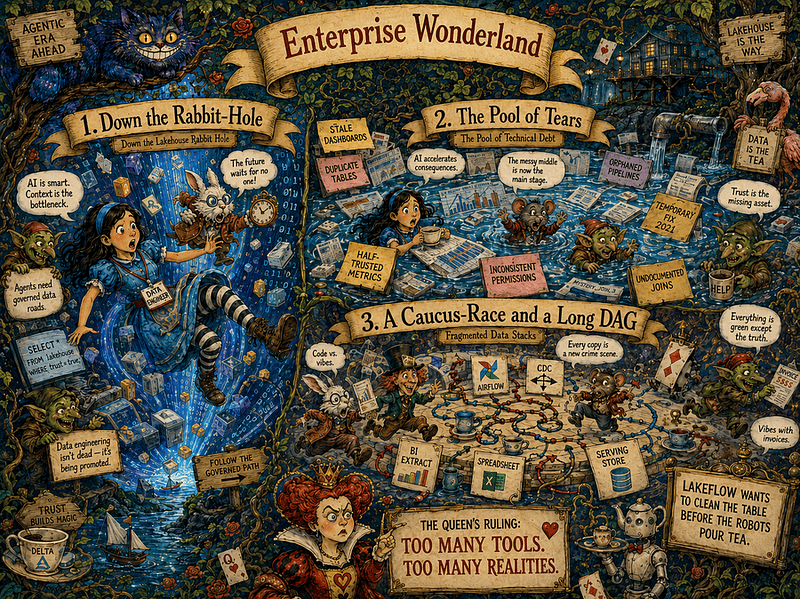
Enterprise Wonderland: where AI agents chase context, dashboards drown in technical debt, and the Queen learns that the real monster was fragmented governance with production credentials.
🐛 Advice from a Caterpillar
At some point in Wonderland, Alice meets the Caterpillar, who does not offer comfort, architecture diagrams, or a complimentary roadmap.
He asks the only question that matters: Who are you?
That is also the first question an enterprise data platform has to answer before it lets agents loose inside the castle: What is this table? What does this column mean? Who owns this metric? Which dashboard depends on this field? Which source produced this file? Which policy governs this customer record? Which agent is allowed to call this tool?
Without those answers, intelligence is just confidence with a login.
This is why Unity Catalog has to appear early in the story. Catalog sounds boring, like a dusty portal where metadata goes to die after someone types “customer table” into a description field and calls it governance. But in the agentic lakehouse, the catalog is no longer a passive library card system.
It’s the map. It’s the law. It’s the runtime memory. It’s the enforcement gate.
👑 Metadata used to be documentation. Now it is where autonomous systems go to think.
From Passive Phone Book to Runtime Engine
Traditional catalogs were compliance furniture. Useful in theory. Ignored in practice. Updated when someone remembered. Audited when someone panicked. Full of descriptions that sounded official and aged like milk.
They were passive phone books: here is a table, here is a schema, here is an owner who may or may not still work here.
That model breaks in an agentic world. A human can pause when documentation smells wrong. A human can notice that a metric definition looks suspiciously political. A human can remember that one column was added for a campaign nobody talks about anymore. A human can ask around before touching something load-bearing.
An agent sees the catalog as the environment. If lineage is missing, its map is incomplete. If permissions are inconsistent, its boundaries are fake. If metrics are duplicated, its answers fork. If descriptions are stale, its reasoning inherits the rot.
*👑*The smarter the model, the more dangerous weak metadata becomes.
A dumb system with bad metadata fails slowly. An unguided agent with bad metadata fails at scale, in polished language, with timestamps.
That’s why the catalog cannot remain a side portal. It has to participate in the runtime. It has to shape what engines, people, tools, and agents are allowed to discover, query, modify, share, and trust.
The Caterpillar was not being rude. He was asking for the minimum viable governance model.
External Lineage: The Map Leaves the Garden
Enterprise data doesn’t live inside one tidy platform boundary.
It begins in SaaS applications, operational databases, ERP systems, CRM fields, support tickets, payment ledgers, partner feeds, event streams, and mystery exports from teams that insist they are temporary.
Then it flows through ingestion jobs, transformation logic, semantic models, dashboards, reverse ETL tools, AI systems, and executive decision loops.
👑 If lineage only works inside the lakehouse, the map stops at the garden wall. That’s not enough anymore.
External lineage matters because blast radius is no longer a slow governance exercise. It’s production safety. Before a data engineer drops a column, changes a transformation, retires a table, or accepts an AI-generated pipeline modification, the platform needs to know what sits upstream and downstream.
Which SaaS source fed this field? Which dashboard will break? Which metric will change? Which model feature depends on it? Which agent context table will become stale? Which business process is quietly using the output?
The old lineage graph answered: What happened inside this platform?
The new lineage graph has to answer: What part of the enterprise will scream if this changes?
Column Popularity: Institutional Memory With a Warning Label
Enterprises are terrible at manual documentation. This is not a moral failure. It’s physics. People are busy, schemas sprawl, dashboards multiply, columns linger, meanings drift, and nobody wants to spend Friday afternoon writing a heartfelt obituary for campaign_flag_old_2.
A production table can have 400 columns. Some are critical. Some are deprecated. Some were added for one regional project in 2019 and now exist mainly as sediment. Some are actively used for reasons nobody remembers but everyone is afraid to question.
Column popularity turns usage into a metadata signal. If a column is frequently queried, joined, filtered, surfaced in dashboards, or used in downstream workloads, that activity becomes institutional memory. It tells humans and agents, “This field matters to the organization, even if the documentation is thin.”
That’s powerful. It’s also dangerous. Popularity is not truth. It’s attention.
A bad column can become popular because an early dashboard used it, everyone copied the dashboard, and eventually the wrong definition achieved corporate immortality. A misleading metric can become sacred through repetition. A stale attribute can survive because the business built a ritual around it.
So column popularity should guide attention, not replace judgment. It’s a lantern, not a crown.
👑 The right pattern is popularity plus certification, freshness, ownership, data contracts, and quality checks. Otherwise the catalog may faithfully preserve the company’s most beloved mistakes.
Metrics as Governed Objects: Ending the KPI Food Fight
Metrics are where corporate departments go to fight in formal clothing.
Revenue in Finance doesn’t match revenue in Sales. Churn in the dashboard doesn’t match churn in the notebook. Active customer depends on who is presenting. Europe depends on whether someone remembered the time-zone rule. And somehow the spreadsheet has the final say because it was used in the board deck once and nobody wants to relitigate the definition.
This is not a dashboard problem. It’s a governance problem.
When metrics live inside BI workbooks, notebooks, ad hoc SQL, and team-specific semantic layers, every department can accidentally maintain its own reality. The result is not analytical flexibility. It’s metric feudalism.
👑 Putting metrics into the catalog as governed objects changes the center of gravity. A metric becomes something defined, versioned, reviewed, owned, and reused. Its dimensions, filters, grains, currency logic, time windows, and policy boundaries are no longer hidden inside a workbook formula or a heroic SQL snippet. They become platform assets.
When a BI user asks for revenue, the system should not improvise.
When an agent asks for churn, it should not invent a SQL expression from vibes. They should call the governed metric.
That is how the Caterpillar’s question becomes operational: not just “Who are you?” but “What exactly do you mean when you say revenue?”
FILE and Multimodal Governance: The Documents Want Passports Too
The agentic enterprise doesn’t run only on rows and columns. It runs on contracts, PDFs, policy documents, call transcripts, claims, emails, tickets, slide decks, audio logs, screenshots, embeddings, retrieval chunks, and agent traces.
For years, unstructured data lived beside the governed data estate like a slightly suspicious attic. Everyone knew valuable things were inside. Nobody wanted to inventory the boxes.
AI changed that. Now those files are not passive archives. They are context fuel. Agents retrieve them, summarize them, extract from them, cite them, reason over them, and turn them into structured outputs that may influence decisions. That makes file governance unavoidable.
A source document is not just a blob. It has an owner, a version, an access policy, a retention rule, a classification, and a lineage chain. If an agent answers a question using a contract clause, the platform should know which document version supplied the text, which parser extracted it, which embedding model indexed it, which user credential authorized the retrieval, and which downstream answer reused it.
Without that, RAG becomes a haunted library with a search bar. The answers may sound useful, but the evidence trail is fog.
👑 Treating files as first-class governed objects brings the unstructured world into the same accountability model as tables and metrics. That is where multimodal AI stops being a demo and starts behaving like enterprise infrastructure.
🧂 Pipes and Pepper
In Pig and Pepper, Alice walks into a house where everything is technically domestic and spiritually unwell. The Duchess is shouting. The Cook is throwing things. The air is full of pepper. The baby is crying. The Cheshire Cat is grinning because apparently this is normal. Then the baby turns into a pig, which is less a plot twist than a governance failure with hooves.
That’s ingestion. Not the clean conference-slide version where sources connect politely, schemas behave, and every dataset arrives wearing a name tag. The real version.
A Salesforce connector here. A homegrown Python script there. A SaaS ELT tool with pricing opinions. An SFTP job that predates several team members. A SharePoint downloader with access to documents nobody has classified. One migration script that began as a temporary bridge and somehow became critical infrastructure.
Nobody planned the zoo. It happened because every source was urgent, so every ingestion path became special. Special credentials. Special schedules. Special retries. Special failure modes. Special invoices. Special reasons nobody wants to touch it during quarter close.
Eventually, the platform doesn’t have an ingestion layer. It has a kitchen full of pipes, pepper, and livestock.
Stop Feeding the Connector Zoo
Every data platform has a connector zoo. Some animals are well behaved. Some are expensive. Some only eat OAuth tokens. Some break when the vendor changes an API field and calls it innovation. Some are actually three scripts in a trench coat pretending to be a managed integration.
👑 The problem is not connectors. The problem is treating every connector as an isolated exception.
A connector is just a pipe. And pipes carry whatever you connect them to: clean water, mud, sewage, customer events, deleted accounts, malformed JSON, or Salesforce opportunities with six competing meanings for closed.
LakeFlow Connect is interesting because the goal is not simply “more connectors.” Connector count is not architecture. A large catalog of pipes doesn’t matter if every pipe lands data with different ownership, monitoring, schema behavior, permissions, lineage, and cost visibility.
👑 The real shift is whether ingestion becomes part of the same governed operating model as the rest of the lakehouse.
Source connections. Serverless execution. Incremental movement. Lineage. Permissions. Auditability. Unity Catalog boundaries. Production monitoring.
That’s the difference between feeding the zoo and building a front door.
Ingestion Is a Product Problem
Many platforms fail because they treat ingestion as plumbing. Just get the data in. That phrase has caused more lakehouse swamp damage than most architectural decisions with longer names.
“Just get the data in” is how you end up with thousands of bronze tables, zero owners, four definitions of account, three different timestamp conventions, and a source folder that looks like someone backed up the internet into a marsh.
👑 Ingestion is not merely the first technical step. It’s the first product boundary.
The moment data enters the platform, it starts making promises. It promises to represent a source. It promises a freshness expectation. It promises a schema contract. It promises a privacy posture. It promises that someone knows what it is, why it exists, who can use it, and when it can be retired.
That means every production connector needs more than credentials. It needs a technical owner. A business owner. A freshness SLA. A schema policy. A PII classification. A lineage path. A cost model. A backfill strategy. A deprecation plan.
Bronze is not a nightclub with no bouncer. If data enters the platform without ownership, metadata, quality expectations, and access rules, everything downstream inherits the mess with interest. Dashboards inherit it. Models inherit it. Agents inherit it. Eventually the business inherits it and asks why the pig is wearing a customer ID.
What LakeFlow Connect Is Really Trying to Change
The old ingestion pattern was simple in the worst possible way: Use a third-party tool to land data somewhere near the lake. Then spend the next several years retrofitting orchestration, governance, monitoring, access control, lineage, cost tracking, and incident response around the pile.
That’s not a front door. That’s a hole in the wall with a clipboard.
LakeFlow Connect tries to pull ingestion into the same platform where the rest of the data engineering lifecycle already lives. The important part is not that a source can be connected. The important part is that connection, execution, governance, lineage, and monitoring can become one operational surface.
👑 That matters because agents don’t need random data dumped into storage. They need governed context. And governed context starts before the first row lands.
If the source was connected without ownership, the agent cannot infer accountability later. If permissions were flattened during ingestion, the agent cannot reconstruct them from vibes. If a schema change was treated as harmless when it changed business meaning, the agent will happily automate the misunderstanding.
Ingestion is where the chaos first enters the house. Letting it arrive ungoverned is how the baby becomes a pig.
Semantic Trapdoors at the Front Door
LakeFlow Connect can absorb a lot of boring operational pain. That’s valuable. But it doesn’t repeal data engineering physics.
👑 Incremental loading is not just a performance optimization. It’s a correctness contract.
If a source represents deletes as a status flag, a tombstone event, a missing row, or a hard purge, the connector cannot magically decide what that means for revenue, compliance, retention, or customer consent.
The pipe doesn’t attend policy meetings. Schema drift is not always harmless. A new nullable column may be fine. A changed enum value may break a metric. A widened type may hide precision loss. A renamed field may look like a cosmetic change while quietly disconnecting half the downstream logic.
Sources evolve. Your ingestion layer has to know the difference between weather and arson.
Backfills are not a button. They are archaeological excavations with invoices. Every connector looks good on today’s micro-batch. The real test is five years of historical data, vendor API limits, throttling behavior, duplicate detection, late deletes, old snapshots, and whether today’s truth gets overwritten by yesterday’s misunderstanding.
Unstructured ingestion is even more treacherous. PDFs, slides, docs, emails, tickets, and SharePoint folders contain organizational memory. They also contain permission traps, stale policies, sensitive HR material, legal obligations, and enough forgotten context to make a chatbot dangerously helpful.
Moving documents into search or vector indexes is not just a retrieval problem. It’s an access-control problem. If folder-level ACLs don’t survive ingestion, your assistant may become the world’s most cheerful HR leak.
🍵 The Self-Service Tea Party
In Wonderland, the Tea Party is not chaotic because tea is bad. Tea is lovely.
The problem is that nobody agrees on the rules of the table. The Hatter changes seats. The March Hare argues with time. The Dormouse tells stories nobody asked for. Cups move, riddles multiply, and somehow everyone behaves as if this is a functioning operating model.
That is self-service data when it escapes governance.
Data engineers have a complicated relationship with no-code tools. In public, we say collaborative things like, “Business users should absolutely be empowered.” Then someone shows us a visual workflow with 187 boxes, three circular dependencies, a filter called temporary_fix_2024, and an output table feeding the board pack. Suddenly, we become medieval.
The issue is not no-code. The issue is no-ownership. No-lineage. No-version-control. No-tests. No promotion path. No idea why a drag-and-drop transformation built during a Monday emergency is now running an executive dashboard with the confidence of royal law.
No-code has existed forever. Excel is no-code. A raccoon driving a forklift is logistics. The real question is whether self-service data preparation can become production code without becoming production folklore.
The Self-Service Three-Act Tragedy
Every organization wants self-service data.
In theory, everyone wins. Analysts move faster. Engineers stop being ticket machines. Business logic gets expressed by the people who actually understand the business. Data teams focus on platforms, contracts, and reusable patterns instead of hand-translating every request into yet another pipeline.
In practice, self-service often becomes a tiny Greek tragedy with dashboards.
- Act I: An analyst builds a useful prep flow in an isolated tool.
- Act II: The flow becomes business-critical because the numbers are useful, the meeting is tomorrow, and nobody has time to productionize anything.
- Act III: The tool breaks, the original analyst is on a different team, the logic exists as a canvas full of hidden state, and data engineering is summoned to reverse-engineer the sacred arrows.
That’s not collaboration. That’s archaeological ETL.
The analyst knew the business logic but not the infrastructure. The engineer knows the infrastructure but not the business context. The tool knows nothing and still charges per seat.
This is how the Tea Party becomes policy. Everyone keeps moving cups because nobody owns the table.
Same Canvas, Same Runtime
LakeFlow Designer is trying to make self-service less haunted.
The important part is not that analysts get a visual canvas. Visual canvases are not new. The industry has been drawing boxes and arrows since before half the stack had cloud pricing.
The important part is what happens underneath.
When an analyst connects sources, shapes data, or asks Genie Code to generate a transformation, the output shouldn’t become a proprietary workflow artifact living in a vendor attic. It shouldn’t become a CSV headed for the swamp. It shouldn’t become another shadow pipeline that data engineering discovers only after it has emotionally bonded with Finance.
It becomes Spark Declarative Pipelines (SDP). That changes the bargain.
Now the visual workflow can run on the same production architecture as the rest of the lakehouse. The logic can be reviewed. The pipeline can be versioned. The lineage can be traced. The permissions can be enforced. The asset can be promoted through CI/CD. The output can be monitored like everything else.
👑 The canvas becomes a front door to production engineering. Not a secret side quest.
That is the difference between democratization and table-flipping.
Genie Code: The Supernatural Intern
Genie Code turns pipeline creation into a conversation.
Join these tables. Remove duplicate orders. Tag PII. Add a schema validation check. Normalize the timestamps. Create a silver table.
Very convenient. Also mildly terrifying.
Generated transformations can still be confidently wrong. A join can look reasonable and quietly bury half the sales metric. A type cast can turn decimals into sadness. A filter can drop the exact records the business cares about. A generated validation rule can check the easy thing and miss the actual semantic trapdoor.
The good news is that Genie Code operates inside platform context. It can see schemas, permissions, metadata, and governed assets. That makes it less like a random script with API keys and more like an intern with superpowers. Still an intern, though. Review the work.
👑 This is the cultural shift: data engineers don’t disappear when code generation gets better. They move from typing every transformation by hand to defining the rules of safe creation.
What patterns are allowed? Which tables are certified? Which joins require review? Which outputs can stay in a sandbox? Which promoted assets need owners, tests, and SLAs? Which generated changes require human approval?
The agent can pour the tea. Someone still has to make sure it’s not soup.
From Toy to Production Adult
AI-assisted self-service is useful only if there is a path from experiment to production.
The sandbox should be fast, forgiving, and creative. Analysts need space to explore, test ideas, and express business logic without opening a ticket for every join.
But production is not a vibe. A promoted pipeline needs a technical owner, a business owner, a freshness SLA, lineage, access controls, cost monitoring, and quality expectations. It needs tests for null rates, uniqueness, referential integrity, distributions, schema changes, and whatever business invariant would make the VP start using phrases like “data credibility.”
- It needs Git. If it doesn’t live in Git, production is just performance art.
- It needs review. Not because analysts are untrustworthy, but because business logic and infrastructure risk are two different species. The analyst may know exactly what the metric should mean. The engineer may know exactly how the pipeline can fail. Both kinds of knowledge belong at the table.
- It needs monitoring. A visual workflow can look beautiful and still lie about revenue. Quality constraints keep the arrows honest.
That’s how a useful toy becomes a responsible production adult.
🧾 The Platform Sends in a Bigger Bill
In Wonderland, when Alice grows too large inside the White Rabbit’s house, the Rabbit does what any sensible executive stakeholder would do. He panics and sends in Bill. Bill, unfortunately, is a lizard with no clear incident plan, limited context, and an extremely questionable job description.
That’s how a lot of orchestration starts. At first, every workflow looks innocent. A cron job here. A notebook schedule there. A small DAG with three steps and the clean optimism of a team that has not yet met vendor file delivery.
Then the baby grows teeth. Suddenly you are managing 27 tasks, four conditional branches, three SaaS APIs, a dbt project, an SFTP file that arrives whenever the vendor remembers capitalism, and a dashboard refresh that must finish before the CFO wakes up emotionally available for numbers.
Every data platform eventually invents an orchestrator. Then the orchestrator becomes its own platform.
Airflow was never the villain. It was the grown-up in the room for a long time: Python-native workflows, explicit DAGs, reusable operators, and enough structure to rescue teams from cron archaeology. The problem is that the grown-up eventually needed Kubernetes tuning, worker pools, provider upgrades, plugin maintenance, secrets rotation, dependency pinning, retry policies, and several people staring silently into sprint planning.
That is the sprawl LakeFlow Jobs is trying to shrink. Not because orchestration goes away. Because orchestration has to move closer to the data it is responsible for.
Scheduling Is Just a Clock Wearing a Manager Badge
👑 Scheduling and orchestration are not the same thing.
A schedule says, “Run this at 3:00 AM.” Very confident. Often wrong.
Three in the morning doesn’t mean the source data arrived, the upstream API behaved, the CDC stream caught up, the table is fresh, the schema is still valid, or the vendor remembered that time zones exist.
It’s just a clock. A clock doesn’t understand consequences.
Orchestration asks better questions: What is ready? What depends on what? What can run in parallel? What failed? Can only the broken step be repaired? Which downstream assets are now stale? How much did that retry cost? Did this failure blind a dashboard, an ML feature, or an agent workflow?
When orchestration lives outside the data plane, it can execute commands but lacks native context. It knows that a task ran. It may not know whether the governed table is stale, whether a quality expectation failed, whether lineage points to a wider blast radius, or whether the job just spent a surprising amount of money producing nothing useful.
👑 That’s the gap between a scheduler and an orchestrator. One tells time. The other understands damage.
Orchestration Inside the Lakehouse
LakeFlow Jobs brings orchestration into the lakehouse operating model instead of leaving it on a separate infrastructure island.
That matters because modern data workflows are no longer just scripts arranged in a polite diagram. They are production commitments connected to ingestion, governance, lineage, serverless compute, metrics, dashboards, ML features, security detections, and increasingly, agents.
👑 The interesting part is not that jobs can be visual. The interesting part is that visual and code-based workflows can feed the same operating model.
Engineers can still define Python workflows when they need source-controlled, reusable, parameterized patterns. Teams can still use visual DAGs for simpler jobs, operational clarity, and day-to-day monitoring. But the output shouldn’t become shadow logic outside production discipline.
It needs to be deployable. Reviewable. Versioned. Promoted. Observable. Connected to lineage. Governed through the same control plane as the rest of the lakehouse.
A visual graph should not be a decorative sticker over mystery behavior. It should be a readable interface to production intent. Otherwise, the Rabbit is not sending in Bill. He’s sending in a second incident.
The End of Cron and the Beginning of Readiness
👑 The big shift is from time-based guessing to data-aware execution.
Instead of asking the universe to cooperate at 3:00 AM, workflows can react to actual readiness: a table update, new files arriving, a completed upstream run, a streaming checkpoint, or a freshness condition being satisfied.
That sounds small. It is not.
Most data failures begin in the gap between when something was scheduled and when reality was prepared.
A file arrives late, but the downstream job runs anyway. A source schema changes, but the transform starts before anyone notices. A CDC stream falls behind, but the dashboard refreshes with confidence. A batch half-lands, but the gold table updates like nothing happened.
Cron doesn’t care. Cron has a watch and self-esteem.
Data-aware triggers care about state. They make orchestration less like superstition and more like production control.
But readiness doesn’t eliminate engineering responsibility. It just makes the contract explicit. Tasks still need idempotency. External APIs still need timeouts and backoff. Writes still need safe retry behavior. Backfills still need throttles. Dependencies still need clear boundaries.
LakeFlow Jobs can help repair failed tasks. It cannot absolve a non-idempotent pipeline.
The orchestrator is not a priest. If your task blindly appends rows, depends on random timestamps, or mutates state without a stable key, retries become a duplicate-data machine wearing a helpful error message.
Backfills, Repairs, and Other Ways to Wake the Dragon
Backfills are where orchestration becomes expensive truth serum.
Re-running history sounds responsible until the old partitions stampede through live production, compute scales up, downstream tables mutate, dashboards flicker, and someone asks why last quarter’s number changed during lunch.
A backfill is not “just rerun it.” It’s cost, concurrency, state, lineage, and blast radius.
Native graph context helps because the platform can understand which tasks depend on which inputs, which downstream assets may move, and where a repair can be isolated instead of detonating the whole DAG for dramatic effect.
That’s the promise of orchestration closer to the lakehouse: fewer blind reruns, fewer heroic manual interventions, fewer workflows where the safest operational procedure is “ask the person who built it in 2019 and hope they still answer email.”
Enterprise workflows call dbt, cloud functions, external webhooks, SaaS tools, operational systems, notification services, and one mysterious transfer job everyone treats like a load-bearing wall.
Native integrations matter because the alternative is plugin spaghetti. But every integration is also a door. And every door needs policy.
AI Agents and the Launch Codes
As agents become part of enterprise workflows, orchestration becomes their control panel.
An agent that can trigger a data refresh, run an evaluation pipeline, inspect a failed task, or propose a repair is no longer just a chatbot with opinions. It becomes an operational assistant.
That can save time. It can also produce a finance incident wearing a friendly interface.
An agent that repeatedly launches a heavy historical backfill because it is “confident this will fix the metric” is not autonomous intelligence. It’s a cloud bill with a personality.
In Wonderland, the Rabbit sends in Little Bill. In the lakehouse, the agent sends in a bigger bill.
👑 Agent-aware orchestration needs hard boundaries: least-privilege tools, approval gates, cost limits, concurrency caps, audit logs, dry-run previews, and human review before anything touches production state.
The question is not whether agents should operate workflows. They will. The question is whether the platform gives them a fenced garden or the launch codes to the kingdom.
👑 The Queen’s Commit Ground
In the Queen’s croquet ground, nothing behaves like a normal game. The mallets are flamingos. The balls are hedgehogs. The arches are soldiers who may or may not stand still. The rules keep changing, the Queen keeps shouting executions, and everyone continues pretending this is a sport.
That’s what enterprise data feels like when too many systems are allowed to update truth independently.
One engine writes a table. Another engine reads a stale snapshot. A warehouse job updates the fact table. A summary mart fails halfway through. A serving layer keeps yesterday’s copy because the sync pipeline blinked. A dashboard refreshes during the gap. An AI agent queries the half-built reality and returns a beautifully phrased lie.
👑 The problem is not that the lakehouse needs more motion. The problem is that the kingdom needs enforceable rules.
Stored Procedures Rise From the Grave
Every few years, someone confidently declares stored procedures dead. Then the enterprise quietly laughs.
Somewhere deep inside a legacy warehouse, a stored procedure is still calculating revenue, assigning customer tiers, reconciling commission logic, and deciding whether Finance can close the month. It has no test coverage, comments from 2014, and a sub-procedure with a name that suggests at least three previous attempts at emotional closure.
It’s very much alive. Stored procedures did not die. They just became embarrassing to mention in cloud-native architecture meetings. But anyone who has migrated a serious warehouse knows the truth: procedural SQL is where a shocking amount of enterprise memory went to hide.
👑 Transactional Lakehouse SQL matters because it closes a warehouse-shaped gap in the lakehouse: coordinating multiple SQL statements across multiple tables as one atomic unit.
That sounds boring. It’s not boring. It’s the difference between publishing a complete data product and letting downstream readers wander into a half-built room with a confident chart on the wall.
The Architecture Coordination Problem
Object storage is wonderful for analytical scale. It’s cheap, durable, elastic, and very good at holding enormous volumes of data without developing opinions. But object storage was not born as a multi-table transaction manager.
Open table formats brought transactionality to individual tables. That solved a huge class of lake problems. But enterprise ETL often needs more than one table to move together.
A fact table updates. A dimension table updates. A summary mart updates. An audit ledger updates.
If step one succeeds, step two succeeds, and step three falls into a hole, the business is left with an asymmetrical universe.
The table is technically valid. The data product is logically broken.
That’s the kind of failure that makes dashboards look refreshed while the truth is still getting dressed backstage.
To avoid this, teams historically built elaborate workarounds: manual view swaps, staging tables, compensating deletes, orchestration retries, control ledgers, and enough defensive SQL to make a simple publication boundary look like a medieval siege.
👑 The lakehouse needed a stronger rule. Either the whole publication happens, or none of it does.
The Queen does not accept half a croquet move.
Catalog Commits: The Referee Finally Gets a Whistle
Multi-table atomicity requires an authority above the individual table. That’s the role of Catalog Commits.
The center of gravity shifts from isolated file paths and table-local commits toward the catalog as the transaction broker. The catalog is no longer just a directory of metadata. It becomes the referee, traffic controller, and rule enforcer for coordinated changes.
When a multi-statement script executes, the platform has to evaluate more than whether each command is syntactically valid. It has to coordinate schema changes.
Check write conflicts. Respect access policies. Preserve masking rules. Apply updates as one consistent publication event. Record what happened. Expose the result as a single stable reality.
That is the point: readers should not see the furniture while the castle is being rearranged.
This also matters for agents. A human may notice a suspicious number and hesitate. An agent may consume a partially updated table mid-publish, generate a recommendation, trigger a downstream workflow, and turn a transaction gap into automated nonsense.
👑 The catalog’s job is to keep the agent from reading the kingdom while the drawbridge is half lowered.
Scripting as Migration Grease
This is where the old warehouse ghosts become useful.
When migrating brownfield environments, it’s tempting to demand instant modernization. Rewrite the stored procedures. Replace procedural SQL with declarative pipelines. Move orchestration into jobs. Refactor every ancient logic knot before anything lands in the lakehouse.
Architecturally beautiful. Organizationally fatal.
If a company has hundreds of SQL scripts that coordinate monthly close, billing, risk, inventory, or customer segmentation, forcing a total rewrite before showing platform value can freeze the migration in place.
Transactional scripting gives teams a landing pad. Legacy procedural logic can be translated into native lakehouse SQL, wrapped in explicit transaction boundaries, validated for parity, and stabilized inside the governed control plane.
Once it is safe, visible, and auditable, teams can modernize piece by piece. Heavy transformations can move into declarative pipelines. Scheduling logic can move into orchestration. Quality checks can become explicit expectations. Metrics can move into governed objects.
👑 The point is not to worship stored procedures. The point is to give the old machinery a safe bridge into the new kingdom before dismantling it.
Migration doesn’t have to begin with perfection. It has to begin with control.
Delta, Iceberg, and the End of Croquet Rules by Committee
The Queen’s Commit Ground is not only about SQL transactions. It’s also about ending the table-format croquet match where every engine swings at the hedgehog differently and insists it understood the rules.
Few things make data engineers happier than a format war: tabs versus spaces, Avro versus Protobuf, and the lakehouse classic — Delta Lake versus Apache Iceberg.
To be fair, table formats matter. They define how engines discover files, track snapshots, represent deletes, preserve schema changes, enforce transactions, and avoid turning cloud storage into a financial reporting crime scene. But users shouldn’t have to care this much.
👑 Nobody wakes up wanting a scalable enterprise architecture because they feel emotionally aligned with manifest lists. A table format should be plumbing: robust, boring, and leak-free. Not a religion. Definitely not a tattoo.
For years, open was necessary but not sufficient. Open table formats rescued the lake from hand-managed folders and half-written files, but then openness fractured into competing metadata brains. Delta leaned into transaction logs and Spark-optimized performance. Iceberg leaned into catalog-agnostic manifests and broad multi-engine access. Often the data files were the same Parquet files, but the table state lived in different heads.
That created split-brain lakehouses. One engine saw one version of a table. Another needed translation. A third supported most features, except the one enabled on a critical gold table five minutes before the incident. Somewhere, a Trino cluster quietly reconsidered its life choices.
👑 The direction now is convergence: fewer translation layers, stronger catalog authority, and more consistent behavior across engines.
That’s the real prize. Not one format kneeling before another, but less synchronization overhead, fewer copies, less policy drift, and fewer reasons to argue about plumbing like it’s a royal succession crisis.
If data files are the body, metadata is the nervous system. Historically, bridging Delta and Iceberg meant translation layers, extra manifests, or compatibility mechanisms so one engine could understand another table’s state. Useful, yes. Clean, no. Every translation layer is another place where reality can lag behind itself.
👑 A better future is shared assumptions: closer alignment around storage boundaries, row-level deletes, snapshots, and metadata structures.
The more the formats converge, the less teams have to copy, convert, or explain why the same table looks different depending on which engine had breakfast with it.
But convergence doesn’t remove the need for authority. In a multi-engine world, letting every engine modify object storage behind the catalog’s back is how table state becomes a crime scene.
Catalog-managed tables and Catalog Commits move control upward. Schema changes, row-level deletes, masking rules, transaction updates, and policy enforcement should pass through one authoritative layer instead of five engines free-styling on the same data.
That’s what makes the catalog the referee. Spark, Trino, Snowflake, DuckDB, notebooks, dashboards, ML workloads, and agents can all access the same governed data. Fine. But they should not create five versions of the truth on the way in.
👑 Delta Kernel points in the same direction: fewer engines reimplementing tricky table behavior from scratch, fewer broken assumptions around deletion vectors or column mapping, and more shared libraries for reading tables correctly.
Less connector madness. Fewer semantic potholes. More adults in the storage room.
For agents, table-format drama is not just an engineer debate. It affects what they can safely query, which engines can write, which policies are enforced, and whether AI-generated workflows accidentally choose a feature downstream readers cannot understand.
👑 So “open” has to become operational, not just philosophical.
A governed table still needs a contract: who can read, who can write, which engines are supported, which features are allowed, what policies apply, what freshness is expected, and what happens when the schema changes. Don’t assume every optimization works everywhere. Don’t enable advanced table features on critical gold assets without checking the downstream blast radius.
The unstructured future makes this even more important. Table formats are no longer only about tidy rows, decimals, and strings wearing neat little schema suits. AI workloads bring messier material into the lakehouse: nested JSON, embeddings, PDFs, audio, video, model outputs, tool-call logs, retrieval traces, token usage, and agent execution metadata that looks like a robot spilled spaghetti into a column.
That is why VARIANT and FILE types matter. Semi-structured and unstructured context are becoming first-class governed data, not leftovers dumped beside the warehouse.
Agent traces, retrieval rankings, prompt versions, token usage, and tool logs are not observability confetti anymore. They are the evidence layer for evaluating, governing, securing, and improving enterprise AI.
The Queen does not care which mallet you prefer. She cares that the hedgehog lands in the same place for everyone, that the catalog knows who moved it, and that no one discovers during the board meeting that open meant “open to interpretation.”
Off With the Sidecars
Serving sidecars exist because performance mattered and the lakehouse wasn’t always fast enough for every use case.
So teams copied governed data into separate systems: search indexes, real-time stores, dashboard accelerators, custom caches, specialized analytical engines, and fast little kingdoms with their own sync logic.
At first, the sidecar is innocent. Then it becomes load-bearing. Then it has its own permissions, transformations, pre-aggregations, refresh rules, cost model, outage pattern, and person who knows why the numbers differ from the lakehouse on Mondays.
👑 That’s the sidecar bargain: speed in exchange for another reality.
Lakehouse//RT attacks that bargain by trying to serve low-latency, high-concurrency analytical queries directly over governed lakehouse tables.
👑 The architectural point is simple: if the lakehouse can serve fast enough, fewer teams need to copy truth into separate systems just to make it usable.
That doesn’t mean every cache, search engine, or operational store disappears. The Queen is dramatic, not foolish.
Some systems exist for good reasons. But every sidecar should have to justify itself: latency, workload shape, query pattern, governance needs, cost, and semantic drift.
Fast data is useful. Fast duplicated truth is how the croquet ground catches fire.
Raiden: The Queen’s Fast Horse
Lakehouse//RT is where Raiden enters the story. Raiden is the real-time serving engine aimed at making governed lakehouse tables fast enough for high-concurrency analytical workloads: dashboards, applications, APIs, and agentic query loops. The important part is not just that it is fast. The important part is where the speed happens.
If Raiden can serve Delta and Iceberg tables directly from the governed lakehouse substrate, then teams have fewer reasons to copy truth into separate serving systems just to make it usable.
That’s the sidecar bargain under attack. Not “make another fast copy.” Make the governed copy fast enough that the extra kingdom has to justify its existence.
LTAP: The Queen Is Tired of CDC Pigeons
For years, the enterprise has moved operational truth into analytical truth by carrier pigeon. A customer changes an address in the app. A transaction posts in the operational database. An order is cancelled. A consent flag flips.
Then the kingdom waits for CDC to notice, extract, serialize, transport, land, merge, deduplicate, reconcile, and eventually whisper the news into the lakehouse.
Sometimes the pigeon arrives late. Sometimes it arrives twice. Sometimes it arrives missing a wing and carrying a schema change nobody approved.
This is the old bargain between OLTP and analytics: operational systems run the business, analytical systems explain the business, and a fragile procession of change-data-capture pipelines tries to keep the two from disagreeing too loudly in meetings.
LTAP is interesting because it attacks that split.
The idea is not simply “make analytics faster.” The idea is to reduce the distance between operational mutations and analytical truth. Instead of treating the lakehouse as a place that receives delayed postcards from production systems, LTAP points toward a world where transactional changes and analytical workloads can live closer to the same governed substrate.
That matters because CDC pipelines are not just plumbing. They are semantic negotiation machines.
A delete in the source may mean deletion, cancellation, suppression, revocation, archival, or “please don’t show this to Marketing ever again.”
An update may overwrite state, create history, trigger a slowly changing dimension, or break a downstream metric if the ordering is wrong. A late event may be harmless for a dashboard and catastrophic for a fraud model.
The pipe doesn’t know the law. It just carries the bird. The more agents, real-time apps, and operational workflows depend on fresh context, the more dangerous this gap becomes.
If an agent queries customer eligibility before the opt-out lands, the system can act on stale consent. If a risk dashboard reads before cancellations are reconciled, the business gets fast confidence in outdated truth. If a profile API serves before identity updates settle, personalization becomes nostalgia with better latency.
👑 LTAP doesn’t magically remove data modeling, governance, or event semantics.
You still need ownership, contracts, keys, ordering rules, idempotency, deletion semantics, quality checks, and clear boundaries between operational workloads and analytical workloads. Nobody should hear “transactional analytics” and immediately decide to run their shopping cart on a gold fact table because the acronym sounded supportive.
But LTAP changes the architectural direction. It says the lakehouse should not be merely a delayed analytical copy of operational life. It should become a stronger shared ground where fresh operational changes can be reflected, governed, queried, and served with less copy tax and fewer fragile replication rituals.
That is why LTAP belongs next to Catalog Commits, open table consistency, and Lakehouse//RT.
- Catalog Commits help publish change safely.
- Delta and Iceberg convergence helps engines agree on table state.
- LTAP narrows the gap between operational change and analytical availability.
- Lakehouse//RT serves the result quickly without creating another sidecar kingdom.
Together, they reduce the number of places truth can get lost, delayed, translated, or professionally misunderstood.
LTAP brings operational change closer to analytical truth. Raiden, through Lakehouse//RT, makes that governed truth fast enough to serve.
The Queen is tired of CDC pigeons. She wants fewer birds, fewer duplicate ledgers, and a kingdom where operational change does not need a heroic migration ceremony just to become analytical evidence.
Transactions Are Seatbelts, Not Sleeping Bags
Multi-table transactions are powerful, but they are not a license to rebuild the worst parts of the old warehouse inside the lakehouse with better branding.
A transaction is a publication boundary. It’s not a lifestyle.
If a team wraps half the warehouse in one giant long-running transaction, conflict, timeout, cost, and operational pain will arrive wearing formal clothes.
👑 Optimistic concurrency works best when scopes are tight and writes are intentional. The more sprawling the transaction, the more likely it becomes a blocking ritual instead of a safety mechanism.
There’s also a category error to avoid. Transactional Lakehouse SQL doesn’t turn analytical tables into a high-QPS OLTP application database.
Don’t run a shopping cart on top of a gold fact table because the release notes used the word transaction and your architecture diagram got excited.
👑 ACID protects the mechanics. It doesn’t bless the business meaning.
A transaction can guarantee that three tables changed together. It cannot guarantee that the metric is correct, the join is valid, the consent logic is legal, or the CFO will enjoy the result. That still requires quality rules, ownership, lineage, tests, and human accountability.
The Queen can enforce the move. She cannot make the hedgehog strategically wise.
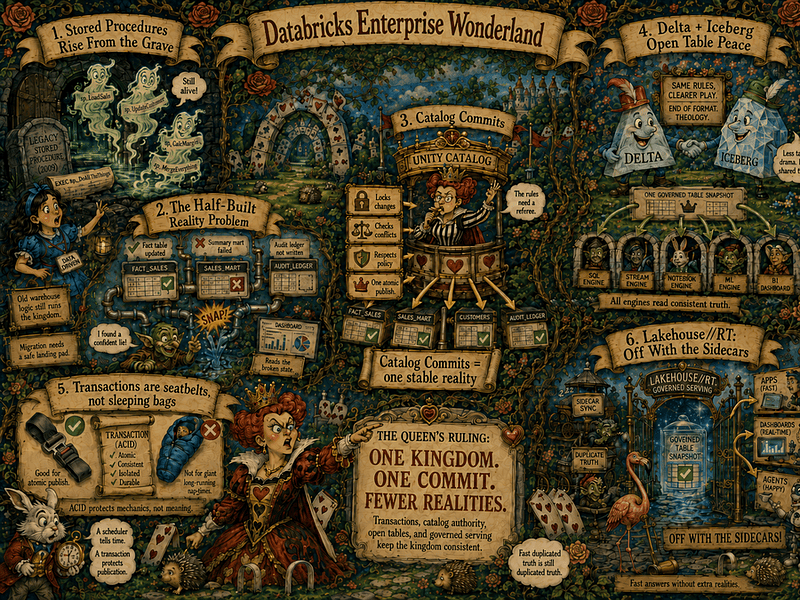
Databricks Enterprise Wonderland, where stored procedures rise from the grave, table formats make peace, and the Queen finally declares: one kingdom, one commit, fewer realities.
🐢 The Old Warehouse’s Story
The Mock Turtle is one of Wonderland’s strangest creatures: part memory, part sadness, part performance art. He tells a story about a world that sounds almost reasonable until you listen closely. There were lessons, rules, routines, and a whole educational system built on puns and melancholy. It’s absurd. It’s also weirdly coherent, because Wonderland has its own internal logic.
Legacy warehouses are like that. Half real. Half myth. And somehow still responsible for Finance.
A lot of AI-readiness work is not greenfield. Greenfield is clean. Greenfield has architecture diagrams with white space, rational naming conventions, and no overnight batch process running under a service account everyone is afraid to disable.
The enterprise is not greenfield. It’s hauntedfield. Behind every ambitious agentic roadmap sits an older estate: Teradata, Oracle, Netezza, SQL Server, Snowflake, Informatica jobs, FTP folders, hand-built reconciliation scripts, dashboards nobody dares retire, and extracts that still move because a business process somewhere learned to depend on them.
Before the lakehouse can become the operating system for agents, apps, and real-time workflows, the old warehouse has to tell its story.
That’s where LakeBridge belongs. Migration is not glamorous. It’s archaeology with invoices.
Migration Is Not Moving Boxes
The naive migration plan sounds dangerously reasonable. Move the tables. Convert the SQL. Repoint the dashboards. Turn off the old platform. Celebrate.
This is how migration programs become budget bonfires. A real warehouse migration is not moving boxes. It’s discovering that one of the boxes is load-bearing.
That report nobody opens? The CFO reads it once a quarter.
That table with no recent writes? It feeds a downstream extract used by a partner contract.
That abandoned dashboard? It’s how Risk verifies a month-end adjustment before signing off.
That transformation nobody owns? It encodes a business exception everyone forgot was negotiated during a crisis three reorganizations ago.
👑 Migration is institutional memory extraction.
The job is not simply to copy assets from one platform to another. The job is to understand which assets matter, what they mean, who depends on them, how they behave, and whether they deserve to survive.
👑 That’s why LakeBridge has to be more than a conversion tool. A serious modernization path needs discovery, assessment, dependency mapping, prioritization, translation, validation, migration, and only then decommissioning.
Skip the middle, and the ghosts come with you.
The Legacy Accent Problem
Every legacy warehouse claims to speak SQL. Technically true. Emotionally misleading.
Each system has its own accent. One handles nulls one way. Another treats dates like a philosophical exercise. One uses proprietary functions. Another has casting rules that look innocent until they change a number during reconciliation. Recursive queries, window behavior, timestamp handling, string comparison, decimal precision, collation, and time zones all vary just enough to ruin a weekend and several reputations.
👑 This is where migration becomes semantic, not syntactic. A simple text conversion can translate the words and still lose the meaning.
LakeBridge’s job is to help preserve intent: not merely “What did this query say?” but “What business behavior was this query protecting?”
That distinction matters because legacy systems are often wrong in familiar ways. They may truncate values silently. They may use old fiscal calendars. They may apply regional logic inconsistently. They may count records differently because a source system changed in 2017 and nobody updated the documentation.
When the new system produces a different number, the immediate question is not always: What did the migration break?
Sometimes the better question is: What did the old warehouse get away with?
The Dependency Graph Was Hiding in the Walls
Legacy systems rarely fail because nobody moved enough tables. They fail because nobody understood the relationships.
The real architecture is usually not in the official documentation. It’s scattered across query history, scheduler logs, BI usage, old tickets, access patterns, export jobs, personal notebooks, team folklore, and the memory of one veteran analyst who has been “meaning to document it” since 2016.
This is why dependency discovery is the heart of migration.
Which reports are actually used? Which tables are read by critical jobs? Which columns appear in joins? Which dashboards drive executive decisions? Which extracts feed external partners? Which workloads can be retired? Which ones only look unused because they run quarterly?
LakeBridge’s value is in surfacing this hidden graph before the migration becomes a demolition project with a cheerful status report.
👑 You cannot modernize what you have not mapped.
And you definitely should not let an AI agent generate new workflows on top of a warehouse estate whose dependency graph is mostly vibes and old meeting notes.
Stop Thinking in Tables
A classic migration anti-pattern is bragging about object counts: We migrated 4,000 tables this quarter!
Lovely.
Can the business close the books? Can the revenue dashboard be trusted? Can the risk model train? Can the old warehouse bill go away? Can anyone retire the duplicate platform without breaking a process that only runs on the third business day after month-end?
If not, congratulations. You moved furniture around a burning house.
LakeBridge points toward a better pattern: use-case-led slicing.
- Pick a high-value business outcome. An executive revenue dashboard. A core finance mart. A customer segmentation product. A risk reporting workflow. A model training dataset.
- Then trace the full dependency chain back to the sources. Migrate that slice. Validate it. Get the business to sign off. Operationalize it. Retire the corresponding old assets.
- Then move to the next slice.
This builds trust because the business sees working outcomes, not migration theater. It also prevents teams from spending months relocating unused sediment while critical logic remains trapped in the old estate.
👑 The goal is not to move tables. The goal is to move trust.
Reconciliation Is a Social Process
Nobody trusts a migration because the code compiled. They trust it because the numbers match. Or, more accurately, because everyone understands why the numbers don’t match.
Reconciliation is where migrations usually bleed time. Schema comparisons, row counts, distinct values, null rates, distributions, aggregates, slowly changing dimensions, and end-to-end dashboard parity all matter.
👑 But the technical checks are only half the story. The other half is social.
Finance needs to understand the variance. Sales needs to recognize the customer logic. Risk needs evidence. Compliance needs lineage. Data owners need enough detail to challenge the result instead of being asked to rubber-stamp a screenshot.
A reconciliation report that only engineers can read is not a migration artifact. It’s a hostage note in spreadsheet form.
The lakehouse has to earn trust in public. That means validation outputs should be readable, reviewable, and tied to business meaning. When the new platform differs from the old one, the team should know whether the difference is a migration bug, a known legacy defect, a source-system timing issue, a time-zone correction, or a long-overdue improvement.
The best part is that these reconciliation checks shouldn’t disappear after cutover. They should become permanent data quality rules.
Migration validation becomes future governance. Very adult. Slightly suspicious. Extremely necessary.
Decommissioning: The Part Everyone Avoids
A migration is not complete when the new platform works. It’s complete when the old platform is retired. Until then, you have not migrated. You have duplicated.
Permanent dual-running is one of the most expensive forms of denial. It means double licensing, double governance, double reconciliation, double incident paths, duplicate access models, and two places where truth can rot while everyone politely calls it a transition period.
The old warehouse will not retire itself. Someone has to freeze assets. Move users. Cut over workloads. Validate replacements. Turn off extracts. Cancel licenses. Archive what matters. Delete what does not. And, most painfully, decide that some things should not be migrated at all.
Do not preserve garbage with perfect fidelity.
- If a table has no owner, no readers, no freshness requirement, and no defensible business purpose, it may not be a data asset. It may be sediment with a schema.
- If a report has not been opened since 2018, perhaps the kingdom can survive without embalming it.
- If a workflow exists only because nobody was brave enough to ask why, retire it with dignity.
The goal is not to pack every ghost carefully into the future. The goal is to let the old warehouse finish its story.
🦞 The Real-Time Quadrille
In Alice’s Wonderland, the Lobster Quadrille is not just a dance. It’s choreography. Everyone has to move in sequence. The partners change places. The timing matters. If one dancer drifts, the whole thing becomes less “elegant seaside performance” and more “seafood incident with witnesses.”
That’s real-time architecture. For years, companies treated real-time like a speed sticker. Add Kafka. Add a stream processor. Add a fast serving store. Add a dashboard refresh. Add five more arrows to the diagram. Call it modern.
👑 But real-time is not random speed. It’s coordinated movement.
Events have to enter the platform cleanly. Transformations have to process them within an actual latency budget. Serving has to answer quickly without copying truth into a second kingdom. Governance has to survive the whole dance.
That’s the real-time chain:
- Zerobus ingests.
- Spark Real-Time Mode computes.
- Lakehouse//RT serves.
Fresh events in. Low-latency processing in the middle. Fast governed answers out. Anything else is just a lobster wearing running shoes.
Zerobus: The Best Bus Is No Bus
There are two kinds of data engineers: those who have had Kafka problems, and those whose Kafka problems are still loading.
Kafka is one of the most successful pieces of data infrastructure ever built, which also means millions of people have suffered professionally in a very consistent way. Offsets, retention, consumer groups, lag, rebalancing, exactly-once semantics — it starts as “we just need to ingest some events” and ends with a platform team investigating why one topic is crying with 800 partitions.
So Zerobus is tempting. The best bus is no bus.
But Kafka is not dead. Some architectures truly need a distributed event backbone with replay, multiple consumers, and complex operational semantics. Others mostly need to push events into the lakehouse, and Kafka became the available hammer.
Zerobus is aimed at that second category.
Traditional real-time ingestion into a lake often becomes a relay race: producers publish to a broker, another job reads from it, and then another layer finally lands the data. Every hop adds tax: infrastructure, credentials, logs, latency, governance gaps, and another place for the raccoon to hide.
Zerobus changes the pattern with a managed push-based gateway. Producers send events directly through gRPC, REST, or OpenTelemetry, and the service handles buffering, basic schema validation, and delivery into Unity Catalog-governed Delta tables.
That matters because telemetry is no longer just observability exhaust. Logs, metrics, traces, tool calls, token usage, and agent execution trails are becoming governed data. In the agentic era, debugging the robot is also a data engineering problem.
👑 Still, removing the broker does not remove distributed systems physics. At-least-once delivery means duplicates are part of the contract.
Producers need event IDs, timestamps, sequence discipline, and downstream deduplication logic. Schema enforcement becomes a live API boundary, not just storage decoration. And the small-file goblin still lurks: high-velocity ingestion needs buffering, batching, and smart layout management so real-time tables do not turn into confetti.
Zerobus gets the dancers onto the floor. It doesn’t teach them all the steps.
Spark Real-Time Mode: The White Rabbit Gets a Stopwatch
Real-time is one of those phrases that should make every data engineer immediately suspicious. Not because real-time is bad. Because people use it like glitter: everywhere, and without adult supervision.
A dashboard that updates every five minutes becomes real-time. A daily batch with an ambitious product manager becomes business real-time. A spreadsheet edited after lunch becomes operational intelligence.
So before Spark Real-Time Mode enters the dance, set the boundary.
*👑*Real-time is not a vibe. It’s a latency requirement with numbers attached.
If the deadline cannot be stated in p50, p90, and p99 latency from source to sink, the architecture is only real-time until the first post-mortem.
Real-time matters when the value of data decays fast enough to hurt. Fraud detection after authorization is historical sadness. An operational agent acting on stale context is a meeting with Legal wearing a chatbot costume.
This is where Spark historically had a gap. Spark is excellent for high-throughput batch and streaming, but micro-batching carries coordination overhead: planning, scheduling, shuffling, committing, and checkpointing. That’s fine for seconds or minutes. It’s not fine when the deadline is measured in milliseconds.
Spark Real-Time Mode tries to close that gap without forcing teams into a separate streaming universe. It works under the same Structured Streaming APIs developers already know, but instead of treating a stream as an endless parade of tiny batches, it keeps long-running execution stages active and moves data continuously between them.
👑 Less waiting for batch boundaries. Less stop-start overhead. Lower latency through the pipeline.
The bigger win is architectural simplicity. The same Spark model can support offline training, streaming features, and low-latency inference paths without copying business logic into a second real-time stack that only three people understand, one of whom is on vacation.
But low latency is still a contract with physics. The p99 tail is where the monsters live. Average latency is where bad engineering hides. A pipeline that averages 10 milliseconds but spikes to 8 seconds at p99 is not operationally real-time. It’s a trap with a nice mean.
Fast processing also doesn’t fix late data. If a mobile app buffers an event offline and sends it hours later, the system may process it instantly and still produce the wrong business answer.
👑 Stateful streaming is the heavyweight fight: rolling risk scores, sessions, customer state, memory pressure, TTLs, checkpointing, recovery, and durable state all matter.
Real-time is not batch with better shoes. It’s choreography under pressure.
Lakehouse//RT: The Final Performance
Every data architecture eventually hits the same wall: The lakehouse is great, but this use case needs to be fast.
That’s when the sidecar appears. At first, it is innocent: a cache, a dashboard index, a specialized real-time engine, a custom aggregate service. Then one day, the sidecar is no longer a sidecar. It’s a second motorcycle with its own driver, fuel tank, governance model, sync logic, and cloud bill that Finance now depends on.
That was the old bargain: the lakehouse holds governed data, and the sidecar holds fast data. Everyone hated the deal. Everyone signed it anyway.
Lakehouse//RT attacks that compromise directly: What if teams stopped copying data into separate systems just to make it fast?
Serving sidecars charge three taxes.
- The duplication tax: copied data drifts.
- The governance tax: masking rules, row filters, and access policies may not survive the trip.
- The engineering toil tax: someone has to build, monitor, tune, patch, and explain the sync layer forever.
Lakehouse//RT tries to move fast query serving back onto governed Delta and Iceberg tables. The point is not merely benchmark speed. The point is where the speed happens: closer to the governed data, without forcing teams to create another reality for dashboards, applications, and agents.
That matters because the new low-latency consumer is not only an impatient BI user clicking filters with coffee in hand. It’s the query goblin.
Agents loop, inspect, retry, branch, cross-check permissions, and ask follow-up questions at machine speed. A single agentic session can hit the warehouse thousands of times while completing one operational task.
That changes the job of the warehouse. It’s no longer just the backend for reporting. It’s becoming part of the application runtime. And the query goblins are hungry.
The Chain, Not the Sticker
The important idea is the chain.
- Ingest: Zerobus gets events into governed tables without forcing every team to run a broker just to land analytical events.
- Compute: Spark Real-Time Mode processes those events with lower latency while keeping logic closer to the Spark and Unity Catalog control plane.
- Serve: Lakehouse//RT serves the resulting tables quickly to dashboards, applications, and agents without automatically reaching for sidecar copies.
That sounds simple because good architecture usually does after someone else has paid for the complexity. But the chain only works if every link has contracts.
Events need IDs, schemas, timestamps, and producer discipline. Processing needs latency budgets, event-time rules, watermark policies, state management, and p99 monitoring. Serving needs query guardrails, concurrency limits, row limits, cost throttles, and semantic discipline.
Governance has to travel from entry to execution to answer. Otherwise the dance becomes a mess: fast ingestion into slow gold tables, low-latency processing into stale caches, fast serving over duplicated truth, or agents querying fresh nonsense at heroic speed.
👑 Real-time intelligence is not the same as real-time ingestion. Fresh rows are not fresh decisions.
️ ☠️ ️ Who Poisoned the Metric?
In Wonderland, the trial begins with certainty and immediately collapses into nonsense. The tarts are missing. The court wants a culprit. The witnesses are strange. The evidence is questionable. The King reads rules that may or may not apply. The Queen is ready to shout before anyone understands what happened.
Enterprise data incidents feel familiar. Something is wrong. A number changed. A dashboard refreshed successfully. A pipeline is green. A model consumed the output. An agent summarized the result. A VP made a decision. And now everyone is standing in the courtroom asking the most cursed question in data engineering: Can someone explain why the number changed?
In the old world, the question was often: Why did the job fail?
In Wonderland, the better question is: Who stole the truth from the metric?
Data Failures Are Silent Witnesses
Software usually fails loudly. A service throws a 500. A deployment crashes. Logs scream. Rollbacks trigger. Someone opens an incident channel and performs the ritual of screenshots.
👑 Data fails differently. Data fails quietly.
A pipeline can run perfectly and still send poisoned metrics downstream. A DAG can turn green while the business truth turns purple. A dashboard can refresh on time and still lie with excellent formatting.
That’s why data operations is more treacherous than ordinary software operations. The failure is rarely sitting politely inside one broken code block. It lives across schema drift, missing lineage, stale assumptions, statistical anomalies, source changes, undocumented business rules, and the terrifying phrase “this has always worked.”
A coding assistant can fix syntax. A data operations agent has to build a case.
What changed? Where did the corruption begin? Which downstream tables, dashboards, features, and agent context scopes are affected? Is this a real anomaly or a business cycle? Is the fix safe? Did the proposed repair create a second problem wearing a nicer hat?
The point is not merely to patch the pipeline. The point is to prove the lake was not poisoned in the process.
Genie ZeroOps: The Queen’s Guards
Genie ZeroOps matters because faster creation also means faster incident creation.
LakeFlow Designer, Genie Code, SQL AI Functions, and agent-assisted workflows make it easier to produce data assets.
Useful? Absolutely. Safe by default? Not unless operations scales with creation.
👑 Productivity without operations is just accelerated entropy.
The Queen needs guards.
ZeroOps is interesting because it treats operations as an evidence loop, not an alert cannon. When a signal fires, it should not simply shout “something broke” and leave humans to perform spreadsheet forensics. It needs to detect, trace, propose, sandbox, validate, and only then ask for approval.
👑 Detection has to go beyond red jobs.
A green pipeline can still produce bad data. So the system has to look for the quiet crimes: volume shifts, null spikes, duplicate explosions, schema mutations, distribution drift, freshness problems, and unexpected sensitive data appearing where it has no business wearing a badge.
👑 Root cause is a lineage walk. When a gold table breaks, it’s usually the victim, not the murderer. The investigation has to walk backward through Unity Catalog lineage to find the upstream change, then walk forward to measure the blast radius.
A broken sandbox table is annoying. A poisoned executive metric is a royal incident.
👑 Validation belongs in a sandbox.
You cannot validate a serious fix on three mock rows and a prayer. The proposed repair needs to run against real distributions, edge cases, and scale, without poking the live kingdom with a fork.
Zero-copy shallow clones make that possible: test the fix in a safe branch, rerun the pipeline, compare outputs against contracts and historical behavior, and produce evidence before production is touched.
Then comes the drawbridge. The final output should not be an agent casually rewriting production while whistling. It should be an auditable pull request with the code diff, validation results, lineage impact, cost estimate, and rollback plan.
👑 The agent can prepare the case. The human still lowers the drawbridge.
SQL AI Functions: The Evidence Gets a Small Brain
SQL used to be innocent. It selected columns, joined tables, filtered rows, and occasionally did a window function when it wanted to feel athletic.
Then AI arrived, and suddenly SQL started asking stranger questions: summarize this contract, classify these tickets, extract invoice fields, mask free-text PII, detect sentiment, parse documents, and turn unstructured context into structured data.
Congratulations. Your SELECT statement has opinions now.
SQL AI Functions matter because they move model inference into the data plane. Instead of wrapping every AI transformation in custom Python orchestration, teams can treat inference like a production transformation:
input column ➜ AI function ➜ governed output column
That is powerful. It also changes the evidence rules.
Traditional ETL is mostly deterministic. Same input, same code, same output. AI-driven ETL is probabilistic. When business logic lives inside a prompt, prompt engineering becomes software engineering. A careless instruction scaled across a million records can manufacture distributed nonsense at premium cloud prices.
So the court needs receipts.
Task-specific AI functions are the safer starting point because they narrow the behavior: classification, translation, sentiment, summarization, extraction. General-purpose model calls are more flexible, but they require stricter contracts: structured outputs, versioned prompts, constrained parameters, materialized results, quarantine paths, confidence scores, and regression tests.
Don’t run expensive AI functions live inside every dashboard query unless Finance enjoys surprise theater. Materialize first. Serve later.
And every AI-enriched table needs breadcrumbs: model endpoint, prompt version, run ID, input hash, timestamp, confidence score, and error state. If an auditor asks why an invoice was flagged, “the model vibes were strong” is not an acceptable lineage story.
Documents Enter the Courtroom
Contracts, claims, emails, PDFs, call transcripts, support tickets, policies, and scanned forms used to sit outside the structured data estate like suspicious boxes in the attic. Now they are evidence.
SQL AI Functions pull those documents into the Medallion architecture.
🥉 Bronze preserves the original source: raw file, immutable hash, ingestion timestamp, source ACLs, classification tags, and provenance. Don’t summarize away the evidence before the evidence is governed.
🥈 Silver is the extraction gate: parse layouts, extract fields, normalize JSON, capture confidence scores, and route broken outputs to quarantine.
🥇 Gold is the trusted product: only validated extractions become analytics, dashboards, vector indexes, or agent context.
That’s how documents stop being mysterious blobs and become governed data products.
But probabilistic plumbing needs stricter rules than normal ETL. JSON has to be a contract. Missing fields should become clean nulls, not friendly prose. Low-confidence results need human review. Prompt and model changes need regression tests because yesterday’s extraction may not match today’s model behavior.
👑 AI can help produce evidence. It cannot be allowed to invent the courtroom record.
Lakewatch: The Queen’s Watchtower
Lakewatch belongs in this chapter because security is also an evidence problem. This is not suddenly a cybersecurity article. This is still data engineering. That’s exactly the point.
Modern enterprises are telemetry volcanoes: cloud trails, network events, Kubernetes logs, application signals, identity records, LLM prompts, tool calls, token usage, retrieval traces, and agent execution trails erupting from every corner of the stack.
Traditional Security Information and Event Management (SIEM) economics often made teams ration reality. Drop noisy sources. Shorten retention. Sample logs. Filter before ingesting. Keep only the evidence the invoice allowed.
That creates a dangerous asymmetry. Attackers can use AI to search broadly. Defenders see the thin slice of telemetry they could afford to keep.
👑 You cannot defend what you didn’t ingest because the bill scared you.
Lakewatch reframes security operations as lakehouse architecture wearing night-vision goggles: ingest broadly, store cheaply, normalize consistently, govern properly, and query fast when everyone is already panicking.
Raw logs alone are not enough. A volcano still needs plumbing.
That’s where Open Cybersecurity Schema Framework (OCSF) matters. One system says user, another says principal, another says actor. OCSF gives security telemetry a common shape so analysts, detections, and agents can query consistently.
Normalize once. Investigate everywhere.
Detection-as-Code and Badged Agents
Security detections shouldn’t be magical queries living inside a proprietary UI maintained by someone who left three reorganizations ago. They’re production logic.
That means they deserve software engineering discipline: Git, review, testing, backtesting, rollback, and CI/CD. Detection-as-Code brings data engineering practice into the SOC. Rules can be written, versioned, tested against historical logs, promoted carefully, and audited like serious production assets.
This matters even more when agents enter security operations. Genie-powered sub-agents can help triage alerts, summarize incident timelines, correlate years of cold telemetry, and hunt across messy data faster than a human analyst opening seventeen tabs while losing the will to live.
But badged agents need leashes. A security agent with unrestricted tool access is not innovation. It’s a compliance incident with a badge.
One careless tool call can launch a petabyte-scale query, burn a small moon of compute, or trigger an automated response that isolates the wrong production system.
Security agents need the same discipline as operations agents: least privilege, scoped tools, hard cost limits, audit trails, simulation spaces, and human approval before response actions touch the kingdom.
The Evidence Layer for Enterprise AI
ZeroOps, SQL AI Functions, and Lakewatch all point to the same conclusion: the lakehouse is becoming the evidence layer for the enterprise.
- Data quality incidents need lineage, telemetry, statistical checks, sandbox validation, and human-approved remediation.
- AI transformations need prompt versions, model metadata, confidence scores, output schemas, quarantine paths, and reproducibility.
- Security investigations need normalized telemetry, long retention, detection-as-code, cross-domain context, and controlled agents.
- And agent systems need all of it.
Because when an agent produces a wrong answer, the root cause may not be “the model hallucinated.” It may be stale context. A bad extraction. A broken metric. A missing ACL. A dropped log source. An untested prompt change. A schema drift. A duplicated table. A silent upstream incident wearing a green checkmark.
👑 The future question is not just whether the output is plausible. The question is whether the platform can prove where it came from.
⚖️ The Queen’s Evidence
In the final chapter, Alice stops being impressed by the court. The trial has rules, costumes, witnesses, scrolls, accusations, and an enormous amount of procedural confidence. But eventually she sees through it. The grandeur doesn’t make the evidence better. The shouting doesn’t make the judgment smarter. The Queen’s authority doesn’t make the deck of cards less ridiculous.
That’s the right place to end this story. After all the pipelines, catalogs, agents, real-time engines, AI functions, governance layers, and royal decrees, the question is not whether the architecture sounds impressive. The question is whether the evidence holds.
Can the business survive a regional outage?
Can data products cross company borders without turning into unsecured CSV confetti?
Can customer profiles become actionable without copying sensitive identity data into yet another marketing silo?
Can agents operate on trusted context rather than elegant nonsense?
Can the platform prove what happened, who changed it, which policy applied, and why the answer should be believed?
That’s the final test of Databricks’ Enterprise Wonderland. Not the keynote. The evidence.
Managed Disaster Recovery: The Emergency Drill
Data engineering is not just building pipelines. It’s keeping the business alive when the cloud has a bad day. And clouds do have bad days. Regions wobble. Control planes misbehave. Identity systems get creative. Suddenly the architecture diagram that looked elegant in review becomes a hostage situation with icons.
This is where Disaster Recovery (DR) stops being compliance theater and becomes an operational question: Can the business still run?
Not after three heroic engineers spend 48 hours reconstructing the data plane from obsolete Terraform modules, Slack screenshots, and the emotional remains of a runbook. Right now.
A backup asks: Can I get the data back?
Disaster recovery asks: Can I get the workload back?
That distinction matters because a lakehouse workload is not just Parquet files in object storage. It includes metadata, catalogs, permissions, jobs, notebooks, dashboards, SQL warehouses, views, service principals, alerts, network paths, and the small forest of configuration that makes the data usable.
If only the files survive, you have not built a failover system. You have built a data museum. Beautiful artifacts. No working city.
Managed Disaster Recovery matters because lakehouse workloads are no longer casual analytical experiments. They support financial reporting, fraud models, security detections, customer applications, and autonomous agents that expect the platform to be alive because they don’t understand the phrase “the region is sad.”
The real language of DR is pain measured in two numbers.
- Recovery Point Objective (RPO): How much data can the business afford to lose?
- Recovery Time Objective (RTO): How long can the workload be down?
Different assets deserve different answers. A real-time fraud feature may need near-zero tolerance. A weekly sandbox report can sit quietly in the corner and learn patience. Not everything deserves active-active royal carriage treatment. But every workload deserves an explicit tier, not accidental neglect wearing a cost-optimization hat.
Managed DR is important because it treats the lakehouse as a bundle: data, metadata, and executable memory. Unity Catalog state, table definitions, access grants, row filters, functions, jobs, notebooks, dashboards, and critical workspace assets need to move together. Otherwise failover becomes archaeology. And archaeology is not a recovery strategy.
Stable connection URLs are the unsung adult in the room. During a disaster, nobody wants to manually update every BI tool, JDBC connection, application endpoint, and downstream consumer while the business is yelling in multiple channels. A stable failover endpoint turns regional recovery from a scavenger hunt into a controlled switch.
👑 But DR has a nasty catch. It protects against regional failure. It doesn’t protect against stupidity replicated at high speed.
If a broken pipeline, bad prompt, rogue agent, or corrupted upstream source writes poison into the primary environment, replication may faithfully carry that poison to the secondary region with excellent reliability.
The backup castle can also be haunted. So DR needs drills, time travel, quality checks, write guardrails, and failback rehearsals.
👑 A plan that has never been tested is not a plan. It’s a bedtime story wrapped in YAML.
OpenSharing: Data Products Need Passports
A data product that cannot be shared is not always a data product. Sometimes it is just a table with stage fright.
Modern data doesn’t stay inside one workspace, cloud provider, region, or vendor ecosystem. Supply chain data crosses to partners. Retail data goes to brands. Financial data faces regulators. Security signals join threat intelligence networks. AI assets may need to travel with their semantic instructions, not just their rows.
👑 External sharing is not a postscript. It’s distribution infrastructure. And distribution infrastructure is data engineering.
The old world of sharing was a tax trap: nightly exports, SFTP servers, copied files, stale replicas, credential rotation, firewall tickets, manual access reviews, and enough CSV sediment to make a data steward quietly stare out a window.
OpenSharing is the passport office for this mess.
The important idea is not merely zero-copy access, though that matters. It’s governed distribution: sharing live assets while preserving identity, permissions, contracts, lineage, and usage controls.
Delta Sharing established the foundational premise: let external consumers access live data without forcing everyone into the same vendor platform or copying raw files across the kingdom. OpenSharing extends that idea into a broader agentic and multi-format world.
The shared asset is no longer only a table. It may be a Delta table. An Iceberg table. A Parquet-backed asset. A federated external catalog. A semantic metric. A model. A prompt skill. A Genie Agent.
That last one changes the whole game. A shared agent is a data product with a mouth. Instead of handing a partner raw tables and hoping they understand your schema, metrics, caveats, and corporate folklore, you can package a governed conversational interface that answers through certified business logic.
Powerful. Also terrifying. If the underlying data product is messy, the agent will not hide the mess. It will broadcast it with perfect grammar and unearned confidence.
External agents need strict quotas, row limits, refusal behavior, prompt-injection defenses, audit logs, and contractual boundaries. A shared agent should not become a charming tunnel into your internal confusion.
SecureConnect solves another deeply unglamorous pain: networking friction. External sharing often dies in firewall tickets, subnet wrangling, IP allowlists, and storage exposure debates. A managed secure proxy turns the border crossing into infrastructure rather than a three-month calendar event.
Global Distribution addresses the economics. Zero-copy is wonderful until cross-cloud egress and latency start eating the product margin. Managed regional replicas can be cheaper and faster, but only if they preserve lifecycle synchronization, lineage, and access semantics.
The Queen’s rule is simple: data products need passports. Not smuggler routes. Not SFTP folklore. Not temporary exports that outlive entire departments.
👑 A shared product needs a contract: allowed uses, freshness, semantic definitions, SLAs, cost model, residency rules, revocation behavior, and named ownership.
Without that, sharing is not openness. It’s professionally formatted leakage.
CustomerLake: Customer 360 Without the Copy Machine
Customer 360 was supposed to be simple. One customer. One view. One trusted golden record.
Then reality arrived carrying twelve source systems, four identity graphs, three consent models, two campaign tools, a warehouse extract, a loyalty feed, a support system, a mobile app event stream, and a spreadsheet named like a cry for help.
Traditional CDPs were built to solve this mess. In practice, they often became another customer-data kingdom: another copy, another identity engine, another consent model, another export pipeline, another place for sensitive PII to live rent-free in a vendor contract.
CustomerLake is the domain-specific version of the lakehouse thesis.
If the enterprise already has governed customer data, ML features, consent history, event streams, and behavioral signals inside the data plane, why copy all of that into a separate SaaS silo just to activate it?
The CDP copy machine charges several taxes.
- The duplication risk tax: every customer copy expands the breach surface.
- The freshness tax: stale personalization is just nostalgia with a coupon.
- The identity drift tax: one platform’s golden record does not match another platform’s probabilistic identity graph.
- The governance drift tax: consent, masking, retention, and deletion rights may not travel cleanly.
- The pipeline toil tax: every campaign becomes another ticket, export, join, and reverse ETL ritual.
CustomerLake tries to keep the customer product where the evidence already lives.
- Bronze keeps the raw customer rumor mill: web events, retail transactions, CRM updates, consent events, support signals, and source records.
- Silver normalizes the chaos: emails, phones, addresses, identifiers, consent attributes, candidate matches, and quality checks.
- Gold materializes the managed opinion: profiles, households, certified attributes, segments, and activation-ready views.
That phrase matters: managed opinion. A customer profile is not an absolute truth handed down from the mountain. It’s a continuously updated platform opinion built from evidence, rules, confidence scores, human overrides, and policy constraints.
👑 Identity resolution is not magic. It’s high-stakes governance with math in it.
Over-merge profiles, and you combine people who should remain separate. Under-merge them, and you fragment the customer relationship. Either way, the business suffers. Sometimes the regulator notices. Sometimes the customer notices, which is often worse for the brand.
So CustomerLake needs audit fingerprints: which rule matched, which model scored, which source records contributed, what confidence was assigned, and whether a human approved the merge.
Consent lineage is even more important. Consent is not a boolean checkbox named marketing_consent = true. It depends on channel, region, purpose, timestamp, jurisdiction, source, and revocation history. If a customer opts out, that state must propagate through segments, campaigns, APIs, and downstream activation views quickly enough to matter.
Real-time profile APIs raise the stakes again. When CustomerLake supports continuous campaign loops and profile agents, the customer table stops being a reporting table. It becomes an operational serving product.
That means low-latency reads, permission-aware access, strict data contracts, consent evaluation, budget throttles, and one very important marketing control: Don’t be creepy at scale.
👸 Final Verdict: God Save the Queen, But Check the Evidence
So what is Databricks really building? Not just a lakehouse. Not just BI. Not just AI. A governed operating system for enterprise data, applications, security, sharing, and agents.
That’s ambitious. It’s also coherent.
The same idea keeps returning: data, metadata, permissions, lineage, quality, cost, and execution should live under one governed control plane.
But the promise only matters if the evidence holds.
Lineage must be trustworthy. Ownership must be real. Metrics must be governed. Prompts must be versioned. AI outputs must be tested. Agents need limits and audit trails. Disaster recovery needs rehearsal. Sharing needs contracts. Customer profiles need consent lineage. Real-time needs latency budgets. Sidecars need justification. Decommissioning needs courage. And humans still need to own the judgment.
The Queen may shout the loudest, but Alice knows ceremony is not evidence. The real test is not whether the demo is magical. It’s whether the system can prove itself when the tarts go missing.
And if you think this article got too long, excellent news: it is only the first half of the Databricks Summit 2026 story. The second part of the article will be out in a couple of days.
But don’t complain too much. You can always watch zillions of talks and extract your own conclusions. Good luck. 🍀
“Don’t be sold what you want
And don’t be sold what you need
There’s no shortcut, no shortcut
No shortcut to truth”
(adapted from “God save the queen” by Sex Pistols)
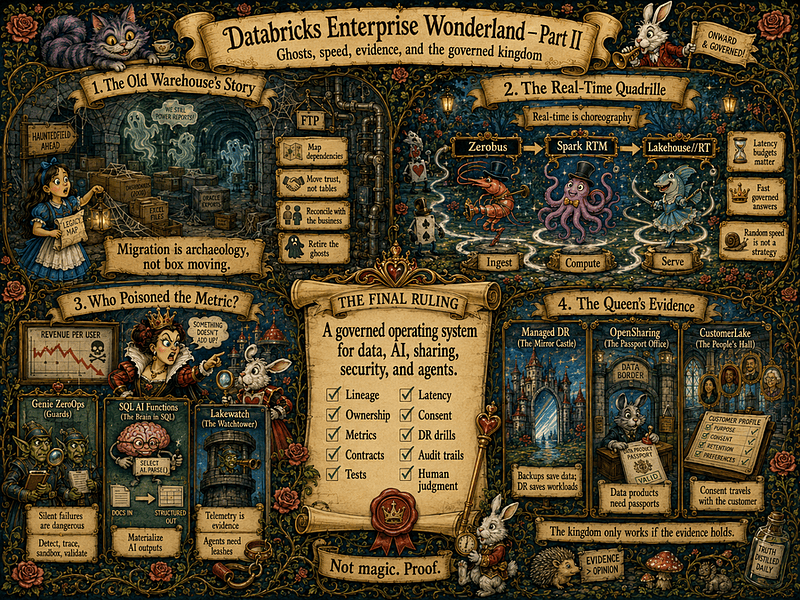
Databricks Enterprise Wonderland, Part II: where haunted warehouses get archaeology, lobsters learn latency budgets, poisoned metrics go on trial, and the Queen demands one thing from every magical demo: receipts.