🕵️ FGA 06: Who Let the Graphs Out? 🐶
From graph research to a testable, evidence-safe engine.
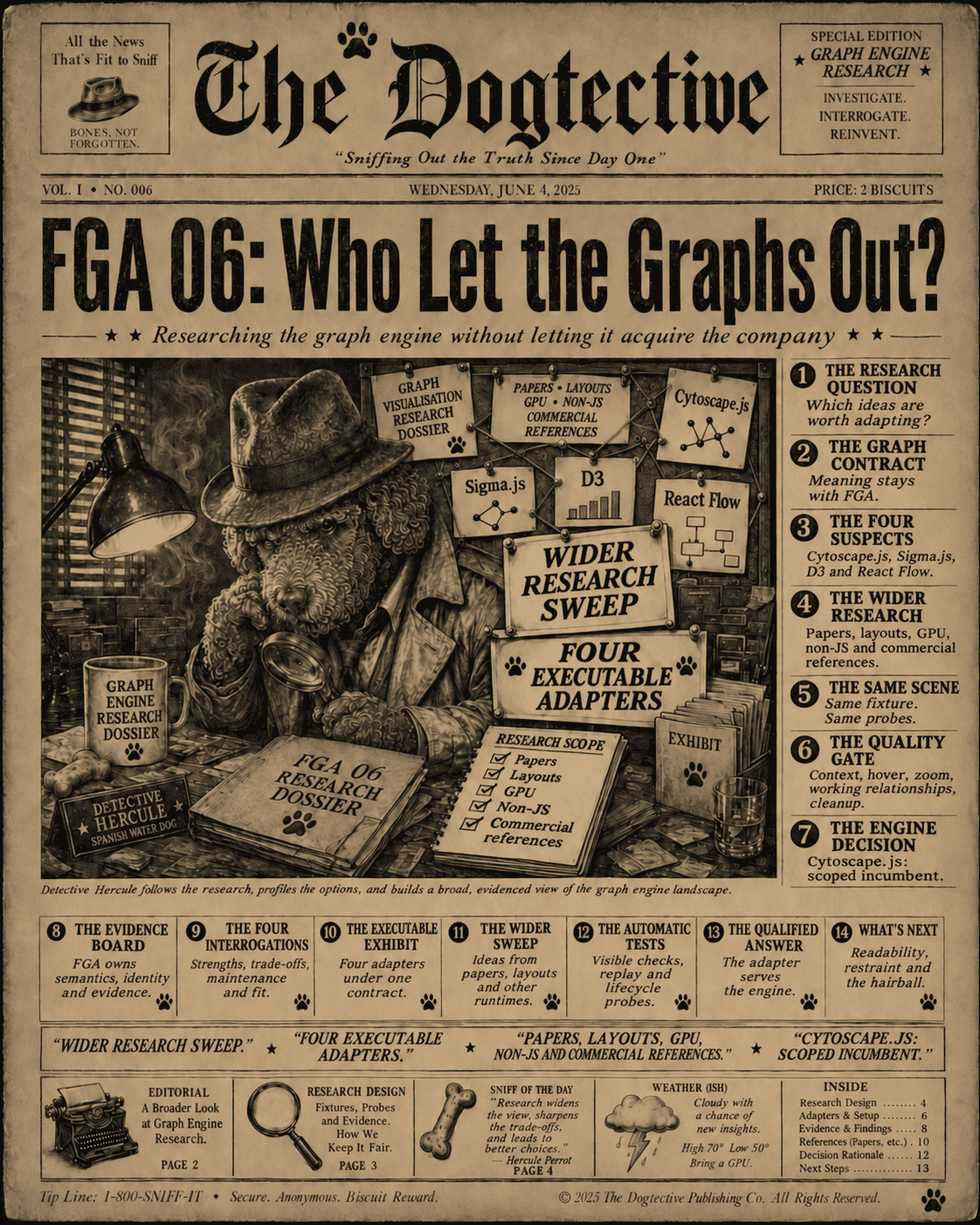
Hercule Perrot, Spanish Water Dog and part-time detective, put his paws on the desk. The case contained people, organisations, accounts and devices. It contained relationships that might matter. It contained a player who needed to follow a trail, inspect a clue, move a node out of the way and come back to it later.
The question on the first page looked harmless: which graph-visualisation library should FGA use?
Hercule read it again. That was the first trap. The real question was not which library could draw the prettiest network. It was which ideas, boundaries and rendering techniques could form a graph engine without allowing the renderer to become the owner of the case.
Our dog raised one ear. Four suspects entered the kennel. The rest of the research file stayed locked in the back room.
Part I — The Board With No Body
The first clue was not a node
FGA 04 had already answered what a record meant.
FGA 05 had answered where a qualified case could live.
Neither article had to decide how a player should look at the evidence once it became a playable investigation.
Hercule drew five questions on the empty board:
What is this record?
Why is it connected to that one?
Which direction does the relationship have?
Can I inspect it without changing the case?
Can I return to it after following another path?
Those questions were more useful than a library shortlist. They described the instrument the player needed: not a picture of a network, but a surface that could expose evidence without quietly changing its meaning. FGA would prepare a player-safe graph projection; the engine would render it and manage presentation state. A click, keyboard action or semantic-list selection would return an FGA identity. The renderer could draw the scene, but it could not decide who was allowed into it.
That boundary protected the first alibi in the file. A crowded neighbourhood was not a conviction. An account connected to a person was a displayed relationship, not proof of guilt. A shared address could deserve attention without merging two records into one person. A candidate-identity confidence score described a proposition about identity; it was not a fraud probability wearing a new hat.
The chain of custody had to stay visible: stable record identity, declared relationship type and direction, relationship family and provenance, then visual treatment.
What the board must protect
The graph had to be large enough to investigate—roughly two thirds of the board—without becoming a cockpit. Zoom, pan, fit, clear selection, filters, a collapsible legend and, when the network earned one, a minimap belonged in compact controls. The graph itself had to remain the protagonist.
The first sketch also exposed a visual problem. Colour alone could make a scene dramatic and still leave two states indistinguishable. People, organisations, accounts, devices and claim clusters needed type-aware glyphs. Investigation state needed more than colour:
uninvestigated	empty circle
candidate		dashed ring
investigated	ring or check mark
confirmed fraud	explicit symbol
discarded		neutral mark
An edge needed the same discipline. Direction, relationship type, evidentiary family, source, time and confidence might all matter. Weight, dashes, arrows, labels and opacity could report those distinctions. Detected relationships would remain continuous and immutable. An investigator-added relationship would be a removable dashed hypothesis, not a new fact.
Then Hercule moved the pointer over a node. A quick glance was useful, but essential evidence needed a persistent dossier and a semantic path. The interaction contract became simple: hover or keyboard focus opened a preview; click, tap or an explicit keyboard action promoted the target to the dossier; the active selection remained authoritative while another target was previewed.
The preview had to stay alive while the pointer crossed into it. Its actions were icons rather than tiny sentences:
+to mark−to unmark⌖to centre×only for an investigator-added relationship
The first prototype failed exactly there. The card vanished in the gap. A menu that disappears while the user reaches it is not a menu; it is a witness refusing to testify.
Camera state and graph state also needed separate rooms. Dragging a node changed its working position. Dragging empty space panned. The wheel zoomed around the pointer. Fit and centre moved the camera only. A camera that changed the evidence was a tampered scene.
Finally, selection had to leave the renderer alive. The application would store FGA node and relationship identities, not CytoscapeElement, SigmaNode, ReactFlowNode or D3SimulationNode. The native object could stay behind the adapter. The case file could not.
Part II — The Four Suspects
A lineup, not a leaderboard
Hercule brought four open-source candidates into the light.
The candidate matrix fixed their versions and their obligations. The renderer qualification exhibit placed each graph in a full-size tab, keeping every renderer’s output and lifecycle evidence separate. It was a renderer lab, not the playable example gallery embedded below.
| Tool | Role in the qualification | Version |
|---|---|---|
| Cytoscape.js | Conditional normative incumbent | 3.34.4 |
| Sigma.js | Comparison candidate | 4.0.3 |
| D3 | Comparison candidate | 7.9.0 |
| React Flow | Comparison candidate | 12.12.0 |
Four was not the size of the research. It was the number of renderers wired into one executable qualification contract. The wider research dossier covered viewers, primitives, diagram frameworks, layouts, graph analysis, academic work, accessibility, commercial products and non-JavaScript ideas; the feature build plan turned that reading into an FGA-owned architecture. The SVG baseline stayed in the room as a semantic fallback, not a fifth candidate.
The stranger in the good suit
The commercial suspect arrived polished.
yFiles and GoJS demonstrated mature context menus, layouts, routing, grouping, undo, overview navigation and professional tooling.
Neo4j Bloom showed how search and exploration could reduce the blank-canvas problem.
Hercule took notes. Good ideas did not become dependencies merely because they arrived wearing expensive shoes.
| What a commercial component could bring | What comes with it |
|---|---|
| Mature APIs, layouts, routing and support | Licence cost, deployment terms and redistribution limits |
| Less generic graph infrastructure to maintain | Vendor lock-in, upgrades and procurement review |
| Polished editing, overview and property-browser features | Fit with FGA semantics, accessibility and public artefacts is not guaranteed |
FGA is open-source and non-commercial. The features were worth studying; the package stayed outside the evidence bag because its legal and distribution weight had not earned a place in the game.
The commercial detour over, Hercule put the four open-source candidates under the same lamp. The question was not simply “Can it draw?” but “What does it make FGA own?”
Cytoscape.js under interrogation
Cytoscape.js spoke naturally in first-class nodes and edges, graph-oriented styling, interaction events and a broad layout ecosystem. Its weakness was the doorway: because its API was not React’s component model, FGA still had to qualify lifecycle, resize, selection translation and cleanup. Strong graph vocabulary was evidence, not a free pass.
Sigma.js under interrogation
Sigma.js arrived with a faster car. Its interactive network pipeline and Graphology data model made WebGL-scale exploration interesting. The hard questions were picking, label budgets, accessibility, exact version pairing, application-owned selection and cleanup.
D3 under interrogation
D3 refused to give a fixed alibi. Selection, zoom, drag and force simulation offered freedom for a bespoke board, but left FGA to own more geometry, hit testing, overlays, lifecycle, accessibility and tests. That was not a defect; it was the bill for choosing primitives instead of a component.
React Flow under interrogation
React Flow brought a polished editor: React components, selection, viewport controls, dragging and a minimap. Its evidence was ergonomic rather than graph-native. FGA’s network was an exploratory evidence board, not a node editor, so larger graphs and external layout semantics could demand more custom work.
Community acceptance supplied another set of fingerprints. Stars and downloads were clues, not architecture. Release cadence, documentation, issue and pull-request activity, maintainer continuity, security history, integrations, browser support, exit cost and recurring complaint classes mattered because they changed the maintenance bill.
| Candidate | Signal to verify | Consequence for FGA |
|---|---|---|
| Cytoscape.js | Mature vocabulary and ecosystem; labels, memory, updates and GPU paths still need checking | Qualify labels, cleanup and the exact workload behind the adapter |
| Sigma.js | Coherent network pipeline; picking, label buffers and teardown deserve scrutiny | Pair exact Sigma/Graphology versions and test pointer work |
| D3 | Durable ecosystem, but primitives rather than an investigation component | Count FGA’s accessibility and long-term maintenance bill |
| React Flow | Strong React ergonomics; large-graph state and DOM cost remain questions | Qualify subscriptions, rich nodes, layout fit and editor-model cost |
The table was not a popularity ranking. It was a list of questions that could become maintenance work later.
The result was not a popularity verdict. It was a dated record of what each suspect did well, what each left behind and how FGA could leave later.
Part III — The Research File Had More Fingerprints
Good ideas do not care which language found them first
The four-suspect lineup answered one executable question, not the whole mystery.
Hercule found footprints outside JavaScript: papers, official examples, changelogs, issue discussions and observable product behaviour.
The research widened because a good idea does not care which runtime first implemented it.
| Research area | Ideas and systems examined |
|---|---|
| Network viewers | Cytoscape.js, Sigma.js, vis-network, VivaGraph |
| Visual primitives | D3, SVG, Canvas, WebGL, WebGPU, PixiJS, Three.js |
| Diagram frameworks | React Flow, GoJS, yFiles, JointJS, mxGraph |
| Layouts and routing | d3-force, ELK, Graphviz, MSAGL, Dagre, Cola |
| Graph data | Graphology, NetworkX, igraph, graph-tool, JGraphT |
| Analysis workbenches | Gephi, Tulip, Graphistry, Neo4j Bloom |
| Accessibility | WAI-ARIA, SVG guidance, Data Navigator, TADA, Benthic |
The file also examined focus-plus-context, semantic zoom, mental-map stability, graphical histories and GPU/WASM worker boundaries.
- Data Navigator treated exploration as a navigable structure.
- TADA studied searching node-link diagrams.
- Semantic-fisheye work balanced local detail with context.
- W3C SVG accessibility guidance made the browser’s semantic surface an engineering concern.
None of those sources supplied a universal best graph. They supplied behaviours to prototype, constraints to test and failure modes to keep visible.
The clues worth keeping
Hercule circled five ideas and crossed out the rest of the shopping list:
- A semantic mirror: SVG as a correctness and accessibility oracle, with stable selectors available even if a denser Canvas, WebGL or WebGPU backend arrives later.
- A command boundary: pointer, keyboard, touch, semantic-list and replay paths converging on serialisable commands with explicit sources.
- Bounded motion: springs, repulsion, damping, release velocity and settling, with Motion and reduced-motion controls instead of a simulation that never stops.
- Multiple representations: node-link, matrix, path and semantic-list views asking the same evidence different questions without changing the snapshot.
- A clean-room implementation: public behaviour and architectural ideas may inspire FGA; code, restricted assets and incompatible licences do not become dependencies.
The discarded clues were just as important:
- A visual canvas as the only route to evidence.
- A force layout that never settled.
- Renderer-native objects escaping into application state.
- A million anonymous dots used as proof for a labelled investigation graph.
- WebGPU before fallback, diagnostics and tests.
- A commercial feature envy turning an open-source project into a licensing puzzle.
The working theory went into the file: the graph engine should be expressive at the surface and boring at the boundary.
The bill behind every alibi
Hercule let the four bargains hang in the smoke. A library might offer graph vocabulary, a GPU pipeline, React ergonomics or primitive freedom; none removed integration, accessibility, upgrades, testing, maintenance or replacement risk. The licence could remove a fee without removing the engineering bill.
total cost = licence
           + integration
           + custom graph work
           + testing
           + maintenance
           + specialist knowledge
           + replacement risk
Hercule added one sentence to the file:
A library is never merely a dependency. It is a relationship the application has to maintain.
Part IV — Reconstructing the Scene
Same graph, same light
A demo could flatter any suspect. Hercule needed a reconstruction. The comparison mode in the demo froze one 18-node, 26-relationship graph with stable FGA IDs, typed records, relationship families, direction, safe metadata and visual-only investigation states. No candidate could bring a friendlier dataset or a more flattering layout.
Every adapter received the same chain of custody:
mount
fit
set viewport
resize
probe a node
probe an edge
destroy
The same graph appeared in four full-size comparison tabs. The exhibit shell owned the inspector, controls, filters, legend, minimap, probes and report. Native renderer objects stayed behind their adapters; no suspect was allowed to rewrite the case file.
Five scenes, five ways to fail
The four comparison tabs were not the whole demo. Its example library contained five deterministic scenes, each built to expose a different weakness:
| Example | Teaches |
|---|---|
empty-academy-board | Empty evidence is an honest state |
shared-device-investigation | Compact node/edge context and movement |
temporal-path-tracing | Direction, paths and source/target context |
keyboard-and-semantic-journey | Non-pointer navigation and cancellation |
dense-cluster-progressive-disclosure | Filters, minimap policy and alternate views |
Each scene carried a safe snapshot, stable IDs, recommended views, explicit actions and expected outcomes. None carried canonical truth, culpability, scoring or renderer-native objects.
These were controlled crime scenes, not friendly vendor demos.
The board opens cold
gallery.html became a zero-install HTML mini-game. It opened directly from disk without a build tool, an API or network access. The graph could be questioned on a cold start.
The gallery demonstrated node-link, matrix, path and semantic-list views. It also made the interaction contract visible: drag a node, pan empty space, zoom around the pointer, pause Motion, inspect a node or relationship, cross into the context panel, mark a target, centre on it, and add or delete a working relationship.
At the bottom of the board, a floating quality panel listed the automatic graph checks. Each row showed its instruction, expected result, observed result, status and duration. That panel was not a task list pretending to be a product. It was the witness stand where the graph had to answer the same questions every time.
Part V — When the Graph Failed to Explain Itself
The witness who disappeared
The first contextual card looked fine in a screenshot. Move the pointer from the node to the card and it vanished. The feature existed; the interaction did not.
The corrected contract treated the preview as a small panel rather than a tooltip with delusions of grandeur:
pointer enters target
        ↓
preview appears
        ↓
pointer travels into card
        ↓
hide timer is cancelled
        ↓
action can be clicked
The hide delay was around 220 milliseconds: long enough to cross the gap, short enough not to leave abandoned panels around the case. Keyboard focus received the same preview information. Touch had no hover state, so selection opened the persistent path instead.
The evidence bag gets a label
A quick preview was not a record. Clicking or activating a target opened the full context dossier with identity-safe metadata, type, status, cluster, relationships, provenance and presentation timeline. Hovering another target did not replace it: the preview whispered; the selection remained authoritative.
Hercule also needed somewhere to put clues he did not yet understand. A node or relationship could be marked with a ring, star or glow. The marked-target list kept its stable ID. Removing a mark removed only the reminder. Selecting an item in the list brought it back to the centre of the graph without moving the node or changing the snapshot.
A hypothesis in dashed ink
On the margin of the file, Hercule drew one relationship of his own. The relationship composer created a local edge between visible nodes with a stable ID, a dashed line and the same context and selection path as a detected relationship. Only that edge could be deleted. It was a working hypothesis, not a new fact.
Then he nudged one node. The neighbourhood answered. The motion controller combined relationship springs, local repulsion, damping, release velocity and a quiet-frame threshold, updating SVG transforms in place while preserving identity. The scene started stable, woke on interaction and settled again. Billiard-ball movement was useful only if the evidence stayed put.
Part VI — The Stopwatch and the Witnesses
Automatic testing is part of the engine
Hercule did not have time to reopen the same case every time a renderer changed. He did not want to select the same witness, click the same edge and resize the board at three in the morning to discover that a cleanup listener had gone missing.
The engine therefore treated autonomous testing as a product requirement. Stable probes, serialisable commands, deterministic replay, lifecycle cleanup, context actions, movement, marks, working relationships and semantic alternatives all had to be testable without a browser or a network. Manual review still judged legibility, label collisions, motion and panel usability, but it could no longer be the only witness.
A stopwatch, not a verdict
The stopwatch report used the same fixture and lifecycle for the four exact versions across repeated runs. The article keeps the signal rather than pretending that one machine’s decimals are a universal leaderboard:
| Candidate | Observed signal | Consequence for FGA |
|---|---|---|
| Cytoscape.js 3.34.4 | Within the frozen interaction envelope | Graph-native incumbent; all required gates pass |
| Sigma.js 4.0.3 | Teardown and long-task costs remain material in this workload | GPU/network candidate; cleanup and lifecycle need extra scrutiny |
| D3 7.9.0 | Fast primitive path in this fixture | FGA owns more product work behind the speed |
| React Flow 12.12.0 | Within the envelope; editor-model fit remains open | Strong React ergonomics, with larger-network questions |
The qualification record still keeps the repeated P95 values, workload receipt, browser context, long-task telemetry and gate results. It qualified a frozen investigation workload, not every future graph size or browser. First-render time was evidence, not a judge.
| Check | Target |
|---|---|
| First useful render of the investigation workload | ≤ 1,000 ms |
| Selection visible in the dossier | ≤ 100 ms |
| Fit or reset | ≤ 500 ms |
| Resize recovery | ≤ 500 ms |
| Semantic fallback | Immediately after the DOM commits |
Those targets were deliberately user-facing. They measured an investigation with typed nodes, labels, relationships, selection and details—not a pile of anonymous dots.
The qualification record covers the Python and browser test suites, typecheck and build, deterministic controller replay, intentional empty and populated graph fixtures, static-gallery and qualification-exhibit journeys, automated accessibility checks and lifecycle probes for all four adapters. The visible browser journey also checks the old hover failure: the panel stays alive, +, − and ⌖ work, the dossier opens, marks can be removed, targets can be centred and dashed edges can be deleted.
The data clerk is not the renderer
The data layer belonged to a separate evidence pipeline, not to the renderer lineup. Earlier iterations checked package lifecycle, namespace recreation, table reconciliation and idempotent reruns. Those checks protected the graph projection; they did not make a storage platform the renderer’s hidden source of truth.
The graph engine consumed a player-safe projection. The storage system could supply evidence; it could not own the visual semantics.
Part VII — The Contract Goes Under Cross-Examination
Necessary furniture, forbidden alibis
The final question was not which candidate looked best in a demo. It was whether a candidate could serve the investigation without forcing FGA to surrender meaning, identity or testability.
| Requirement | Evidence to keep |
|---|---|
| Meaning stays visible | Types, families, direction and provenance remain distinguishable |
| FGA identities survive | Selection returns stable IDs; native objects stay inside |
| Navigation works | Zoom, pan, fit/reset, positions and resize work |
| Cleanup is complete | Listeners, resources and contexts are released |
| Details remain available | Safe evidence persists after selection |
| A semantic fallback exists | Keyboard and HTML reach the same information |
| Performance is measured | Fixture results record the actual workload |
| Maintenance is understood | Versions, issue signals and lifecycle risks are documented |
| Licensing fits | Development, deployment, redistribution and examples are covered |
FGA could own the legend, counts, inspector, marked-target list and semantic relationship list. A native minimap, animation or layout shelf might help, but decorative furniture could not compensate for a missing hard requirement.
Hercule left the architect’s questions on the desk:
What exact version and licence are we taking?
Who owns graph identity, selection and cleanup?
What happens during resize or context loss?
How are labels and edges picked, and can the semantic path stay equivalent?
What will FGA maintain, and how hard is replacement later?
What do issues, changelogs and the exit cost reveal?
The decision at the door
The four suspects did not leave the room with equal alibis. The evidence did not choose a renderer by popularity or by the fastest stopwatch reading. It applied the decision rule to the same fixture, the same probes and the same hard requirements.
| Candidate | Decision | Why |
|---|---|---|
| Cytoscape.js 3.34.4 | Qualified incumbent | Graph-native semantics, styling and layouts; stable IDs, details, cleanup and performance gates passed within the frozen FGA 06 envelope |
| Sigma.js 4.0.3 | Not selected | Functional gates passed, but teardown and long-task costs remained material trade-offs; picking, labels and accessibility still required more application-owned work |
| D3 7.9.0 | Not selected | Fast and highly flexible, but FGA would own too much of the graph product: geometry, hit testing, overlays, lifecycle and accessibility |
| React Flow 12.12.0 | Not selected | Excellent React composition, but its editor/diagram orientation and external layout model left more fit and maintenance questions for this network |
| Commercial components | Out of scope | Studied for ideas, licensing and support context only; no proprietary dependency was introduced or evaluated as a production candidate |
All four open-source candidates met the frozen functional envelope. That made the comparison fair; it did not make the candidates interchangeable.
Cytoscape.js became the conditional normative incumbent because it was the strongest fit for the graph-native semantics and the complete hard-requirement envelope—not because it won a popularity contest or a single timing chart.
The decision is bounded, not eternal. A hard-requirement failure, a changed performance envelope, a licence problem, materially larger graphs or a new capability requirement reopens qualification. FGA must record a normative change before promoting another candidate; it may not silently swap renderers.
The production boundary stayed deliberately boring:
Canonical and application models would never contain a vendor object. Selection would leave as an FGA node or relationship ID; viewport state would remain an FGA shape; semantic style tokens would stay FGA-owned. The renderer could enter the building. It would not get the keys.
Choose the implementation that satisfies every hard requirement, remains responsive across the qualified FGA workload, integrates behind the FGA contract, supports autonomous testing and leaves the game responsible for the least unnecessary generic graph infrastructure.
Part VIII — The Case Stays Open
What the evidence supports
FGA 06 proves that player-safe data, stable IDs, direction, type, family and provenance cross the graph boundary while the empty Academy case remains empty by intention. Nodes and relationships keep redundant semantics. Movement does not mutate the snapshot. Bounded motion starts stable and settles. Hover, keyboard focus and dossiers expose context. Working relationships are dashed and deletable; detected relationships remain continuous and immutable. Nodes and edges can be marked, listed, removed and recentred.
The interaction slice is replayable without a browser or network: five deterministic examples, four views, six visible graph checks and one fixture for all four adapters. Automated tests cover the interaction mechanics.
The qualification remained deliberately scoped: the renderer decision, performance envelope, manual review and release evidence describe this iteration, not a universal graph-engine catalogue.
What it does not prove
It does not prove that every relationship should be visible, that two hundred nodes remain understandable, that a layout creates clarity, that filters prevent hairballs, that lasso or multi-selection is complete, that replay export is complete, that the minimap policy works at every scale, that popularity predicts fit, that visual prominence implies suspicion or that the graph is fun.
The investigation had passed the driving lesson. Nobody had yet sent Hercule into rush-hour traffic.
The four open-source adapters were the executable sample; behind them sat the wider file of papers, layouts, primitives, graph-analysis systems, commercial products and non-JavaScript ideas. Each suspect left something on the desk: D3 its freedom, Sigma.js its GPU pipeline, React Flow its React ergonomics and Cytoscape.js its graph-native model.
We are not choosing a library to become the game. We are designing an engine that can use a qualified renderer without surrendering the game’s identity, evidence boundary or testability.
Hercule closed the folder. Our dog found the leash beside the desk. The graph had a visual language, working memory, semantic fallback and a testable interaction model. Then it grew from seven nodes to fifty; edges crossed, labels argued, and somewhere below the bundle was an accountant. Probably.
The next investigation would be readability.
Next in the Series
🕵️ FGA 07: Every Node You Take 🐶
FGA 06 asked whether we could draw the evidence.
FGA 07 will ask whether we should draw all of it at once.
The next investigation owns bounded expansion, relationship filters, focus modes, layout stability, semantic zoom, progressive rendering, minimap policy and the catastrophic everything query.
The graph has stopped being a blank panel. Now it needs to learn restraint.
Source Code
Browse the source code for FGA 06 on GitHub ↗
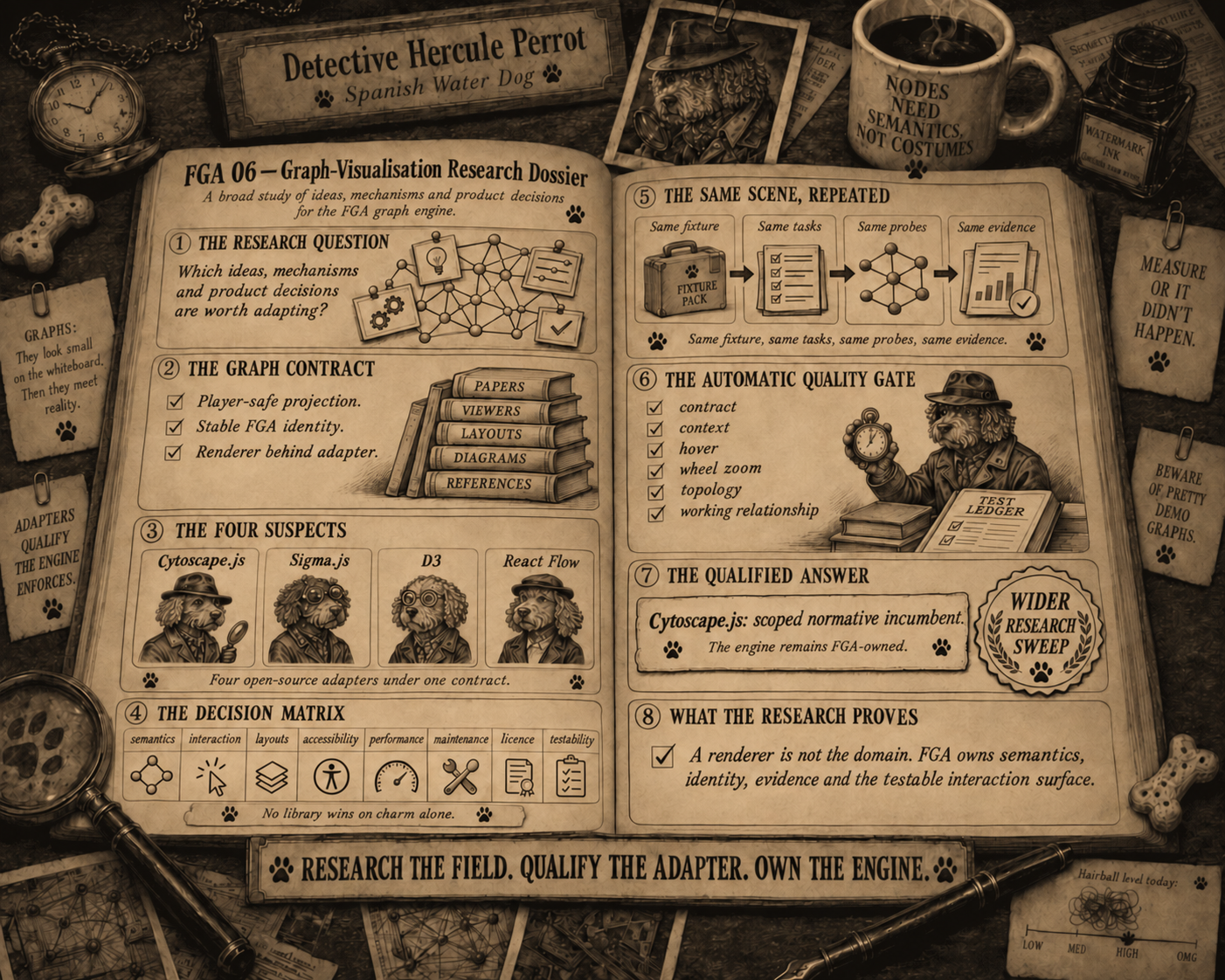
The research field is wider than the executable exhibit: four adapters were tested under one contract, while the broader dossier supplied ideas, constraints and questions.
INTERACTIVE EXTRA
🎮 Investigate the graph engine
Explore the graph in the same static gallery used by the FGA 06 qualification work: switch scenarios, move nodes, inspect nodes and relationships, add working relationships, mark evidence, centre the camera and run the visible automatic graph checks.
Use the arrow keys or A/D to steer. On mobile, use the touch controls. Press Escape to leave full screen.