
🕵️ FGA 09: Zingg Me a River 🐶
Using entity resolution without turning similarity into guilt
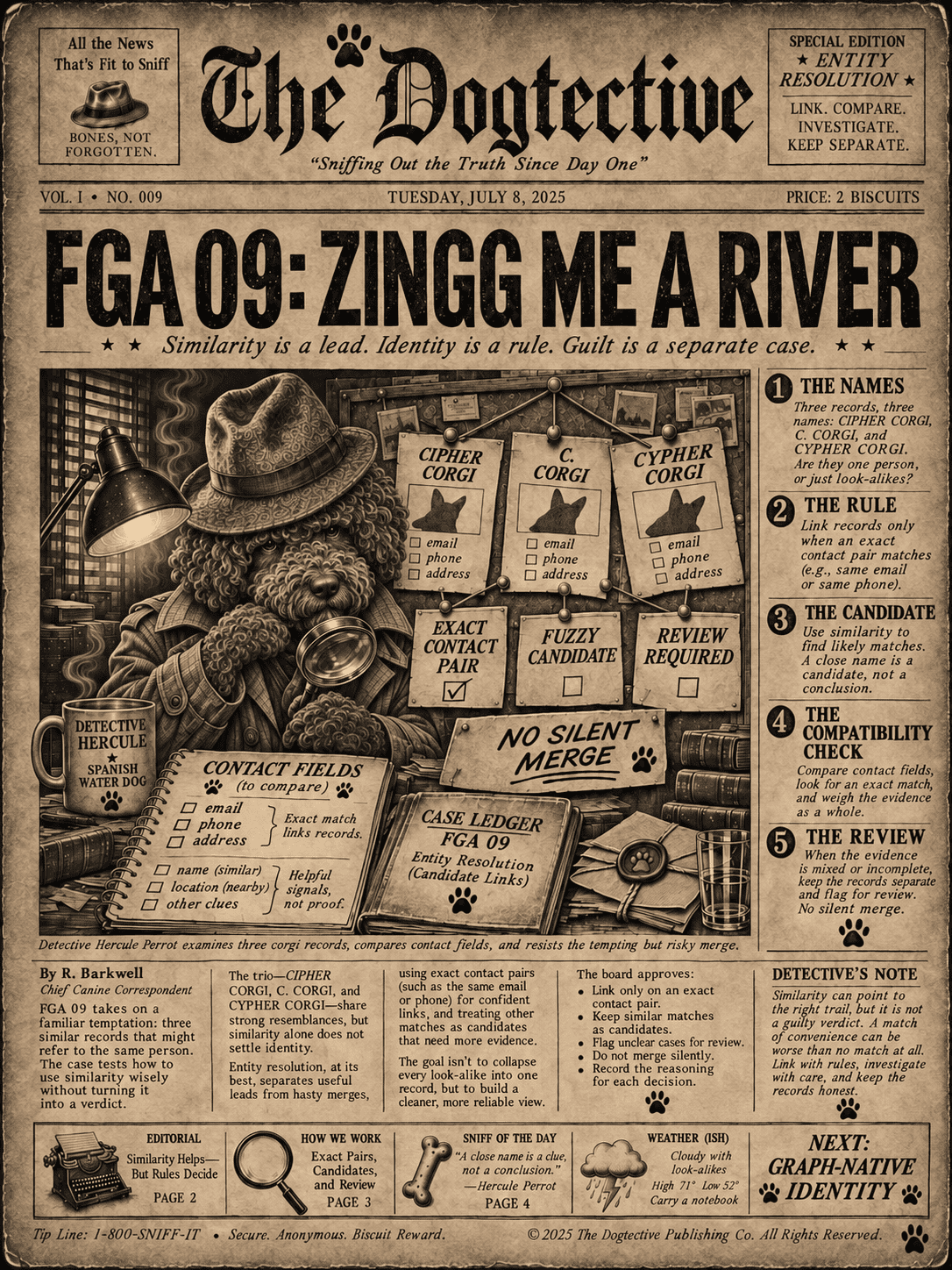
Hercule Perrot found three records beside the keyboard. The first two shared a phone and an email. The third shared only a surname and a resemblance. The trio invited the label “Same person.”
Our dog was about to treat all three records as one identity when he put his wet nose between his paw and the keyboard. A comparison, apparently, had to come first.
FGA 08 taught us to record a suspicion without rewriting the case.
FGA 09 takes that suspicion to the identity desk, where exact rules, fuzzy candidates and player review decide what “same” is allowed to mean.
Our dog raised one ear. The suspect was SAME PERSON.
How can the game compare records without turning a resemblance into an identity?
Part I — The Names in the Fog
The file had three names and one bad idea
The graph had finally learned restraint. A selected record could now become an explicit investigation request instead of another unexplained mark on the board.
Hercule had a useful question to ask the machine: do any two of these records describe the same real-world entity?
The data answered with the usual generosity of a witness who had already deleted half the paperwork.
- One source used a full name.
- Another used an initial.
- A third offered a near-spelling: close enough for a fuzzy matcher, wrong enough to matter.
The case file gives each row a handle. The name on the form is for the reader; the record ID is the file number the game uses to keep one record from being confused with another.
Two of these records were prepared to represent the same real-world person. The third was prepared as the near miss: close enough to raise a question, wrong enough to keep the question open.
| Record | Name | Contact trail | First reading |
|---|---|---|---|
T2-P-CIPHER-A | Cipher Corgi | Same email and phone as B | Known match |
T2-P-CIPHER-B | C. Corgi | Same email and phone as A | Known match |
T2-P-CYPHER | Cypher Corgi | Conflicting email and phone | Deliberate near miss |
The first two rows are the golden pair: the known match used to check that normalization and identity rules can recognise the same real-world person through different presentations.
The third is the hard negative: a look-alike that should attract comparison but must not become an exact identity match.
Neither result is a production verdict, an automatic merge or proof of fraud.
- An exact match would ask whether a declared set of normalized fields agrees under a strict rule.
- A fuzzy match would ask whether two records are close enough to deserve attention.
- Entity resolution is the larger workflow that preserves the originals, normalizes the fields, generates candidates, evaluates the result and lets a reviewer understand what happened.
The identity workflow asks two narrower questions: do these records describe the same entity, and what evidence supports that comparison? It is not asking “who committed the fraud?”
The practical reason to care is that a database stores observations, while the game needs to reason about possible real-world entities without erasing uncertainty. Two rows can be linked for analysis and still remain separate published records. A candidate is therefore a prompt for review, not a new identity silently written back into the case.
Identity is not control. Control is not culpability.
A shared address can connect two organisations without making them the same entity; a similar name can open a file without earning a conviction.
The dog had seen databases confuse those boundaries before. They always looked very confident in the post-mortem.
Similarity had to stay in its lane
The first design decision was therefore a negative one. The identity workflow could produce a candidate, an observation and a reason. It could not silently create a canonical merge, import an evaluator’s answer or promote a similarity score into a fraud verdict.
Hercule wrote the question in the margin:
Can the system explain why two records deserve to be compared without pretending that the comparison has already decided the case?
Part II — The Normalization Desk
The first suspect was punctuation
The first temptation was to look for a model. The first real problem was a policy.
If one source writes cipher@houndmail.example, another adds a stray space and a third changes the case, the engine needs a reproducible comparison. It must compare analytical values without rewriting the published ones.
To compare those three records without rewriting their published values, the game needs a deterministic path it can run and explain. The FGA 09 fallback is that bounded, FGA-owned path, used when a qualified matching runtime is not available.
It applies Unicode NFKC through unicodedata.normalize("NFKC", ...), then case folding, whitespace handling and field-specific rules. Those rules are implemented and versioned as fga09-norm-v1; the same policy version is persisted in the analysis result, so a replay remains reproducible and later changes remain auditable.
NFKC means Unicode Normalization Form KC: compatibility decomposition followed by canonical composition. In plain English, it turns certain different representations of the same text—such as full-width letters or typographic ligatures—into one comparable representation. It does not decide that two similar-looking names belong to the same entity, and it does not catch every visual trick. It only removes one class of encoding noise before the real comparison begins.
The important distinction is ownership. The game does not assume that a matcher supplies this exact NFKC policy by default. FGA keeps the published value untouched and sends only the derived value into comparison. That makes preprocessing visible, testable and versioned instead of quietly assuming that a dependency made the choice for us.
The field rules stay deliberately narrow:
- Emails get a strict shape check.
- Phones keep digits and need a minimum valid length.
- Names and identifiers are normalized for identity comparison.
- Device, address and network fields may remain in the analytical record, but sit outside the engine’s identity feature allowlist.
Hercule ran the normalizer twice. The second run produced the same analytical value. He ran it a third time to be sure.
The normalizer did not become more confident. It merely remained itself, which is what idempotency is supposed to look like when nobody is trying to sell it a hat.
published value
      │
      ▼
NFKC → case folding → field rule
      │
      ├── original stays available for display and provenance
      └── derived value enters identity comparison
Unknown checked in under six aliases
The next witness was a placeholder. unknown, N/A, none, not provided, a zero-filled identifier and a test email may arrive dressed differently, but they carry the same investigative content: no identity evidence. A versioned placeholder registry gives them a shared classification instead of allowing punctuation to turn six absences into one suspiciously popular customer.
| State | What it means | What the identity engine may do |
|---|---|---|
| Missing | The field was not supplied | Keep it out of the comparison |
| Empty | The field was supplied without a value | Record the state, not an agreement |
| Invalid | A value fails its field contract | Keep the failure explicit |
| Placeholder | The value means “unknown” or “test” | Contribute neither exact identity nor fuzzy confidence |
| Valid | The field can participate under its policy | Compare it with the appropriate rule |
Missing is not disagreement. An absent phone cannot contradict another phone; it simply cannot decide. An invalid email is not the same thing as an empty email. Those distinctions matter to the player, to precision and recall, and to the engineer who has to explain why a candidate appeared.
Locale is another boundary, not a decorative setting. This synthetic Academy case uses English data, so its deterministic policy is intentionally narrow. It does not pretend that removing accents, rearranging name tokens or transliterating every script is a universal solution. A policy that admits its jurisdiction is safer than one that claims to understand the whole world because it can remove spaces.
Part III — The Exact Rule
The golden pair took the stand
The golden pair—the two test records prepared to represent the same real-world person—was T2-P-CIPHER-A and T2-P-CIPHER-B. Their names were presented differently, but their normalized email and phone agreed. The surname agreed too. That combination gave the case’s strict rule something stronger than a hunch: the normalized contact pair satisfied STRICT_CONTACT_PAIR_MATCH under fga09-norm-v1.
The player-facing observation does not copy the contact values into the response. It reports the field families, the rule, the source references and the versions that produced the observation. The system can say “strict contact-field policy satisfied”. It cannot say “this person is guilty”, because the identity rule never ran a guilt test.
The rule also has a carefully fenced exception for identifiers. A single-field exact match is allowed only when the source contract marks the identifier as identity-bearing and both records carry validated metadata. A value appearing twice in a snapshot is not magically unique because the column has an impressive name. The identifier needs a contract, not a motivational poster.
The hard negative wore the same surname
T2-P-CIPHER-A and T2-P-CYPHER were designed to make the shortcut uncomfortable. The names were similar enough to generate a candidate. The contact fields disagreed. The engine kept the pair in view as a MEDIUM, review-required candidate and refused to make it an exact identity edge.
| Pair | What agrees | What conflicts | Result |
|---|---|---|---|
| Golden pair | Contact pair and surname | Presentation of given name | HIGH strict identity observation |
| Hard negative | Surname and similar name shape | Email and phone | MEDIUM candidate; review required |
That second row is the point of the test. A system that only returns comfortable matches teaches the player that ambiguity is a failure to be hidden. A system that keeps the hard negative visible can teach the opposite: resemblance is a lead, disagreement is information and review is a real outcome.
strict contact pair agrees
          │
          └── exact identity observation

similar signal, conflicting contact
          │
          └── candidate → player review
The address declined to be a person
The published case also contains exact shared-field relationships for devices, a login IP and a registered address. Those rows are useful graph evidence. They are not identity matches. The address belongs to Gamma Bone Ltd and Blue Bowl Bakery; neither organisation consented to becoming a person because they rented the same building.
Every stored pair is canonicalized: the smaller record ID comes first, the larger second. That makes reruns comparable and prevents A → B and B → A from becoming two theories with different hats. No self-edges, duplicate pairs or mystery ordering are allowed into the case file.
Part IV — Zingg Me a River
Zingg was invited, not present
At this point the famous name entered the room. Zingg is an open-source entity-resolution tool: it helps find records that may describe the same real-world entity by narrowing the comparisons, measuring field similarities and learning from labelled examples.
Zingg provides field-level matching types and supports standardisation or custom preprocessing, but this exact NFKC policy is not documented as a default for every field. Its output is a matching or clustering signal—not a fraud verdict. In FGA, that signal would still need an explanation, a player-safe boundary and a review workflow.
Before the name could become a dependency, Hercule checked whether the available Databricks environment could actually run and qualify it. The environment could answer read-only questions about the published data, but it did not provide a qualified runtime for Zingg. That decision matters: no package was installed, no job was submitted and no table was mutated just to make the article sound more decisive.
The compatibility check told the truth
The game therefore uses RUNTIME_DETERMINISTIC_FALLBACK for this case. The analysis record names the fallback, preserves the model and threshold versions and carries actual_engine_run=false. Its framework semantics are Zingg-like candidate semantics; they are not a claim that Zingg executed.
That distinction matters because a fallback can be useful and still be a fallback. Calling it a Zingg run would turn a compatibility gap into marketing copy. Hercule had no objection to a small engine doing honest work. He objected to putting a famous engine’s name on the small engine’s collar and hoping nobody checked the teeth.
Feature selection is the next trust boundary. The case’s identity configuration allows given name, surname, email, phone and identifier signals. A source contract is still required before one identifier alone can produce an exact identity observation.
It excludes fraud role, culpability, evaluator answer, hidden network membership, player score and ending rule. Including those fields would not make the model clever. It would give the model the answer and then applaud it for reading.
The answer key stayed offline
The matching fixture contains one golden match and two intentionally difficult negatives. The training manifest—the list of labelled examples used by the offline evaluator—is separate, balanced and disjoint from the matching pairs and record IDs.
Its labels never cross into the web application. The evaluator checks whether known matches are found and difficult non-matches stay separate; the player receives none of the hidden labels or the hard-negative annotations.
On this small synthetic fixture, the regression confirms that the golden pair survives normalization and that the hard negative stays out of the exact identity result. That is useful evidence that the counterexample survives the rule. It is not a production-quality claim, a universal threshold or a passport for another locale. A small fixture can protect a lesson. It cannot certify the world.
Part V — The Action at the Typewriter
The button did not arrest anyone
The new action appears only for the active Academy round. Hercule can run the bounded analysis globally, or select a published PERSON record to focus it. An organisation, login event or document can still be clicked in the graph; it cannot borrow a person’s identity desk because it happens to be blue on the screen.
Hercule selects a record, opens Compare identities and sends an explicit request. The server validates the round, the case, the subject type and the published-record boundary. It normalizes the records, generates the bounded analysis and stores the run. The browser can explain the action. It cannot authorise itself.
Three credits and two doors
The round starts with nine credits. A new identity analysis costs three. The charge is settled on the server, alongside the analysis identity, request hash, source snapshot and the versions of the policies that produced the result. The answer is not optimistic until that transaction has survived the desk.
The first door is the analysis. An exact retry with the same idempotency key and the same request returns the same analysis without another charge. Reusing that key for a different focus record is a conflict, not a creative shortcut. Concurrent identical requests settle on one analysis and one debit.
The second door is the review. ACCEPTED, REJECTED and UNRESOLVED are player decisions about a candidate, not changes to the source publication. The review has its own idempotency identity because “I ran the analysis” and “I rejected the candidate” are different state transitions.
The browser keeps an unchanged pending key in round-scoped session storage until success, so a remount cannot quietly charge again. A lost response can be retried; a changed request needs a new key.
Review is not merge
An accepted review may produce a player-owned PLAYER_REVIEWED_IDENTITY edge in the IDENTITY_REVIEW family. Its meaning is narrow: Hercule reviewed this candidate in this round. It does not create a canonical ID, rewrite the published records or tell the evaluator that the player found the mastermind.
The graph projection also resolves the latest review before drawing the player mark. If Hercule accepts a candidate and later rejects it, the old accepted edge leaves the visible workspace even though the append-only history keeps both decisions.
A history tells us what happened. A projection tells us what is current. The graph can show that decision as player-owned. The dog dislikes both kinds of confusion, but only one of them can make the graph lie in real time.
Part VI — The Evidence Bag
A score needed a reason
A bare score is a rumour wearing a lab coat. The response therefore returns a candidate ID, the two records, the entity type, a HIGH, MEDIUM or LOW band, the configured score, agreement fields, disagreement fields, missing fields, evidence reasons and the policy information needed to explain and replay the result.
observe → compare → explain → review
    │         │          │        │
    │         │          │        └── ACCEPTED / REJECTED / UNRESOLVED
    │         │          └── reasons, fields and policy versions
    │         └── exact rule or candidate signal
    └── published records remain unchanged
The golden pair can explain itself in field families: surname, email and phone agree; the given-name presentation differs; the strict contact rule supports an identity observation. The hard negative can explain itself too: the surname and name shape invite a review, while email and phone disagree. Neither explanation exposes the raw contact values, the hidden label or a fraud answer.
Confidence here describes the configured resolution signal. It is not fraud probability, criminal intent or the correct ending. A HIGH resolution signal can still be innocent, misconfigured or outside the next case’s field policy. A MEDIUM candidate is not a confession with a lower font size.
Missing sat apart from disagreement
This distinction became especially important in the player panel. If one record has no phone, the explanation says that the phone is missing. It does not say the phones disagree. Missing means the field cannot decide; disagreement means both records supplied conflicting values. Collapsing them into one red warning would make the interface dramatic and the evaluation wrong.
The same care applies to placeholders, invalid values and source provenance. The player sees enough to understand the reason and the scope, but not enough to reconstruct hidden truth from a response that was supposed to be safe.
Pairs do not make a cluster
Two accepted pairs can form a tempting chain: A resembles B, B resembles C, therefore A, B and C must be one tidy entity. That is how a graph becomes a courtroom with the verdict preprinted.
FGA 09 stays at pair-review level. A future component policy will need conflict detection, stable component IDs, giant-component protection and explicit publication rules before transitive identity reasoning can enter the player-safe graph. The next article is allowed to open that door. This one leaves it locked and labels the key.
Part VII — The Bodies We Found Later
The blocking bug ate every neighbour
The first focused engine probe returned no candidates. No error. No warning. Just the clean, empty answer produced by a filter that had politely removed every possible neighbour.
Blocking is the cheap first cut: it decides which records are plausible neighbours before the engine spends attention comparing every possible pair. The focused path had asked each record for its own blocking set and then discarded the record itself.
The correction computes the selected record’s block once, keeps the selected record and its neighbours, and compares pairs from that bounded set. The golden match and the hard negative returned together. The lesson was unfashionable but useful: a blocking optimization is part of correctness, not merely a performance detail.
SQLite forgot the witness
The first persistence test passed while the application was still awake. It failed after restart. The repository had returned a successful object, but the new SQLite context closed without committing the write. The process remembered; the file did not. A successful response had been mistaken for a durable case file.
The repository now commits on success, rolls back on error and closes the connection. The restart test creates the analysis, closes the first context, reopens the database, replays the same request and checks the review history and single charge. A successful response is not enough to call a case file durable. It is durable because the next process can find it.
The review wore yesterday’s face
The API history was append-only, but the first graph projection collected every accepted review. A later rejection could therefore leave an accepted edge standing in the workspace. The fix resolves the latest decision per candidate before projecting the visible player mark. The regression accepts a candidate, rejects it under a new key and confirms that the old edge is gone while the history remains.
That distinction is small enough to miss in a happy-path demo and large enough to undermine the player’s trust. FGA’s checks had to test both the diary and the current photograph.
The labels tried to sit the exam
The evaluator originally had labels and metrics, but its leakage boundary was an intention rather than an executable gate. The repaired evaluator keeps training labels out of the web application, checks that the manifest is balanced, checks pair disjointness and checks record-ID disjointness independently. An unbalanced manifest, a reused pair and a reused record now each fail their own test instead of hiding behind one combined boolean.
This is why the hard negative matters more than the perfect fixture score. The regression is not there to announce that the model is brilliant. It is there to stop a future shortcut from deleting the difficult example, importing the answer key or calling a leaked lookup “learning”.
The qualification needed a chain of custody
The qualification path first worked only when a test runner arranged the environment for it. That was not good enough for an operator. The game now checks the same path the operator is expected to use, because a procedure that works only inside a test harness is a prop, not a tool.
The first Databricks check counted rows without proving that they belonged to the active player publication. The stronger check ties the candidate and association evidence to that publication, accepts only the expected person candidates, rejects relationships that masquerade as identity and checks that every result carries an explainable status. The lesson is simple: a qualification result must prove provenance and semantics, not merely contain plausible numbers.
The smaller bodies in the margin
There were other lessons, less theatrical but no less useful. The focused path learned to use the same name, contact and identifier signals as the global path; otherwise a shortcut changed the product’s meaning. An organisation focus is rejected instead of receiving a person analysis. A shared email can remain a review candidate without becoming an exact identity match.
The local fallback calls its SequenceMatcher field similar_given_name, not “phonetic”, because a ratio is not phonetics just because the label has a nice suit.
The Databricks qualification may use a different explanatory label; that is publication evidence, not proof that the fallback or Zingg computed phonetics.
The checks covered the parts that could quietly make the game lie: normalization had to be deterministic, the golden pair had to resolve, the hard negative had to remain review-only and labels had to stay outside the player response.
Charges and reviews had to survive retries and restart, and the visible graph mark had to follow the latest player decision. The browser contract and build were checked from the frontend itself, and the qualification path was run in the same shape an operator would use. A green check is useful only when it protects a boundary the player can feel.
Part VIII — The Read-Only Room at Databricks
The warehouse was a witness, not a workshop
The boundary check used Databricks in read-only mode. Its job was narrow: qualify the active player-safe publication without writing to it. This is the useful practice when an external engine is not yet available: verify the data boundary, the shape of the evidence and the absence of mutation, then label the engine result honestly.
The qualification found the golden pair as a strong identity observation and the hard negative as a review candidate. It kept shared devices, network details and addresses in their proper lane: useful relationships, not identity matches. Nothing in the graph was promoted merely because two records shared infrastructure.
No mutation was allowed. The warehouse supplied a witness statement; it was not allowed to rearrange the furniture. And because no qualified runtime executed Zingg, the game labels the result as a deterministic fallback rather than borrowing the famous engine’s name.
Part IX — Playable Evidence
Hercule runs the identity desk
In the active Academy board, Hercule selects a PERSON record and opens Compare identities. The server charges three credits once, normalizes the published records, returns the golden candidate and the hard counterexample with their reasons, and leaves the source publication alone.
Hercule can accept, reject or leave a candidate unresolved. The graph can show that choice as a player-owned review. It does not have to pretend that his paw has become a database administrator.
The useful moment is the pair on the screen: the golden pair arrives with the strict contact observation; the hard negative arrives with a similar name and conflicting contact fields. The panel makes the difference legible without handing the player the hidden solution. That is playable evidence: enough structure to investigate, enough uncertainty to make the decision matter.
What the game now supports
FGA 09 supports a bounded identity-resolution action with deterministic, versioned normalization; explicit placeholder handling; strict contact-pair identity evidence; explainable candidates; offline golden and hard-negative evaluation; idempotent analysis charges; durable review history; and a player-owned review mark that remains separate from canonical publication truth.
The evidence is deliberately scoped to this synthetic workload and to the deterministic fallback. The checks form one chain: the player action has a contract, the engine has counterexamples, the persistence remembers what happened and the publication boundary refuses to be rewritten by an experiment.
What FGA 09 does not prove
It does not prove that Zingg executed in Databricks. It does not prove production model quality, a universal threshold, a locale-independent name policy or that HIGH means fraud.
It does not prove that shared infrastructure means shared identity, that an accepted player review is a canonical merge or that A–B and B–C should become one transitive person. It does not qualify GraphFrames, Genie retrieval, cross-player authorization or the next case’s field policy.
It proves something smaller and more useful: the game can ask whether records resemble one entity, show why the question was raised, remember the player’s decision and keep that decision from impersonating evidence.
The Arrest
The suspect was not the hard negative. It was the shortcut that wanted a surname to do the work of a proof.
The engine let the hard negative into the room, showed the conflicting contact fields and stopped at review. The server charged once, replayed safely and preserved the review without rewriting the publication. Zingg’s name stayed on the compatibility board until a qualified runtime can earn it.
The dog filed the final report:
Similarity is a lead. Identity is a rule. Guilt is a separate case.
Hercule put down the pencil. For once, it had not made an arrest.
Case Closed?
Not closed. The next case moves from pairs to graph-native identity reasoning: connected components, GraphFrames-style relationships, component stability, giant-component detection and publication rules that refuse to turn a convenient cluster into a convenient verdict.
Next in the Series
🕵️ FGA 10: GraphFrames of Mind 🐶
FGA 10 will take the next suspect into the graph: connected components, graph-native identity reasoning, component stability and publication rules that keep a convenient cluster from becoming a convenient verdict. The graph may connect the dots; it will still need to explain who drew them.
Source Code
Browse the source code for FGA 09 on GitHub ↗
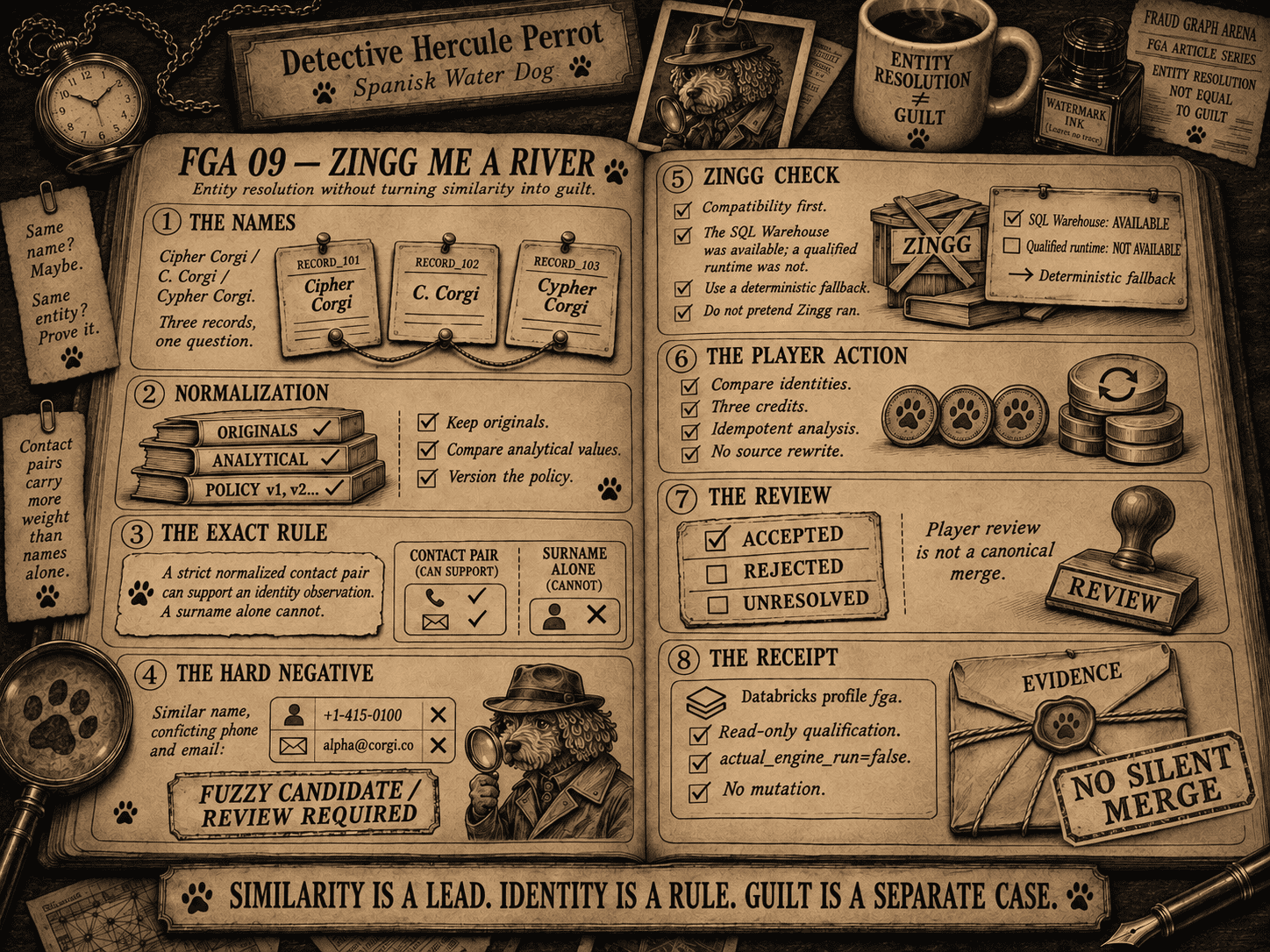
Similarity is a lead. Identity is a rule. Guilt is a separate case.